
Newz: Scatter Charts, Do Not Use List, UAD 3.6 Key Changes and Resources
March 30, 2026
What’s in This Newsletter (In Order, Scroll Down)
- LIA AD: Am I Still on the ‘Do Not Use’ List
- The Power of Scatter Charts: Bringing Objectivity to Appraisals
- by Scott Cullen
- 1780 Tiny Home That Was Built by a British Sea Captain Hits the Market in Georgetown for $1,198,000
- MY AD: Highest and Best Use of the Cost Approach
- The housing market so far in 2026 By Ryan Lundquist, March 11, 2026
- Trump’s Executive Order on Access to Home (including appraisers)
- MBA Origination Stats: Mortgage applications decreased 10.9 percent from one week earlier

Click here to subscribe to our FREE weekly appraiser email newsletter and get the latest appraisal news
————————————————
The Power of Scatter Charts: Bringing Objectivity to Appraisals
by Scott Cullen
Excerpts:
“Objectivity is isolating the effect of individual variables on value.”
Once upon a time, in a suburban neighborhood not so far away, an appraiser came across a pure pair, two homes that seemed almost identical. They shared the same neighborhood, lot size and condition. The only difference was size. One house had 2,500 square feet of above grade finished area and the other had 2,300. The first sold for $460,000, the second for $446,000. The difference in price was $14,000. The difference in area was 200 square feet—producing an adjustment of $70 per square foot.
Traditionally, an appraiser might document this relationship as a simple table, noting the difference in sale price and living area. Unfortunately, pure pairs are so rare that they often seem like a fairytale—something every appraiser dreams of finding but seldom does. In the real world, properties rarely align so neatly. Markets shift, concessions appear, and location nuances creep in. Yet there is hope. By learning to use scatter charts, embracing adjusted pairs, and understanding sensitivity analysis, appraisers can move closer to true objectivity in their valuation work.
From Paired Sales to Sensitivity Analysis
The Appraisal of Real Estate, 15th Edition defines paired data and grouped data as forms of sensitivity analysis—a method used to isolate the effect of individual variables on value. Sensitivity analysis is the overarching principle that allows us to quantify how much one variable contributes to price, while holding others constant (Appraisal Institute, 2020, p.371). Scatter charts are among the most powerful tools available to visualize and calculate these relationships.
Why Visualization Matters
Scatter charts do more than calculate—they communicate. They combine mathematical precision with the clarity of visualization. For appraisers, this means turning abstract numbers into evidence that both clients and reviewers can see.
A well-constructed scatter chart illustrates the logic behind the adjustment and lends weight to the appraiser’s conclusions. It reinforces transparency: others can replicate the math, verify the trendline, and confirm that the adjustments are derived from observable market behavior.
As the saying goes, “A picture is worth a thousand words.” In appraisal, it’s also worth credibility. Scatter charts bring statistical discipline to the craft of valuation, grounding professional judgement in data.
To read more, Click Here
My comments: Read more to see scatter chart samples and how they are used.
—————————————————-
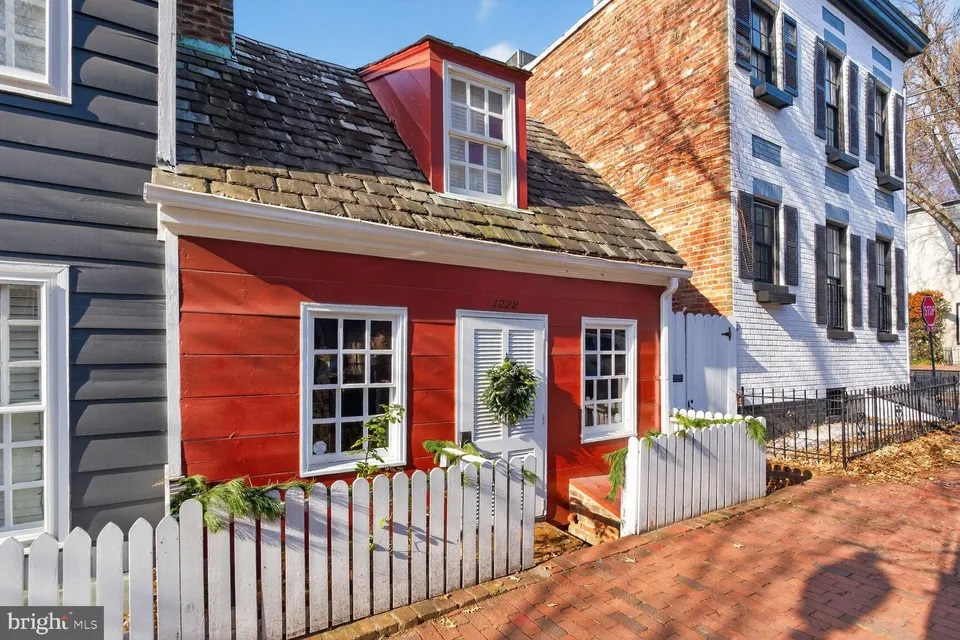
1780 Tiny Home That Was Built by a British Sea Captain Hits the Market in Georgetown for $1,198,000
Excerpts: 1 bedroom, 1.5 baths, 1,015 sq.ft., 1,307 sq.ft.lot built in 1780
An adorable red tiny home that is said to have been built by a British sea captain nearly 250 years ago has hit the market in Washington, DC, for just a touch under $2 million.
Described in its listing as a “treasure,” the home, which is “believed to be one of the oldest homes in Georgetown,” comes complete with just one bedroom and 1.5 bathrooms, and spreads across a pint-sized 1,015 square feet of living space.
But what the dwelling lacks in stature, it more than makes up for in rich history, which dates back to 1780, when it is understood to have been constructed by the European sailor, with some reports suggesting that the hand-hewn beams inside the home were made with wood from a ship that had come aground in the area.
More recently, the adorable abode was home to Ann Caracristi, a cryptologist, World War II veteran, and the first woman to serve as deputy director of the NSA. Caracristi purchased the dwelling in the mid-1900s and lived there for more than six decades until her death in 2016.
According to the listing, the home is being made available with many of the traditional decor elements seen in the listing photos, including a personal library of books that belonged to Caracristi.
Soon after her death, the dwelling was purchased for $825,000—before later trading hands again in 2023, this time for $1.1 million.
The home is being offered partially furnished, allowing buyers to get their hands on wooden desks, rustic decor, pewter pieces—and Caracristi’s personal library.
To see the listing with many photos, Click Here
My comments Fascinating to see a home this old with a known history.
————————————————————–
UAD 3.6 Key Changes (And Resources You Need to Know)
Excerpts: Key Changes to Note:
Material Difference
One of the first things appraisers notice about the new UAD is the way property characteristics are captured. Gone are the days of squeezing every nuance into a comment box the size of a Post-it note. Instead, the new system requires us to think more like data scientists — a structured, repeatable process that logically organizes the characteristics of each property.
That includes thinking differently about what counts as a “material difference.” Appraisers have always had to consider market-relevant features, but now those distinctions need to be expressed in a standardized way.
Ceiling Height
If you were to search for “ceiling height” within the F1 reference guide, you’ll find that one of the references (report field ID: 10.045) details when to include it, and the answer is always. But I’m going to back up real quick and read what it says about starting under walls and ceiling.
“The appraiser must…” Must is not a suggestion, folks; must means you have to do it — i.e., “provide information about the walls and ceilings in the unit.”
The walls and ceilings row always displays in the interior features table, and you have to choose one or more of the allowable answers. So ceiling height (that is, the approximate ceiling height in the unit, rounded to the nearest foot) is always required.
Broadband Internet
Let’s talk about one of the more surprising features in the new UAD: broadband availability.
Yes, you read that right. In 2025, internet access joins the ranks of site, view, and utilities. And honestly, it’s about time. If you’ve ever tried to run your business off two bars of rural cellular service, you know that internet speed can be a real market factor.
It’s a simple question – “Is broadband internet available?” — and your answers are yes and no.
If you check “yes,” you’re confirming high-speed internet access is publicly available exclusively through a digital subscriber line, fiber optic, or cable. If you answer “no,” you’re saying public high-speed internet access is unavailable, or it’s only available through a private satellite. If it’s a satellite, it’s a no. You might say, “Well, what if it’s Starlink? Is that a satellite?” Nope, the answer is still no.
But how do you verify it
To read more, Click Here
My comments: Good discussion on how the new URAR reports are dramatically different from the legacy forms. Real estate agents, appraisal reviewers, attorneys, buyers and sellers etc. all prefer the new reports. The days of typed appraisal reports are long over. If I was doing lender appraisals I would do the new URAR reports.
———————————————————–
Are you getting too many ad-only emails?
4 ways to get only the FREE email newsletters and NOT the ad-only emails.
1. Twitter: https://twitter.com/appraisaltoday Posted by noon Friday
2. Read on blog www.appraisaltoday.com/blog Posted by noon Friday. You can subscribe to the blog in the upper right of each blog page. NOTE: the popular ads with liability tips are below the first topic on my blog posts.
3. Email Archives: https://appraisaltoday.com/archives
(posted by noon Friday) The link is above and to the left of the big yellow email signup form. Newsletters start with “Newz.” Contains all recent emails sent.
4. Link to the 10 most recent newsletters (no ads) at www.appraisaltoday.com. Scroll down past the big yellow signup block. The newsletters have abbreviated titles, taken from their blog posts.
To read more about the 4 ways, plus information on why I take ads, etc.
———————————————————–
Highest and Best Use of the Cost Approach
By Scott Cullen
In the April, 2021 issue of Appraisal Today
Excerpts: To most residential appraisers, the Cost Approach is like old school
comedian Rodney Dangerfield. “It don’t get no respect.”
Effective Age
Where do we get effective age? Residential appraisal forms assume the
economic age-life method of depreciation. Effective age includes all forms
of deprecation.
“In applying the concepts of economic life, effective age, and remaining
economic life expectancy, appraisers consider all elements of depreciation
in one calculation. Therefore, the effective age estimate includes not only
physical wear and tear but also any loss in value for functional and external
considerations.” [2] Source: The Appraisal of Real Estate 15th Edition, The
Appraisal Institute, Chicago p562.
Because all forms of depreciation are included in effective age, the
percentage of depreciation applied to economic life is the effective age.
Sixty year economic life x 10% = 6 years effective age.
Calculating GLA Adjustments
Knowing that the house’s market reaction is 90% of value, we can
extract a GLA adjustment from the cost data.
When we compared the pure pair of houses that sold for $310,000 and
$294,800, we divided the price difference by the difference in GLA to get a
GLA adjustment of $76.
We get the same result by applying market derived depreciation to the
difference in GLA cost of those houses. We extracted depreciation from the
market using unbiased, third party cost data. We used the same data to
compare cost. Even if the cost data is not exact (it never is), we get
credible results when we use the same data to calculate depreciation as
we do to calculate the cost difference.
When depreciation is extracted from the market, depreciated cost is a
market based method of developing sales grid adjustments.
The same reasoning can be applied to a bath count adjustment. If the
unbiased third party cost data states that a full bath costs $12,000, and the
market reaction is 90%, a bath count adjustment is $10,800.
To read the full article, plus 3+ years of previous issues, subscribe to the paid Appraisal Today at www.appraisaltoday.com/order .
Not sure if you want to subscribe?
Sign up for monthly auto renewal for $8.25!
Cancel at any time for any reason! You will receive a prorated refund.
$8.25 per month, $24.75 per quarter, and $89 per year (Best Buy)
or $99 per year or $169 for two years
Subscribers get FREE: past 18+ months of past newsletters
——————————————
What’s the difference between the Appraisal Today free Weekly email newsletter and the paid Monthly newsletter? Click here for more info.
——————————————————————–
If you are a paid subscriber and did not receive the
March, 2026 issue emailed on
Monday March 2, 2026 please email info@appraisaltoday.com, and we will send it to you. You can also hit the reply button. Be sure to include a comment requesting it. Or, call 510-865-8041
————————————————————

The housing market so far in 2026
By Ryan Lundquist, March 11, 2026
Excerpts: All ships rise and fall with the tide. That’s one of my favorite things to say in real estate because the trends we see in one local county are often seen in other counties.
SPRING VIBES IN THE STATS
We’re starting to see spring show up in the stats. Here are two examples. Do you see days on market starting to tick down for the season? And check out the median sales price rising in February. These were both expected. Price change ahead is still to be determined, but a February uptick was a safe bet.
“MY AREA DIDN’T DECLINE LAST TIME”
Sometimes people say things like, “My neighborhood didn’t decline during the Great Financial Crisis.” I get the sentiment, but every local neighborhood saw price declines back then. It’s just some higher price points were able to weather the storm a bit better as there wasn’t extreme carnage like entry-level price points had. In short, no neighborhood escaped the trend back then, and the same is true today with every area feeling more softness over the past year (and now heating up for the spring). Know what I’m saying?
To read more, Click Here
My comments: Ryan writes for his local market. He writes this for real estate agents, the best source of referrals for residential appraisers. See how Ryan explains what is happening to apply it to your appraisals when possible. Graphs and tables are very important to let your clients see what is happening.
———————————————————-
Trump’s Executive Order on Access to Home Loans
EXPANDING ACCESS TO HOME LOANS: Today, President Donald J. Trump signed an Executive Order to reduce regulatory burdens that have driven up mortgage costs, limited access for creditworthy borrowers, and weakened community bank participation in lending. March 13, 2026
How it affects appraisals
Sec. 6. Appraisal Modernization.
(a) The Vice Chairman for Supervision of the Federal Reserve, the Director of the CFPB, the Chairman of the NCUA Board, the Chairperson of Board of Directors of the FDIC, the Comptroller of the Currency, and the Director of the FHFA shall consider, as appropriate and consistent with applicable law and their statutory authorities:
(i) modernizing appraisal regulations and guidance to expand the use of alternative valuation models, desktop and hybrid appraisals, and artificial intelligence valuation tools;
(ii) simplifying appraiser qualification requirements; and
(iii) reducing appraisal requirements for low-risk transactions, including low loan-to-value refinancing and small‑balance loans; and setting clear appraisal timelines.
(b) The Secretary of Housing and Urban Development (HUD) and the Secretary of Veterans Affairs (VA) shall consider, as appropriate and consistent with applicable law:
(i) aligning appraisal standards between the Federal Housing Administration and VA Home Loan Program where risk is comparable;
(ii) clarifying the distinction in an appraisal inspection between safety and habitability concerns that necessitate pre-closing repairs versus cosmetic concerns; and
(iii) expanding post-closing repair flexibility.
To read the Fact Sheet for the Executive Order, Click Here
My comments: Interesting suggestions. Who knows what will be implemented.
————————————————————–
Note: I publish a graph of this data every month in my paid monthly newsletter, Appraisal Today. For more information or get a FREE sample go to www.appraisaltoday.com/order Or call 510-865-8041, MTW, 7 AM to noon, Pacific time.
My comments: Rates are going up and down. We are all waiting for rates to drop lower in 2026.
Mortgage applications decreased 10.9 percent from one week earlier
WASHINGTON, D.C. (March 18, 2026) — Mortgage applications decreased 10.9 percent from one week earlier, according to data from the Mortgage Bankers Association’s (MBA) Weekly Mortgage Applications Survey for the week ending March 13, 2026.
The Market Composite Index, a measure of mortgage loan application volume, decreased 10.9 percent on a seasonally adjusted basis from one week earlier. On an unadjusted basis, the Index decreased 10 percent compared with the previous week. The Refinance Index decreased 19 percent from the previous week and was 69 percent higher than the same week one year ago. The seasonally adjusted Purchase Index increased 1 percent from one week earlier. The unadjusted Purchase Index increased 2 percent compared with the previous week and was 12 percent higher than the same week one year ago.
“Mortgage rates continued to move higher, driven by increasing Treasury yields as the conflict in the Middle East kept oil prices elevated, along with the risk of a broader inflationary shock. Mortgage rates increased across the board, with the 30-year fixed rate rising to 6.30 percent, the highest rate since December 2025,” said Joel Kan, MBA’s Vice President and Deputy Chief Economist. “Rates were around 20 basis points higher than they were two weeks ago and this caused a reversal in refinance activity, particularly for conventional refinance applications, which decreased 27 percent over the week. Government refinances also declined but by 5 percent, as FHA rates have not increased quite as rapidly. Purchase applications remained steady despite the higher rates, with conventional purchase applications unchanged and growth in both FHA and VA segments. Overall purchase applications remained ahead of last year’s pace, supported by higher inventory and slowing home-price growth in many markets.”
The refinance share of mortgage activity decreased to 52.3 percent of total applications from 57.8 percent the previous week. The adjustable-rate mortgage (ARM) share of activity decreased to 8.0 percent of total applications.
The FHA share of total applications increased to 19.4 percent from 17.1 percent the week prior. The VA share of total applications increased to 16.7 percent from 16.1 percent the week prior. The USDA share of total applications remained unchanged at 0.4 percent from the week prior.
The average contract interest rate for 30-year fixed-rate mortgages with conforming loan balances ($832,750 or less) increased to 6.30 percent from 6.19 percent, with points increasing to 0.63 from 0.58 (including the origination fee) for 80 percent loan-to-value ratio (LTV) loans. The effective rate increased from last week.
The average contract interest rate for 30-year fixed-rate mortgages with jumbo loan balances (greater than $832,750) increased to 6.39 percent from 6.26 percent, with points increasing to 0.34 from 0.30 (including the origination fee) for 80 percent LTV loans. The effective rate increased from last week.
The average contract interest rate for 30-year fixed-rate mortgages backed by the FHA increased to 6.08 percent from 6.02 percent, with points remaining unchanged at 0.70 (including the origination fee) for 80 percent LTV loans. The effective rate increased from last week.
The average contract interest rate for 15-year fixed-rate mortgages increased to 5.66 percent from 5.54 percent, with points increasing to 0.73 from 0.68 (including the origination fee) for 80 percent LTV loans. The effective rate increased from last week.
The average contract interest rate for 5/1 ARMs increased to 5.65 percent from 5.26 percent, with points increasing to 0.67 from 0.64 (including the origination fee) for 80 percent LTV loans. The effective rate increased from last week.
The survey covers U.S. closed-end residential mortgage applications originated through retail and consumer direct channels. The survey has been conducted weekly since 1990. Respondents include mortgage bankers, commercial banks, thrifts, and credit unions. Base period and value for all indexes is March 16, 1990=100.
——————————————————-
 Ann O’Rourke, MAI, SRA, MBA
Appraiser and Publisher Appraisal Today
1826 Clement Ave. Suite 203 Alameda, CA 94501
Phone: 510-865-8041
Email: ann@appraisaltoday.com
Online: www.appraisaltoday.com
We want to know what you think!! Please leave a comment.