How many appraisals per week and how much time to complete an appraisal report?

To keep up on what is happening in appraisal businesses, mortgage lending, USPAP, etc. , Plus humor and strange homes, sign up for my FREE weekly appraisal email newsletter, sent since June 1994. Go to Home on the left side of the menu at the top of this page or go to www.appraisaltoday.com
Sign up in the Big Yellow Boxes

I regularly write about hot topics in appraising and appraisal business management issues
in my paid Appraisal Today monthly newsletter.
$99 per year or (credit card only) $8.25 per month, $24.75 per quarter, or $89 per year.
For more info, go to https://www.appraisaltoday.com/products

How many appraisals per week and how much time to complete an appraisal report?
Source: Steve Costello at www.fncinc.com. Published 8-4-15
This month I want to discuss three recent polls dealing with how much time it takes to complete appraisal reports and how many hours you end up working to get them all done. In the first poll, we asked “On average, how many “interior inspection” appraisals reported on a 1004 do you normally produce in a week?” This poll was very popular with 4945 responses. There was a clear winner with the response of “4-6 appraisals per week” pulling in 44 percent of the vote. The next most popular answer of “7-9 appraisals per week” took quite a drop and only pulled in 20 percent vote. The last two available answers were those at either end of the scale and they were almost tied. A few appraisers really crank out the orders because 16 percent responded that they do “10 or more” appraisals per week. On the opposite end were those representing 17 percent of the vote who only complete “1-3” appraisals per week. My guess is that many of the people in this group may be semi-retired but like to keep active in the profession while making some extra money. Of course, any individual’s volume is going to depend a great deal on their specific geographic area and general complexity of their assignments.
In the next poll we asked: “On average, how long does it take you to complete a 1004 interior inspection appraisal report including inspection time (excluding driving time)?”
This was another popular poll with 4836 responses. The winner here was “4-5 hours” with 39 percent of the vote. Not far behind was “6-7 hours” with a 29 percent share of the vote. From here the numbers dropped substantially with 13 percent of appraisers going with the response of “8-9 hours”. That is really getting to be painful when it’s taking that long to finish each assignment. The most extreme answers both received the lowest number of votes. “More than 9 hours” was the choice of 8 percent of the appraisers with the final 10 percent going for the answer of “2-3 hours”. My guess is that the appraisers in that final group really have their system down to a science and fully utilize all the available technology.
Finally, we asked, “On average, how many hours per day do you spend working on appraisals and appraisal-related business?” This poll was the most popular of the three with a total of 5451 responses. The winner was “9-10 hours” with 37 percent of the vote. The second most popular answer with 23 percent pushed the level up to “11-12 hours”. The old standard workday of “7-8 hours” came in a distant third gathering only 17 percent of the vote. Not far behind were the 15 percent who really “burn the midnight oil” working “13 or more hours” per day. Only 9 percent work “6 hours or less” each day with most of these appraisers reporting at least 5-6 hours worked per day. It’s clear, and not at all surprising, that most appraisers are working very long hours there days.
My comment: Appraisers are working long hours now because appraisal volume is way up. If you are willing to work for low AMC fees you can get as much work as you want. I would have liked to see how many hours per week. I suspect many appraisers are working 6-7 days a week. I did, during previous boom times. These polls do not include time spent on revisions. I have some data below on that. Plus, the amount of time returning update requests – answering phone calls and emails.
============================================
How much time is spent on revisions?
 From the November 2014 Appraisalport newsletter
On average, how much time do you spend making and delivering requested revisions on any given appraisal?@ We had a total of 4870 responses to this poll. Nearly half (48%) of those chose the response of A10-30 minutes.@ This would seem about right for most minor to moderate revisions. Many must be making pretty minor revisions because the second most popular response with 24 percent of the vote was under 10 minutes@. Another 18 percent are having to take a bit more time and went with the choice of A31-60 minutes.@ A smaller group of 7 percent is having to invest some real-time to make the revisions and picked the response of over an hour.@ The final 3 percent selected the answer of AI  to make revisions.@ I=m not sure if that means they are doing an amazing job on every report and never get a request or if they just refuse to do any revisions!
My comment: Lots of appraisers complain about excessive revision requests, but this poll indicates that appraisers aren’t spending much time on them. The time may have increased since 11/14.
—————————-
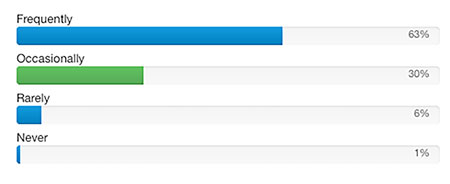
How often have you received revision requests that have no contributory value to the report, or were already addressed in the report commentary?” Sept 7 poll – www.fncinc.com received 3,273 votes


Appraisal Humor

Appraisal business tips

A very, very funny appraiser video!

Appraisal Today newsletter

NOT customary and NOT reasonable fees?//TRID??

NOT customary and NOT reasonable fees?
What is reasonable? Let me see… For example, the amount of work to produce the appraisal plus respond to request for more information, updates, etc. increases the time from 5 hours ($70 per hour) to 8 hours ($47.50 per hour),  a 33% decline. Of course that is gross, not considering your expenses. You are able to get the same fee – $350. But, the fee is not reasonable. Calculate this for your typical appraisal fees.
What is customary? Somehow AMCs seem to think that “one price fits all”. Before AMCs took over, appraiser fees varied widely around the country. The Midwest was typically the lowest, around $250. The West Coast (Washington and Oregon) and some East Coast states were higher, around $450. Alaska and Hawaii were much higher. We accepted “standard” fees from our clients as we took the easy appraisals and the hard appraisals, which balanced out. I didn’t ask for a fee increase when a property took more time. If was a high end home or a rural acreage property, the lenders paid higher fees. Or, we scheduled appraisals to reduce driving time. Clients understood that they could not give us all the hard appraisals and appraisals scattered over a wide geographic area.
Now, AMCs have standard fees, but they don’t consider the factors above. Many appraisers have responded by asking for fee increases or just turning down the assignment.
——————————————–
TRID vs. the current system of AMC ordering appraisals
TRID will make the method above (“one fee for all appraisals”) very difficult for AMCs. Lenders have to provide an appraisal fee within 3 days. AMCs won’t be able to spends days “shopping” for the lowest fee for a tough appraisal. AMCs won’t have time to negotiate with appraisers. Yes, there are options but they delay the loan.
Now, appraisers can quickly accept broadcast orders with the expectation of getting a fee increase. After Oct. 3, that will create problems for lenders and AMCs.
What will happen? How can AMCs tell their lenders what to charge for a specific appraisal (the full cost, including AMC fees) within a few days? Their systems assume all appraisals are the same. I doubt if they have anything set up to distinguish complex rural from a tract home. Can AMCs even quote different fees within a state? I see AMCs making less money because the appraisal fees they pay will increase. Now, they are waiting for appraisers to tell them that the fee has to be higher.
What does this mean for appraisers who work for AMCs? Higher “standard” fees to cut down on appraisers refusing fees? This cuts into AMC profits unless they can get higher fees from their lender clients. But, AMCs compete with other AMCs. Fees are a big factor when a lender selects an AMC.
I have no idea what will happen. I am glad I don’t own an AMC with lots of lender clients. Maybe they will never raise appraisal fees for difficult properties. But, who will do them?
Volume is high now and AMCs have difficulty finding appraisers to do the tough appraisals and FHA appraisals. When volume is low and appraisers need the money, the “one fee for all” is easier for AMCs to use.

Appraisal Today newsletter

Amazon and AMCs

Amazon and AMCs
You may, or may not, have heard about Amazon’s attitude towards employees – expected to be available 24×7, including holidays, significant health and family problems, etc. I don’t know if this is a bad way to run a company, but they do pay well and it is not bureaucratic. Demanding a lot of employees is not unusual for a tech company also. I do know that many other companies expect their employees to be available on weekends and evenings for emails.
But, I keep hearing from fee appraisers working for AMCs that they are expected to be available 24×7, including holidays. Phones and emails are sent at all times of the day. A quick response is expected. Cell phones ring on weekends and all times of the day and night. Appraisers have difficulty shutting off their phones and/or refuse to buy another phone for personal calls so they can shut off their only cell phone.
But… AMCs don’t pay well and have increasing Scope Creep, as compared with other clients. Why do appraisers put up with this treatment? Low self-esteem (no one else will give them work) or fear of having no business (common with self employed people)?

Appraisal Today newsletter

The Power of Social Media and Appraisers

A few months ago, an AMC sent out an email to all their appraisers saying it was requiring that they include a copy of their work file with the appraisal.
Within a very short period of time after it was sent, I saw the email posted to a Facebook group. There were 356 comments posted. It soon “went viral” spreading all over the Internet. The AMC backed down.
Within the past week, another AMC sent a very rude email response to an appraiser who declined applying for a staff position at the AMC. I saw it posted on a Facebook group. It also went somewhat viral, although not as widely distributed as the workfile email.
Read more, including the original email, in the very interesting Jonathon Miller’s Housing Notes – August 21 edition.
Click here – it is near the bottom of the page.
What does this mean? In the pre-Internet days, often it would take weeks, or months, for appraisers to find out about FHA and Fannie changes, for example. Now it is available within a few minutes.
What’s the downside for appraisers? Even if you post to a group that requires approval, your postings can be obtained by others. Group members can send them to anyone. This is a definite problem if do court testimony. A while ago an attorney asked me how many appraisals I had done in the past 6 months as I had a broken ankle. How did she know about my ankle? She did not subscribe to the email-only discussion group. She asked another appraiser to check online for anything that might help her case. Other appraisers have reported similar situations.
Remember the Primary Rule, which I learned when I first browser opened the Internet to us all. At that time you assumed it could be published on the front page of the New York Times, Wall Street Journal, etc. Now, it is even worse – it can go all over the Internet. The only communication that I know of that is private is the inside of postal mail envelopes. Government agencies can track what is on the outside, but not the inside without a special court order.

Appraisal Today newsletter

Facing AMC License Denial, Coester Sues Virginia Board


Facing AMC License Denial, Coester Sues Virginia Board
by Isaac Peck, Editor, WorkingRE
Excerpt:
Facing denial of its license to operate an appraisal management company (AMC) in the state of Virginia, the AMC Coester VMS has filed a lawsuit against the Virginia Real Estate Appraiser Board alleging that the Board is engaged in “a conspiracy to restrain and monopolize trade” and is operating in violation of federal antitrust laws.
The suit follows Virginia’s recently passed AMC licensing laws, which set an August 18 deadline for applicants to obtain AMC licensure or cease operations in the state. The Board has issued dozens of AMC licenses but selected Coester for closer examination. On July 15, Coester attended an informal fact-finding conference and addressed several of the Board’s concerns, including Coester’s history of consent orders and settlement agreements in five other states, for alleged violations of state laws: Maryland, North Carolina, Tennessee, Louisiana, and Minnesota. The allegations against Coester in these states include: unlicensed AMC activity, false advertising, failure to pay appraisers on time, failure to pay customary and reasonable fees, failure to respond to requests within the time period specified, failure to submit biannual certification, as well as USPAP violations committed by Brian Coester himself.
Read lots more, and get links to the docouments at:
For lots more info on Coester, just google Coester AMC or brian coester appraiser
My comment: Looks like various state appraisal boards are looking closer at AMCs. Coester recently got into a tiff with the Louisiana State Board, which was resolved. I am so glad California has never had an appraisal board!! (Gov.  Schwartzenegger wanted to cut costs back then.) Too many possible conflicts of interest… The issues seems to be mostly about fees. I am also not comfortable about appraisal state boards regulating appraisal fees. They should focus on what is important – USPAP.

Appraisal Today newsletter

Are you or your firm planning on any hiring trainees within the next 5 years?

Are you or your firm planning on any hiring trainees within the next 5 years?


My comment: I wonder what the response would be if lenders allowed trainees to sign on their own… remember the mortgage broker days? I sure wish there was a survey on trainee commercial appraisers as I see lots of them where I am. I am hearing that it is back to the “old days” when fee appraisers only hired relatives (because most appraisers were staff appraisers at lenders).


Appraisal Today newsletter

AMC/lender now accepts trainees signing on appraisal reports

Be sure to check your state’s requirements, as they vary widely among the states.

This is the first one I know of. Maybe they have been reading my free emails where I suggest this is the only solution to the appraiser shortage, now and in the future, that can start immediately. FYI, Red Sky is owned/affilated with U.S. Bank

Excerpts from an email (Appraiser Partner News) sent to appraisers on its panel June 11, 2015

======================================

Supervisory Appraiser Change

Upon review, Red Sky Risk Services, LLC has refined its expectations regarding the involvement of appraiser trainees. Important to note, the following change DOES NOT override specific state statute(s) or appraiser training requirements.

Effective immediately, Red Sky is no longer requiring supervisory appraisers to be physically present with trainee appraisers at all subject property inspections and driving comparable sales.

My comment: There is a short additional list of specific requirements. But, they are nothing new – Supervisor to review report, responsible for report, etc.


Appraisal Today newsletter

Are You a Tier 1 or Tier 2 Appraiser?

by Richard Hagar, SRA

Excerpt:

Nordstrom or Walmart? Mercedes or Yugo? Are you a Tier 1 or Tier 2 appraiser? Appraisers have two different business models to choose from.

I have seen that many lenders classify appraisers into two or three different tiers based on their perception of the quality of your product. Which tier are you? The amount of business you have and the amount you are paid is very likely based on how lenders classify you.

There is a lot of appraisal business right now and lenders are begging for high-quality appraisals. Many firms are buried in business, quoting three-plus weeks out in turn time, with high fees; here in the Northwest we are earning $550 for a standard home. If your company is not busy or you are making far less than this, here are some tips.

My comment: Appraiser tiers have been around for a long time. They were used when I started my appraisal business in 1986. In the past, they were referred to as “preferred” or “private banking”, etc. Prior to HVCC they were often used for high dollar properties. After HVCC, lenders placed the appraisal orders directly, not through AMCs they used.

Read the full article. Worth reading!!

http://www.workingre.com/tier-1-tier-2-appraiser/


Appraisal Today newsletter

Appraiser shortage – for AMCs (Appraisal Management Companies), not other clients

Appraiser shortage – for AMCs, not other clients

There is a significant shortage of appraisers willing to work for AMCs with low fees and escalating Scope Creep.

AMCs whose business model is based on low fees to appraisers are having difficulty finding anyone willing to accept their appraisals. They keep calling and calling trying to find someone to work for their low fees.

Direct lenders or the few “good” AMCs are not experiencing an appraiser shortage. Appraisers who work for them turn down AMC work.


Appraisal Today newsletter

Why have AMCs changed so much since HVCC?

AMCs have been around for a long time. The first AMC, LSI, started in the 1960s. Before HVCC, their market share was an estimated 10-15% of lender residential appraisals. There were relatively few AMCs. Now, there are an estimated over 400-500 AMCs.

I have been writing about AMCs in my paid Appraisal Today newsletter since soon after my first issue in June 1992. In the mid-1990s, when lender business crashed in many areas, some appraisers signed up for AMCs to get work. In those pre-Internet days, often specific forms software and transmission methods were required. Fees were lower than for direct lender work but were stable. There were no broadcast orders, shopping for low fees, or Scope Creep. When business picked up, few appraisers continued to work for them. In my area, there were a few larger appraisal companies who did all the work for specific AMCs.

Then HVCC came and most lenders shifted to AMCs to handle their appraisals. Now AMC market share is estimated at over 80%. Fees varied widely. Residential appraisal fees became sensitive to supply and demand. When business was slow, fees went down. When demand for appraisals is high, such as now, fees went up as many appraisers would not work for low fees. Many appraisers, like other business persons, were afraid to turn down work, even with low fees.

Lenders have always wanted fast turn times, to be more competitive and close their loans. Thus, AMCs push for faster turn times.

When working for direct lenders (and mortgage brokers prior to HVCC) appraisers could establish a reputation for accurate and good quality appraisals with their clients. This is still true today with those clients. However, this is not possible with AMCs who have multiple lender clients and ordering that is not done locally and is done by clerks not appraisers.

The greatest change is in the increasing Scope Creep, which has resulted in longer and longer appraisal reports and replying to many questions about appraisals. Unfortunately, much of the additional information does not affect value or make the appraisals more reliable.

Another significant factor is the widespread use of automated review software, including CU, which means that fewer and fewer licensed appraisers are used for reviews.

Even if you don’t work for AMCs, direct lenders are more “picky” but nothing like AMC requirements. Probably because they only manage appraisals for that lender.

Why has this happened? AMCs work for lenders. Lenders tell the AMCs what they want. I suspect that AMCs with multiple clients combine requests from different lenders into one very long engagement letter/list of requirements.

Everyone I have spoken with, from the lender side, says the recent mortgage crash caused lenders to be more concerned about residential appraisals. The previous crash in the late 1980s, the S&L failures, was caused by commercial property loans. There were some changes made to commercial appraisal requirements, but were minor compared with the changes in residential appraisal requirements post-HVCC.

Mortgage lending is a boom and bust business, starting with Fannie and Freddie in the 1970s. They purchased loans from lenders and made refinancing much easier. When interest rates are low, there are lots of loans. When rates are up, loans decline.

Mortgage lending is also boom and bust regarding risk of defaults. Prior to 2008, since the Great Depression, there had never been property value declines that affected the entire country. Statisticians working for lenders, investors, etc. only looked at their data from the past and did not worry about a national meltdown. So, none predicted it. This is, of course, the minus of using statistical data from the past.

What will happen in the future? We will return to the “typical” days of getting mortgage loans with loosened credit requirements. More and more homeowners will not be “underwater” and will be able to refinance. Will residential appraisal “requirements” loosen? No one knows as we have never had so many requirements that keep increasing. Lenders control the requirements. Until they decide that they are causing too many appraisers to quit, want to speed up their loan approval processes, etc. nothing will change. Residential AMC appraisal fees will continue to be cyclical, depending on supply and demand, similar to commercial appraisal fees as long as AMCs are managing appraisals. The less AMCs pay to appraisers, the higher their profits. Maybe lenders will step in and tell AMCs what they must pay their appraisers.

What about direct lenders? There is some scope creep, but not much as compared with AMCs. They don’t shop for the lowest fee. My advice to appraisers is to work for direct lenders whenever possible. Many appraisers with over 20 years of experience still get most of their work from them. When business is slow, they accept AMC work. Another option is to work for AMCs that work for one, or a few, lenders. Then the requirements will not be from a lot of different lenders.

NOW IS THE VERY BEST TIME TO LOOK FOR NEW NON-AMC CLIENTS. WHEN EVERYONE IS BUSY AND TURNING DOWN WORK!! I HAVE SPECIAL REPORTS, LOTS OF MARKETING TIPS FOR NON-AMC LENDER WORK AND ARTICLES ON NON-LENDER WORK IN MY PAID APPRAISAL TODAY NEWSLETTER. www.appaisaltoday.com


Appraisal Today newsletter