
Newz: Expanded Intended Users?
The Appraiser Exodus and How to Fix It.
May 8, 2026
What’s in This Newsletter (In Order, Scroll Down)
- LIA AD: Expanding Intended Users? Not So Fast
- Under Pressure: What’s Driving the Appraiser Exodus and How to Fix It, By David Massey
- Historic Tudor Estate With English Gardens and Prairie Views Is Listed for $4.7 Million Near Chicago
- What is a Pre-listing appraisal? Written for Home Owners But Has Good Tips for Appraisers, By Tom Horn
- MY AD: What Happened When Government Decided That Appraisers Needed Protection, By Cindy Chance, PhD
- How to See the Potential in Homes That Don’t Look Perfect. Written for Home Owners But Has Good Tips for appraisers
- More Than 60% of America Is Covered by Drought and Millions of Homes Are at Risk
- UAD 3.6 Bootcamp, LIVE in Chicago, IL and on Zoom, Wednesday – Friday, May 13th-15th
- MBA STATS: Mortgage applications decreased 4.4 percent from one week earlier

——————————————————————-
Under Pressure: What’s Driving the Appraiser Exodus and How to Fix It,
By David Massey
Ask any veteran appraiser or physician what has changed most over the past twenty years, and the answer is usually the same: paperwork.
Professions once centered on skill, judgment, and service are now dominated by portals, compliance layers, and third-party control. Burnout rises, independence falls, and a quiet exodus follows.
The American Medical Association reports that physicians now spend nearly two hours on documentation for every hour of patient care.
The appraisal profession is now well into that cycle.
According to the Appraisal Institute’s 2023 Fact Sheet, the number of practicing appraisers in the United States has declined by roughly 8,000 in recent years. The Conference of State Bank Supervisors shows a longer-term drop from about 120,000 appraisers in 2008 to fewer than 96,000 by 2017, a 21 percent decline in less than a decade. IBISWorld reports another six percent employment drop between 2018 and 2023. The U.S. Bureau of Labor Statistics projects only modest growth through 2034, far short of what is needed to replace retirees.
The pipeline is shrinking while demand remains steady.
The National Association of Realtors ® 2023 Appraisal Survey found that more than half of appraisers are now asked monthly, or more often, to complete assignments outside their normal geographic or property-type expertise. More telling, 54 percent cited Appraisal Management Companies as the single greatest challenge to their business. That statistic alone explains much of what has gone wrong.
When I started in this profession, appraisal centered on analysis, interpretation, and professional opinion. I studied neighborhoods, walked properties, and applied experience to market behavior. Today, much of the job revolves around compliance portals, redundant uploads, and layers of review by people who have never inspected a property.
AMCs were created after the 2008 crisis to protect appraiser independence. The idea made sense. The execution has failed. Today, borrowers commonly pay $600 to $700 for an appraisal, while the appraiser often receives about half of that after AMC fees. Turn times lengthen. Panel depth shrinks. Geographic competency erodes. And experienced appraisers quietly step away.
What was meant to reduce pressure has become a system of control. Communication between lenders and appraisers is filtered. Pricing is dictated by algorithms. Scope interpretations are issued by third parties removed from the field. Judgment is slowly replaced by checklist compliance.
Healthcare has already traveled this road.
A 2025 Annals of Internal Medicine study showed nearly five percent of U.S. physicians left clinical practice in a single year, driven largely by burnout and administrative burden. The American Medical Association reports that physicians now spend nearly two hours on documentation for every hour of patient care.
Appraisers now operate inside the same imbalance. More time formatting reports than analyzing markets. More time satisfying review protocols than developing defensible opinions. Judgment yields to process.
This is not a workforce inconvenience. It is a structural market risk.
The fix is not complicated, but it does require courage.
First, appraisal fee transparency must be mandatory. If a borrower pays $650 and the appraiser receives $325, both parties deserve to know. Transparency restores accountability and allows market forces to function.
To read more, Click Here
My comments: Worth reading, especially how to fix it. We all know what is happening to residential lender appraisers.
For doctors, corporate medicine has taken over. For example, primary care physicians are allowed only 15 minute visits with patients. Large insurance companies make it very difficult for patients to get the care they need by denying what the patient needs. Doctors don’t like it, plus the excessive paperwork.
I play pickleball with a retired doctor. He had to sell his medical practice as he was underbid on fees by large health insurance companies.
————————————————————-

Historic Tudor Estate With English Gardens and Prairie Views Is Listed for $4.7 Million Near Chicago
Excerpts: 4 bedrooms, 5.5+ baths, 5,576 sq.ft., 9.62 acre lot, Built in 1945
North Shore estate with deep roots in Midwestern history has returned to the market with a price adjustment. It presents the opportunity to own a pastoral retreat that feels like a slice of rural Britain rather than a home just 40 minutes from the Windy City.
The Tudor-style residence at 499 West Old Mill Road in Lake Forest is listed for $4.7 million and sits on nearly 10 fully fenced acres bordering a restored prairie reserve originally created by landscape architect Jens Jensen, best known for his work on historic public gardens throughout Chicago.
Long before these reimagined gardens began blooming, the 1935 home was part of a much larger agricultural estate tied to one of Chicago’s early business leaders, George Rasmussen, founder and chairman of the National Tea Company.
A butterfly garden, organic potager, orchard, vineyard, and stocked water lily pond create a layered landscape, while beehives that produce honey and a fully organic vegetable garden continue the home’s legacy of land stewardship.
To read the listing, Click Here
————————————————————
What Is a Pre-Listing Appraisal — Written for home owners but has good tips for appraisers
By Tom Horn
Excerpts: A pre-listing appraisal is an appraisal that is ordered by a seller or their agent before the home is listed for sale. It’s not done for a bank or a lender; it’s done for the benefit of the person selling the home. Just like any other residential appraisal, the appraiser will inspect the property, measure the home, take photos, research recent comparable sales, and arrive at an opinion of market value. The difference is that this appraisal can be used to accurately price your home based on what is currently happening in the market, using recent sales and current listings, which will be the competition for your property.
Why would a seller or agent want one?
The most obvious reason is pricing. Setting the right list price is one of the most important decisions you’ll make when selling a home. Price it too high, and buyers will pass on it. Price it too low, and you’re leaving money on the table. A pre-listing appraisal takes a lot of the guesswork out of that decision because it gives you an unbiased, data-driven opinion of what the home is worth in the current market.
I’ve been appraising for around 35 years, and I’ve seen what happens when a home is overpriced. It sits on the market longer than it should, buyers start to wonder what’s wrong with it, and eventually the seller has to cut the price anyway, often ending up below where they would have been if it had been priced correctly from the start. It doesn’t always happen that way, but it happens enough that it’s worth paying attention to.
When does it make the most sense?
Not every home sale needs a pre-listing appraisal, but there are certain situations where I think it’s a smart move. These include:
- Homes that are hard to price because there aren’t many similar sales in the area
- Properties that have been significantly updated or renovated
- Homes that are unique in some way — unusual floor plans, large acreage, mixed-use potentialSellers who are going the for-sale-by-owner (FSBO) route and don’t have an agent to help them price the home
- Estate or inherited properties, where the family may not have a realistic sense of the current market value
- Situations where the agent and seller are not on the same page about price.
To read more, Click Here
My comments: What does this mean for appraisers? Another non-lender opportunity – pre-listing appraisals. No AMCs, No UAD 3.6, etc. This article tells you why it is important for the home owner. The list of when it is most useful is good for appraisers to determine which homes need pre-listing appraisals the most. This information is useful for marketing to get the appraisals.
————————————————————-
Are you getting too many ad-only emails?
4 ways to get only the FREE email newsletters and NOT the ad-only emails.
1. Twitter: https://twitter.com/appraisaltoday Posted by noon Friday
2. Read on blog www.appraisaltoday.com/blog Posted by noon Friday. You can subscribe to the blog in the upper right of each blog page. NOTE: the popular ads with liability tips are below the first topic on my blog posts.
3. Email Archives: https://appraisaltoday.com/archives
(posted by noon Friday) The link is above and to the left of the big yellow email signup form. Newsletters start with “Newz.” Contains all recent emails sent.
4. Link to the 10 most recent newsletters (no ads) at www.appraisaltoday.com. Scroll down past the big yellow signup block. The newsletters have abbreviated titles, taken from their blog posts.
To read more about the 4 ways, plus information on why I take ads, etc.
———————————————————–
What Happened When the Government Decided that Appraisers Needed Protection?
In the May 1 issue of Appraisal Today
By Cindi Chance, Ph.D.
Excerpts: Banking
When I went to work as CEO of an organization called the Appraisal
Institute, little did I know that I would be receiving a masterclass in the
unintended consequences of regulation. Appraisers are professionals
responsible for providing accurate valuations of real property at a point in
time for lending, resolution of legal claims and, less and less, tracking
portfolio values for big investors. By regulation, banks must use appraisers
to ensure the sufficiency of real property collateral, in many (most)
circumstances. (That is, until the GSEs introduce limited “appraisal waivers”
in 2016, and then dramatically in creased their use during the pandemic…
but that’s another story.)
What could possibly go wrong? As it turns out, a lot.
The lender was still “responsible” for the debt, so they should have still cared
whether the appraisal was performed well. (Consumers want what they
want, but they too, obviously, have a vested interest in the real value of their
largest purchase.) But the banks’ interest and attention was and is often
short-lived. Since many big lenders sell their loans, risk can be quickly
offloaded, reducing the attention of banks to the collateral valuation process.
Meanwhile, the AMC, now the closest party to the appraisal as the “buyer” of
it, is in some sense “responsible” for its quality, and yet is not actually
responsible at all, the appraiser (still) is.
Moreover, AMCs are not incentivized to see to it that the appraisal is done well; their incentive is to increase their own net margin and volume by providing appraisals quickly and cheaply to their customers, the banks.
To read the full article, plus 3+ years of previous issues, subscribe to the paid Appraisal Today at .
Not sure if you want to subscribe?
Sign up for monthly auto renewal for $8.25!
Cancel at any time for any reason! You will receive a prorated refund.
$8.25 per month, $24.75 per quarter, and $89 per year (Best Buy)
or $99 per year or $169 for two years
Subscribers get FREE: past 18+ months of past newsletters
What’s the difference between the Appraisal Today free Weekly email newsletter and the paid Monthly newsletter? Click here for more info.
Subscribe to Monthly Newsletter at www.appraisaltoday.com/order
——————————————————————————–
If you are a paid subscriber and did not receive the
May, 2026 issue emailed on
Friday, May 1, 2026 please email info@appraisaltoday.com, and we will send lt to you. You can also hit the reply button. Be sure to include a comment requesting it. Or, call 510-865-8041
—————————————————
How to See the Potential in Homes That Don’t Look Perfect
Written for home owners but has good tips for appraisers
Understanding What Really Stops a Buyer
Most “this house won’t work” reactions come from three decision barriers: a gut response to dated finishes, difficulty imagining furniture in empty rooms, and confusion about how people would move through the space. Once you spot those barriers, you can separate cosmetic issues from true livability limits.
This matters because updates are often solvable, but a layout that never functions will keep costing you time and money. It also helps you read appraisal-related risk more clearly, because a scary-looking house can still be structurally typical when 86% of home inspections find something that needs fixing.
Appraisal FAQs
Q: What “ugly” issues are actually red flags for structural integrity?
A: Cosmetic wear is usually manageable, but stair-step cracks, uneven floors, and doors that won’t latch can signal movement. Ask for a seller disclosure, then budget for a qualified inspection focused on foundation, framing, and moisture. If the inspector recommends an engineer, treat that as a price and timeline checkpoint.
Q: How can I estimate whether renovations will show up in the appraisal?
A: Appraisers look for market-supported improvements, not just spend. A home renovation appraisal connects specific upgrades to market value, which helps you plan financing and prioritize work. Bring a written scope and before-and-after comps to your lender early.
Q: Why do “nice” finishes sometimes not add much value?
A: Value depends on what similar homes in the area sell for and whether the upgrade is typical for the price bracket. Even well-done big projects often return less than you paid, since homeowners get back about 74 cents per dollar on large remodels. Focus first on safety, function, and widely expected updates.
… and more for appraisers.
To read more, Click Here
My comments: Be sure to read all the Appraiser FAQs.
We have all appraised homes that don’t show well. I have appraised a few hoarder homes and homes that did not smell well. Once I had to hold my breath, run through part of the house and then run outside to take a breath.
Condition often makes a difference in the price a buyer will pay.
I was taught to look at a home “as if” it was vacant, but some features have problems that affect the value, as discussed above.
In my market, almost all listings are staged. For homes packed with personal belongings and furniture of the seller, overgrown landscaping, etc. buyers expect a discount. I divide them into: livable with minor cleanup, tolerable and could rent to tenants, dirty and smell bad needs lots of work, or Contractor Specials – not livable. They almost always sell for lower prices and/or marketability is affected.
For many years I did relocation appraisals. Usually two appraisers were hired to appraise the home of an employee who was being relocated. Appraisers’ “scores” often depended on how close your value was to the later sales price. I always let the relocation company know what changes would make a big difference in marketability and sales price. Over time, volume declined as I don’t live in an area where many employee relocations are done. It was my favorite type of appraisal – trying to get an accurate future sales price and advising on what repairs should be done.
Whenever I do an estate appraisal on a home needing some updating or repairs, I always suggest to the executor that changes be made if possible. A home that is full of old furniture needing repairs and cluttered with personal items will be less appealing to buyers. If the beneficiaries don’t have much money to spend, I tell them to take out all the stuff and clean it so you can eat off the floor. A few times there was so much stuff I could barely get through the house. I had to make assumptions on the condition of the flooring, walls, etc.
—————————————————————-
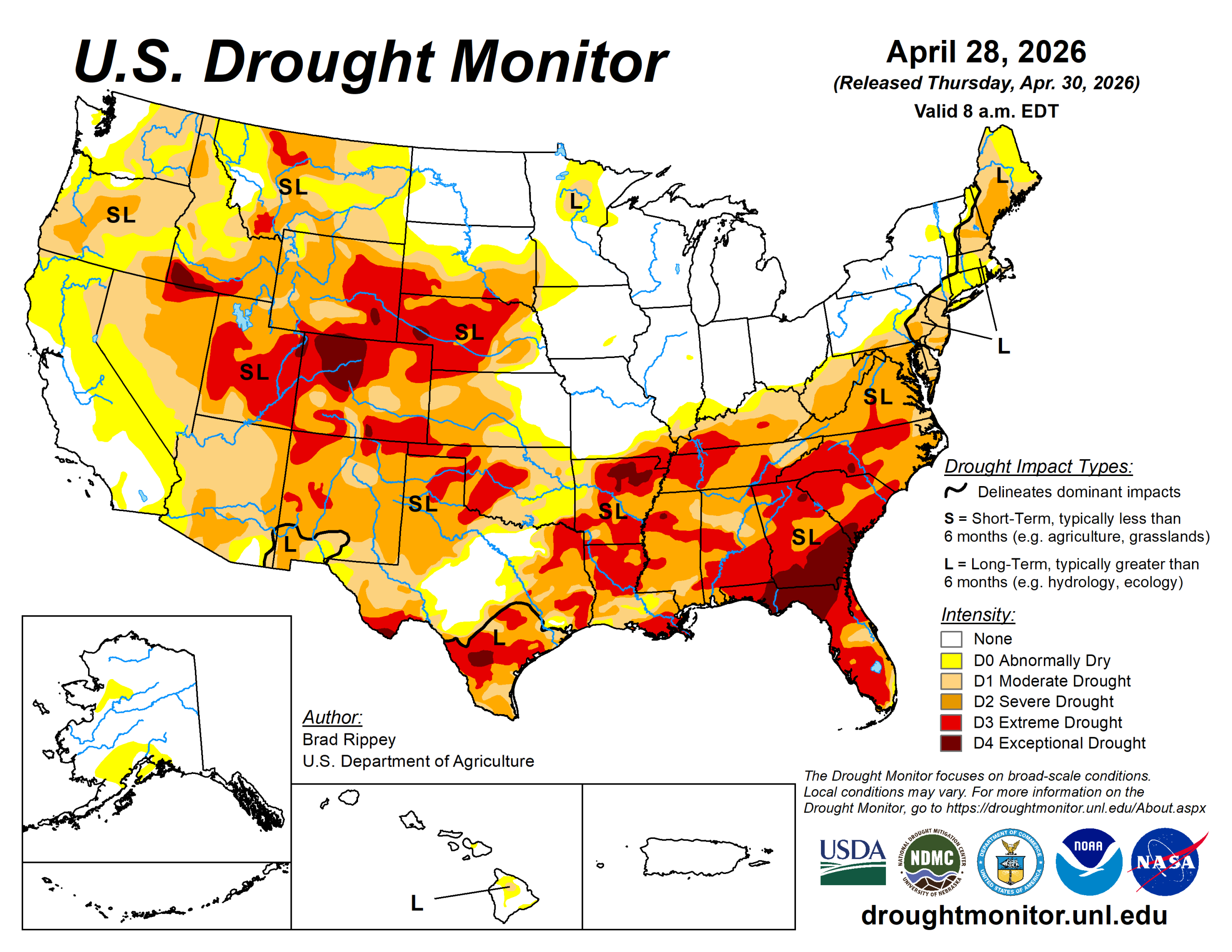
More Than 60% of America Is Covered by Drought and Millions of Homes Are at Risk
By Realtor.com
Excerpts: The current drought crisis in the U.S. is poised to take an enormous toll on homeowners.
More than 60% of the country is facing drought conditions, “just 2 percentage points shy of the most widespread drought this century, which occurred in 2012,” according to the Washington Post.
Paul Pastelok, AccuWeather senior meteorologist and long-range forecaster, said the states most affected include Colorado, Utah, Georgia, Florida, and southern Texas.
“The Southeast Region from Virginia to Alabama is near 100% abnormally dry or greater currently. This region is nearly 50% in extreme drought conditions,” he explained. “Across Texas, the worst of the drought is from Northeast Texas to the lower Valley. The state is 21.23% in extreme drought. Northwest Colorado to eastern Utah is the worst area for drought in the West, ranging from severe to exceptional drought.”
Just like other catastrophic weather events, drought conditions can have an enormous impact on property value and maintenance expenses—and homeowners need to be prepared.
First the drought, then the wildfires
Drought conditions can trigger or amplify wildfires, and the AccuWeather 2026 U.S. Wildfire Forecast predicts “5.5 [million to] 8 million acres of land to burn across the country this year, compared to the historical average of 7 million acres.”
“Larger and more destructive wildfires are likely this year, with the interior Northwest and the Rockies regions facing the highest risk,” the report said.
Currently, Pastelok said that fires are occurring in North Carolina, Georgia, Florida, Mississippi, Alabama, New Mexico, Colorado, South Dakota, and Nebraska, with the majority occurring in north-central Florida and southern Georgia due to the drought.
He also noted that the increase of people moving out of cities and into suburban wildlands to build their houses is only putting them in the path of fires.
“The increase in drought coverage, the increase in dry fuels, continues to put suburban areas at risk every year,” he said.
To read more, Click Here
My comments. Lack of access to water and fire risk can definitely affect home values.
When I worked in a northern California assessor’s office in the late 1970s there was a drought. People living in the hills had wells running dry. They had to pay for water to be delivered up winding, narrow roads. I appraised a lot of these properties. The first question was the status of their well. Was the well working?
Today, the same hilly areas have significant fire danger. One had a major fire with many homes destroyed. It was was hard to fight fire without adequate water. They had limited water capacity. Would you pay less for a home in an area with known wildfire risks? Can you get home insurance?
Humans can generally survive without water for 3 to 4 days. I always have water in my disaster kits for my car and house, plus water purification pills. For me the most likely disaster is an earthquake.
Drought is happening all over the world due to increasing temperatures, depleted ground water, and other problems. In countries where many people rely on farming small plots of land, many have to relocate somewhere else as their land is too dry to farm. Some major cities in other countries do no not have running water available for the residents on a regular basis. Their water sources are drying up – lakes, rivers, dams, groundwater, etc.
——————————————————————
UAD 3.6 Bootcamp,LIVE in Chicago, IL
Wednesday – Friday, May 13th-15th
Hybrid event with CE: In-Person or by Zoom
Take a tour of the new URAR, see how it works with verified UAD 3.6 software, and get your questions answered by representatives from Fannie Mae and Freddie Mac.
The 14 hours of CE will be streamed live and recorded and sent to all registrants. The 3rd day will be live streamed but we are not allowed to record.
You can register for all 3 days, 2 days or 1 day.
Topics include:
Mobile appraising & ScanToSketch workflows to improve field efficiency
The new URAR: what’s changing and how to report it correctly
UAD 3.6 data clusters explored through real examples and live software demos
Live GSE access with Q&A featuring Sean Murphy (Freddie Mac) and Ken DeFeo (Fannie Mae)
To read more, Click Here
My comments: One of the best ways to understand what is happening is attending a national event. This one is available and on Zoom.
In the past, for about 20 years, I spoke at many appraisal conferences and large meetings in the U.S. and Canada. I learned the value of going to conferences. I quit going due to business traveling burn out.
I am working on an article for my monthly newsletter: Which UAD 3.5 appraisal software do you want to buy? Lots of issues. Few vendor software is ready to go and has finished beta testing.
What we all need is much more than the “official” 7 hour GSE class. I want to hear what the GSEs say in person, see software demos, and more.
I recently spent some time looking at comments on Facebook appraiser groups. There is a lot of confusion.
This event looks good for to give you the “big picture”. Plus, no traveling required!
November 2, 2026 is coming soon. GSEs said they will not change the date. What would Polymarket, the world’s largest prediction market, say? Want to make a bet?
———————–—————————————–
HOW TO USE THE NUMBERS BELOW. Appraisals are ordered after the loan application. These numbers tell you the future for the next few weeks. For more information on how they are compiled, Click Here.
Note: I publish a graph of this data every month in my paid monthly newsletter, Appraisal Today. For more information or get a FREE sample go to www.appraisaltoday.com/order Or call 510-865-8041, MTW, 7 AM to noon, Pacific time.
My comments: Rates are going up and down. We are all waiting for rates to drop lower in 2027.
Mortgage applications decreased 4.4 percent from one week earlier
WASHINGTON, D.C. (May 6, 2026) — Mortgage applications decreased 4.4 percent from one week earlier, according to data from the Mortgage Bankers Association’s (MBA) Weekly Mortgage Applications Survey for the week ending May 1, 2026.
The Market Composite Index, a measure of mortgage loan application volume, decreased 4.4 percent on a seasonally adjusted basis from one week earlier. On an unadjusted basis, the Index decreased 4 percent compared with the previous week. The Refinance Index decreased 5 percent from the previous week and was 29 percent higher than the same week one year ago. The seasonally adjusted Purchase Index decreased 4 percent from one week earlier. The unadjusted Purchase Index decreased 3 percent compared with the previous week and was 5 percent higher than the same week one year ago.
“The ongoing conflict in the Middle East continues to push rates higher. Mortgage rates last week increased to their highest level in a month, with the 30-year fixed rate rising to 6.45 percent,” said Joel Kan, MBA’s Vice President and Deputy Chief Economist. “As expected, elevated rates and shrinking refinance incentives continued to weigh on activity, with refinance applications declining again from the prior week – most notably for conventional and VA loans. The refinance share of applications was the lowest since August 2025.”
Added Kan, “Despite purchase applications declining over the week, overall activity remains higher compared to last year’s pace. Additionally, the average loan size on a purchase application increased to $467,300, the highest in the survey’s history dating back to 1990. This increase could indicate that potential first-time buyers, and buyers looking for homes at lower price points, might be the most hesitant to move forward given the economic uncertainty and higher rates.”
The refinance share of mortgage activity decreased to 42.0 percent of total applications from 42.5 percent the previous week. The adjustable-rate mortgage (ARM) share of activity increased to 8.8 percent of total applications.
The FHA share of total applications increased to 17.7 percent from 17.2 percent the week prior. The VA share of total applications decreased to 14.9 percent from 15.0 percent the week prior. The USDA share of total applications remained unchanged at 0.5 percent from the week prior.
The average contract interest rate for 30-year fixed-rate mortgages with conforming loan balances ($832,750 or less) increased to 6.45 percent from 6.37 percent, with points increasing to 0.66 from 0.61 (including the origination fee) for 80 percent loan-to-value ratio (LTV) loans. The effective rate increased from last week.
The average contract interest rate for 30-year fixed-rate mortgages with jumbo loan balances (greater than $832,750) increased to 6.47 percent from 6.45 percent, with points increasing to 0.47 from 0.38 (including the origination fee) for 80 percent LTV loans. The effective rate increased from last week.
The average contract interest rate for 30-year fixed-rate mortgages backed by the FHA increased to 6.12 percent from 6.09 percent, with points increasing to 0.74 from 0.71 (including the origination fee) for 80 percent LTV loans. The effective rate increased from last week.
The average contract interest rate for 15-year fixed-rate mortgages increased to 5.83 percent from 5.77 percent, with points increasing to 0.73 from 0.63 (including the origination fee) for 80 percent LTV loans. The effective rate increased from last week.
The average contract interest rate for 5/1 ARMs decreased to 5.60 percent from 5.66 percent, with points decreasing to 0.83 from 0.96 (including the origination fee) for 80 percent LTV loans. The effective rate decreased from last week.
The survey covers U.S. closed-end residential mortgage applications originated through retail and consumer direct channels. The survey has been conducted weekly since 1990. Respondents include mortgage bankers, commercial banks, thrifts, and credit unions. Base period and value for all indexes is March 16, 1990=100.
————————————————————————————–

Ann O’Rourke, MAI, SRA, MBA
Appraiser and Publisher Appraisal Today
1826 Clement Ave. Suite 203 Alameda, CA 94501
Phone: 510-865-8041
Email: ann@appraisaltoday.com
Online: www.appraisaltoday.com
We want to know what you think!! Please leave a comment.