
Newz: UAD 3.6 Adapt or Step Back,
Getting Started With AI
May 29, 2026
What’s in This Newsletter (In Order, Scroll Down)
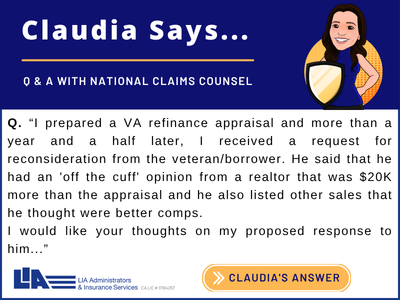
- LIA AD: Too Late for a Reconsideration of Value
- Adapt or Step Back? How UAD 3.6 Is Forcing a Career Decision for Appraisers, By Rachel Mann
- 109-Year-Old ‘Boathouse’ That Appears To Float on Washington Canal at High Tide Hits the Market for $2.1 Million
- Getting Started with AI for Appraisers
- MY AD: Loose Lips Cause Claims (Loose Lips Lead to Lawsuits) By Claudia Gaglione, Esq.
- Wells Fargo Settles Mortgage Discrimination Suit With $100M Fund To Help Low-Income Homebuyers
- HB 355 and What Every Appraiser Should Learn from Kentucky’s Legislative Win, By Bryan S. Reynolds, MNAA
- MBA: Mortgage applications decreased 8.5 percent from one week earlier
——————————————-
Adapt or Step Back? How UAD 3.6 Is Forcing a Career Decision for Appraisers
By Rachel Mann
Behind the technical transition lies a more personal question: Is it worth starting over at this stage of a career?
Excerpts: A Profession Split in Real Time
While there’s plenty of buzz around UAD 3.6 itself, it’s worth taking a boots-on-the-ground look at what active appraisers are actually feeling. In a recent industry poll conducted on Facebook, the findings were telling.
Out of 233 responses from active appraisers, 36.5% reported they are actively preparing, while 36.1% are taking a “wait and see” approach. The remaining responses, which we’ll get into below, reveal the deeper undercurrents.
The clear takeaway is that the industry isn’t aligned. There’s real uncertainty in how appraisers are responding to the shift, and a large unknown hanging over the profession.
And it raises a question: Is the uncertainty driven by the change itself, or by the lack of clear options for what happens next?
Appraiser Voices: Real Reactions to UAD 3.6
Beyond the “actively preparing” and “wait and see” camps, smaller groups of respondents revealed the deeper anxieties at play.
About 8.2% cited concerns about the learning curve, 4.7% said they’re considering stepping back from volume, and 2.6% plan to retreat into private work only.
Another 12% fell into smaller categories ranging from software testing readiness and hardware concerns to skepticism about implementation timelines.
The overall picture is a mix of readiness, hesitation, and resistance — revealing capacity limits and decision fatigue at a critical moment: adapt or step back? The underlying question for those nearing retirement is: Is it worth the time, cost, and effort to adapt at this stage in my career?
When a Workflow Change Becomes a Career….
A sudden decline in active appraisers could carry real consequences:
- Loss of experienced appraisers who currently make up the majority of the workforce
- 2. Disruption of long-standing client relationships, leaving lenders, AMCs, and homeowners scrambling
- A thinning mentorship pipeline for new appraisers, weakening the path forward for the next generation
- These changes, paired with the lack of exit planning, have broader implications. This isn’t an individual issue; it impacts industry stability and continuity.
To read more, Click Here
My comments: Worth reading the entire post for the details and interesting comments.
———————————————————–

109-Year-Old ‘Boathouse’ That Appears To Float on Washington Canal at High Tide Hits the Market for $2.1 Million
Excerpts: 5 bedrooms, 3 baths, 4,808 sq.ft., 4,792 sq.ft. lot, built in 1917
An extraordinary five-bedroom residence in Washington that appears to float atop the Hood Canal has hit the market for the first time in more than 20 years with an asking price of $2.1 million.
Known as “The Boathouse,” the historic residence built in 1917 still boasts many period details along with an expanded and thoughtfully modernized open floor plan—features that have helped it to surf to the top of the week’s most popular homes list.
But perhaps the most intriguing aspect of the dwelling’s design is the incredible optical illusion that surfaces during high tide, when the water surrounds the bottom of the property, making it look as though it is floating atop the canal.
To read the listing, Click Here
My comments: I used to rent a house with a small “boathouse” over the water, built on pilings behind the house. They were common on this street. No permits, of course. I used it for my office when I started my appraisal business. Had a bath.
Once the residents nearby tried to straighten it out the permit problems and asked me for an appraisal. I had been living on the street for 10 years and was very familiar with the issues.
They were on a waterway between my city and another city. Who was in charge of the boathouses behind many of the homes was not clear. They did not like my fee and said “no thanks”.
———————————————————–
Getting Started with AI for Appraisers
Excerpts: Survey Results: In What Aspects of the Appraisal Process Are AI Tools Most Effective?
Knowing that AI can help is one thing—knowing where it’s actually delivering value for working appraisers is another. To find out, we surveyed our community of real estate appraisers and asked: “In what aspects of your appraisal process have AI tools been most effective? (Select top three.)” Here’s what they said.
While 23% of survey respondents said they haven’t applied AI tools to their appraisal process yet, 40% identified “writing narrative for appraisal reports” and 33% identified “research (property, regulations, records)” among the top areas in which they’re finding AI tools to be most effective.
“Summarizing documents” (20%), “market analysis (17%), and “responding to appraisal disputes or reconsideration of values” (17%) are other aspects of the appraisal process where AI can be particularly useful, according to survey respondents.
What’s clear from the data is that appraisers aren’t using AI to replace core valuation work. They’re using it to handle the surrounding tasks that consume time without requiring professional judgment. That’s exactly the right place to start, and it’s a good model to follow as you’re getting comfortable with the tools.
How to Get Started with AI
You don’t need to take a deep dive on day one. And if you’re wondering where to begin, the survey results above are a useful guide. Tasks like narrative report writing and property research ranked at the top, and they’re also great starting points.
Here are a few low-stakes ways to start building familiarity with AI tools…
The Bottom Line
AI isn’t going to replace the appraiser. But real estate appraisers who understand how to use AI responsibly and effectively will have a real edge over those who don’t.
You don’t need to become an AI expert overnight. You just need to start. Get familiar with the tools, learn their limitations, and figure out where they fit into your workflow. The learning curve is gentler than you might expect—and the upside for your practice is real.
To read more, Click Here
My comments: Worth reading. Well written and includes very practical advice for appraisers. Where to learn more section is very good.
————————————————————-
Are you getting too many ad-only emails?
4 ways to get only the FREE email newsletters and NOT the ad-only emails.
1. Twitter: https://twitter.com/appraisaltoday Posted by noon Friday
2. Read on blog www.appraisaltoday.com/blog Posted by noon Friday. You can subscribe to the blog in the upper right of each blog page. NOTE: the popular ads with liability tips are below the first topic on my blog posts.
3. Email Archives: https://appraisaltoday.com/archives
(posted by noon Friday) The link is above and to the left of the big yellow email signup form. Newsletters start with “Newz.” Contains all recent emails sent.
4. Link to the 10 most recent newsletters (no ads) at www.appraisaltoday.com. Scroll down past the big yellow signup block. The newsletters have abbreviated titles, taken from their blog posts.
To read more about the 4 ways, plus information on why I take ads, etc.
——————————————
Loose Lips Cause Claims (Loose Lips Lead to Lawsuits)
By Claudia Gaglione, Esq., National Claims Counsel LIA Administrators &
Insurance Services
In the August 2025 issue of Appraisal Today
We’ve seen multiple claims, lawsuits, and licensing board complaints arise simply because an appraiser-or someone close to the appraiser-said too much.
Sometimes, confidential information was explicitly disclosed. Other times, the
appraiser believed they were just making polite conversation, only to be blindsided later.
The Importance of Confidentiality
Every appraiser knows that USPAP’s Ethics Rule requires
confidentiality-not just in the written report but in all aspects of the assignment. Unfortunately, appraisers sometimes let their guard down during friendly or informal discussions.
Key takeaways:
• Confidentiality applies at all times, not just in the written report.
• Be mindful of who’s around-family, friends, co-workers, and vendors
must also respect confidentiality.
• Avoid gossip, speculation, and personal opinions, even if others initiate the
conversation.
• When in doubt, say less. A simple “I’m not at liberty to discuss that” goes a long way.
There’s no guaranteed way to avoid being falsely accused-but minimizing
casual conversation, especially around third parties, greatly reduces your risk.
To read the full article, plus 3+ years of previous issues, subscribe to the paid Appraisal Today at www.appraisaltoday.com/order .
Not sure if you want to subscribe?
Sign up for monthly auto renewal for $8.25!
Cancel at any time for any reason! You will receive a prorated refund.
$8.25 per month, $24.75 per quarter, and $89 per year (Best Buy)
or $99 per year or $169 for two years
Subscribers get FREE: past 18+ months of past newsletters
What’s the difference between the Appraisal Today free Weekly email newsletter and the paid Monthly newsletter? Click here for more info.If you are a paid subscriber and did not receive the
May, 2026 issue emailed on
Friday, May 1, 2026 please email info@appraisaltoday.com, and we will send it to you. You can also hit the reply button. Be sure to include a comment requesting it. Or, call 510-865-8041
—————————————————–
Wells Fargo Settles Mortgage Discrimination Suit With $100M Fund To Help Low-Income Homebuyers
Realtor.com
Excerpts: Low- and moderate-income homebuyers from 50 cities will be eligible for new mortgage assistance programs after Wells Fargo & Co. settled a lawsuit alleging discriminatory hiring and lending practices.
A judge in California district court approved a final settlement May 15 in a lawsuit against Wells Fargo’s board by several of its shareholders. It follows a four-year dispute alleging the company’s board failed to maintain adequate oversight of its lending practices.
Wells Fargo did not admit any wrongdoing as part of the settlement. However, the bank will establish a $100 million, three-year mortgage assistance borrowers program for communities with barriers to obtaining a mortgage. The directors must also pay $10 million to shareholders, whom it will notify.
Low- and moderate-income homebuyers from 50 cities will be eligible for new mortgage assistance programs after Wells Fargo & Co. settled a lawsuit alleging discriminatory hiring and lending practices.
A judge in California district court approved a final settlement May 15 in a lawsuit against Wells Fargo’s board by several of its shareholders. It follows a four-year dispute alleging the company’s board failed to maintain adequate oversight of its lending practices.
Wells Fargo did not admit any wrongdoing as part of thar mortgage assistance borrowers program for communities with barriers to obtaining a mortgage. The directors must also pay $10 million to shareholders, whom it will notify.
To read more, Click Here
My comments: I have been hearing about lender discrimination for decades farther back than “red lining”. Finally a major lender has to do do something about their discrimination. Of course, appraisers can lose their careers and have expensive legal problems. No person at Wells Fargo Bank was mentioned.
——————————————————–
HB 355 and What Every Appraiser Should Learn from Kentucky’s Legislative Win
By Bryan S. Reynolds, MNAA
Kentucky’s recent passage of House Bill 355 is more than a state legislative victory—it is a case study in what can happen when appraisers come together to shape the future of their profession.
Over the last five months, the Kentucky Association of Appraisers (KAA) worked closely with Representative Shawn McPherson, legislative counsel, and Bill drafters to help create what I believe is one of the most significant pieces of appraisal-related legislation ever enacted in the Commonwealth.
This was a comprehensive Bill designed to modernize Kentucky’s appraisal laws, strengthen consumer protections, and provide meaningful legal safeguards for appraisers.
Introduced in December 2025, HB 355 addresses several key issues affecting the profession, including:
• Establishing a one-year statute of limitations for most complaints and civil actions involving appraisals.
• Clarifying that appraisal-related services must be performed by licensed or certified professionals, subject to statutory exceptions.
• Expressly authorizing credentialed appraisers to perform evaluations.
• Modernizing terminology from “real estate appraisal” to “real property appraisal”.
• Restructuring and strengthening board oversight.
• Expanding board membership.
• Updating renewal and continuing education requirements.
• Improving administrative and enforcement procedures.
In short, HB 355 brings Kentucky’s appraisal framework into a more modern and practical structure while reinforcing public trust in the profession.
As Peter Christensen stated, “Appraisers in Kentucky now have the best legal protections of any appraisers in the U.S.”
For those practicing outside Kentucky, there is an important takeaway here.
I strongly encourage every appraiser to carefully review the statutes and administrative rules within their own state. As
Peter Christensen stated, “Appraisers in Kentucky now have the best legal protections of any appraisers in the U.S.”
For those practicing outside Kentucky, there is an important takeaway here.
I strongly encourage every appraiser to carefully review the statutes and administrative rules within their own state.
To read more, Click Here
My comments: In California I have never heard of anything like this happening. Be sure to read Peter Christensen’s comments near the end.
———————————————————-
HOW TO USE THE NUMBERS BELOW. Appraisals are ordered after the loan application. These numbers tell you the future for the next few weeks. For more information on how they are compiled, Click Here.
Note: I publish a graph of this data every month in my paid monthly newsletter, Appraisal Today. For more information or get a FREE sample go to www.appraisaltoday.com/order Or call 510-865-8041, MTW, 7 AM to noon, Pacific time.
My comments: Rates are going up and down. We are all waiting for rates to drop lower in 2027.
Mortgage applications decreased 8.5 percent from one week earlier
WASHINGTON, D.C. (May 27, 2026) — Mortgage applications decreased 8.5 percent from one week earlier, according to data from the Mortgage Bankers Association’s (MBA) Weekly Mortgage Applications Survey for the week ending May 22, 2026.
The Market Composite Index, a measure of mortgage loan application volume, decreased 8.5 percent on a seasonally adjusted basis from one week earlier. On an unadjusted basis, the Index decreased 9 percent compared with the previous week. The Refinance Index decreased 18 percent from the previous week and was 19 percent higher than the same week one year ago. The seasonally adjusted Purchase Index decreased 0.4 percent from one week earlier. The unadjusted Purchase Index decreased 2 percent compared with the previous week and was 5 percent higher than the same week one year ago.
“The 30-year fixed rate has increased 30 basis points over the past five weeks to its highest level since August 2025. With the rate now at 6.65 percent, many borrowers understandably backed away from refinancing last week,” said Joel Kan, MBA’s Vice President and Deputy Chief Economist. “There were large declines in applications across loan types – conventional refinances were down 14 percent, along with an 18 percent decrease for FHA applications and a 34 percent decrease for VA applications. Overall, refinance applications accounted for 38 percent of applications, the lowest share since June 2025.”
Added Kan, “Purchase applications were slightly lower across all loan types but still ran at a stronger pace than last year’s pace. The average loan size for a purchase application reached another survey high at $473,600, as borrowers with smaller loan sizes were less active given the higher rate environment and its negative impact on their purchasing power.”
The refinance share of mortgage activity decreased to 37.5 percent of total applications from 41.9 percent the previous week. The adjustable-rate mortgage (ARM) share of activity decreased to 9.4 percent of total applications.
The FHA share of total applications decreased to 17.2 percent from 17.9 percent the week prior. The VA share of total applications decreased to 13.2 percent from 14.4 percent the week prior. The USDA share of total applications increased to 0.5 percent from 0.4 percent the week prior.
The average contract interest rate for 30-year fixed-rate mortgages with conforming loan balances ($832,750 or less) increased to 6.65 percent from 6.56 percent, with points increasing to 0.65 from 0.60 (including the origination fee) for 80 percent loan-to-value ratio (LTV) loans. The effective rate increased from last week.
The average contract interest rate for 30-year fixed-rate mortgages with jumbo loan balances (greater than $832,750) increased to 6.68 percent from 6.58 percent, with points increasing to 0.42 from 0.38 (including the origination fee) for 80 percent LTV loans. The effective rate increased from last week.
The average contract interest rate for 30-year fixed-rate mortgages backed by the FHA increased to 6.31 percent from 6.24 percent, with points increasing to 0.79 from 0.67 (including the origination fee) for 80 percent LTV loans. The effective rate increased from last week.
The average contract interest rate for 15-year fixed-rate mortgages increased to 5.97 percent from 5.93 percent, with points increasing to 0.84 from 0.73 (including the origination fee) for 80 percent LTV loans. The effective rate increased from last week.
The average contract interest rate for 5/1 ARMs increased to 5.81 percent from 5.76 percent, with points decreasing to 0.82 from 0.85 (including the origination fee) for 80 percent LTV loans. The effective rate increased from last week.
The survey covers U.S. closed-end residential mortgage applications originated through retail and consumer direct channels. The survey has been conducted weekly since 1990. Respondents include mortgage bankers, commercial banks, thrifts, and credit unions. Base period and value for all indexes is March 16, 1990=100.
——————————————
Ann O’Rourke, MAI, SRA, MBA
 Appraiser and Publisher Appraisal Today
1826 Clement Ave. Suite 203 Alameda, CA 94501
Phone: 510-865-8041
Email: ann@appraisaltoday.com
Online: www.appraisaltoday.com
We want to know what you think!! Please leave a comment.