Appraisers – The Clipboard Has to Go!

Newz: The Clipboard Has to Go, Systemic Failures in FHA Appraisal and Loan Review

May 22, 2026

What’s in This Newsletter (In Order, Scroll Down)

  • LIA AD: Am I Still on the ‘Do Not Use’ List?
  • Joe the Appraiser: Calling It Like It Is. The Clipboard Has to Go
  • Florida Megamansion That Starred in ‘Scarface’ and Was Used as President Nixon’s Winter White House Hits the Market for $237 Million
  • Systemic Failures in FHA Appraisal and Loan Review by Desiree Mehbod
  • MY AD: List of my articles about UAD 3.6
  • America’s Homes Are Older Than Ever—and Local Red Tape Could Make Them Harder To Fix
  • Survey: While Some Brokers Push Private Listing Networks, Most Soon-to-Be Sellers Want their Homes Seen By Every Buyer
  • MBA: Mortgage applications decreased 2.3 percent from one week earlier

————————————————————————–

Joe the Appraiser: Calling It Like It Is.

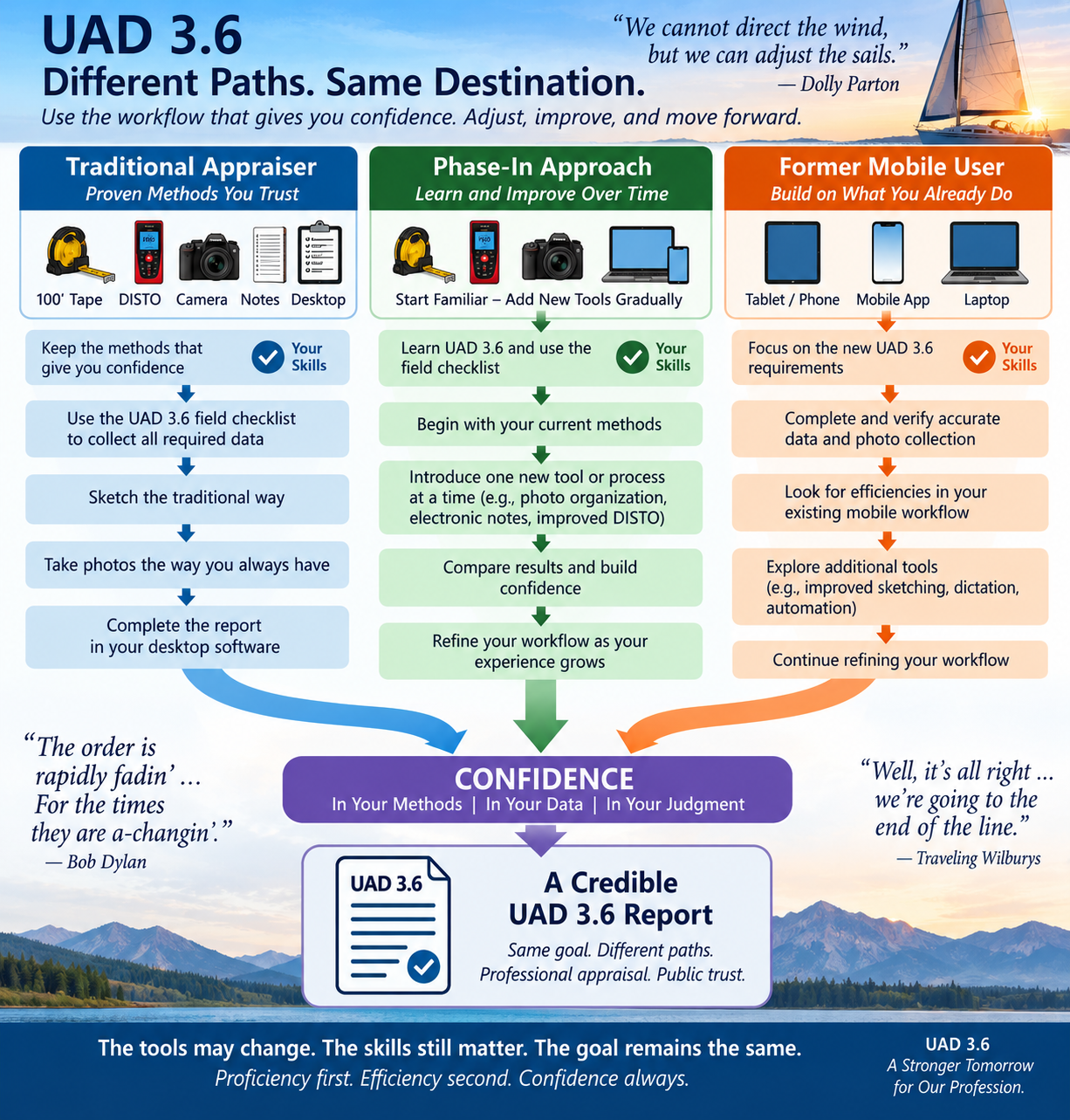
The Clipboard Has to Go

By Joe Pravettone

Excerpts: I’m Joe. I’ve been doing this a long time. Long enough to remember when “cutting-edge technology” meant a pager, microfiche, and a Thomas Guide rattling around in the glove box. (If you know, you know.)

I’ve spent nearly 30 years in this profession — 15 years in the mortgage world doing processing, underwriting, and operations, and another 15 deep in appraisals, wearing just about every hat there is, from fee appraiser and AMC staff to QC.

Let’s start with the UAD.

If you’ve been in this business longer than five minutes, you’ve felt it. That low-grade tension humming in the background. The new Uniform Appraisal Dataset is here. The forms are changing, the workflow is changing, and a lot of appraisers are somewhere between uneasy and ready to stress-eat.

I get it. I really do.

But here’s the other reality: We’re also heading toward a volume surge. Rates are easing. Refinances are starting to creep back. And when you combine industry-wide change with rising volume, things can get messy.

So let’s be honest about something. The clipboard has to go. I know, I know, you’ve got a system. Your scratch paper has a system. Your clipboard definitely has a system. You’ve been doing it your way for years, and your way works. I’m not saying it doesn’t. But the road has curved, and it’s time to turn the wheel.

To read more, Click Here

My comments:

This article was written by a long time lender appraisal “insider”. Worth reading.

As the November 2, 2026 UAD 3.6 deadline approaches more lenders and appraisers are getting ready. But, many appraisers don’t like the changes. Those that get ready will have lots of work from AMCs, who are looking all over the country now for appraisers who will do UAD 3.6 appraisals for them. GSEs do about 50% of mortgage loans. Lenders who don’t sell their loans to GSEs will be using the forms software you have been using. I am working on an article on how to get business from them.

I remember the “old days” of microfiche, Thomas Brothers Maps. When I first started appraising 50 years ago, I remember filling up my car by peeling off the back of polaroid photos. I still have old Thomas Bros. maps in my car “just in case” my electronic maps don’t work or are inaccurate. I also have some very old microfiche files but don’t have anything to see them on.

I definitely prefer using an inspection app. I will be writing an article on which tablets are required. I will also have an article with paper checklist instructions that go through SFR, condo and 2-4 units UAD 3.6 appraisals.

————————————————————–

Florida Megamansion That Starred in ‘Scarface’ and Was Used as President Nixon’s Winter White House Hits the Market for $237 Million

Excerpts: 5 bedrooms, 7.5 baths, 11,528 sq.ft., 2.38 Acre lot, Built in 1981

A five-bedroom Florida megamansion that had an unforgettable role in the legendary movie “Scarface” and was later part of President Richard Nixon’s Winter White House has just hit the market in Key Biscayne for an eye-watering $237 million.

Regarded as “one of America’s most iconic waterfront estates,” the 2.38-acre property boasts 862 feet of Biscayne Bay frontage along with a private marina that once operated as a presidential helipad.

Offering sweeping views of the Miami skyline, the 11,528-square-foot residence features 24-foot ceilings, marble floors, and retractable glass walls to capture the spectacular surrounding views.

Other over-the-top amenities include a piano-shaped saltwater pool, a cabana bath, and dockage for yachts up to 200 feet. Resort-style grounds include a piano-shaped saltwater pool, cabana bath, lush tropical landscaping, and expansive lawn areas with artfully integrated lighting extending the estate’s experience well beyond sunset. A private marina, formerly a presidential helipad-features rare 3-phase power and dockage for yachts up to 200′, plus over 34,000 SF of submerged land

To read the listing with 82 photos, aerial views and videos, Click Here

—————————————————————

Systemic Failures in FHA Appraisal and Loan Review

by Desiree Mehbod

Published May 18, 2026 · Updated May 19, 2026

Excerpts: This case exposed the cracks in an FHA system where failures by the lender, the AMC, and the review process aligned in ways that no borrower could have anticipated. It shows how easily an appraisal error can escalate when every safeguard designed to prevent harm breaks down at the same time.

When the first article about this case ran on July 15, 2024, it already raised serious concerns about how an FHA appraisal could miss something as basic as the type of water and sewer service. What has emerged since then paints a much larger picture, one that shows how easily a lender, an AMC, and HUD’s own review process can reshape a clear eligibility violation into something that looks harmless on paper, even as the borrower is left dealing with the full fallout.

This case offers a rare look into how easily borrower protections can be neutralized when the classification of a defect determines the outcome. The system keeps moving, the reviews stay shallow, and the burden keeps falling on the borrower, exactly as it has for years. Until transparency becomes the rule rather than the exception, and until accountability is applied to the parties who control the process rather than the people who depend on it, nothing about this structure will change.

To read more, Click Here

My comments: Read the details of what the AMC, FHA, etc. did and what happened to the appraiser. HUD document included.

—————————————————————-

Are you getting too many ad-only emails?

4 ways to get only the FREE email newsletters and NOT the ad-only emails.

1. Twitter: https://twitter.com/appraisaltoday Posted by noon Friday

2. Read on blog www.appraisaltoday.com/blog Posted by noon Friday. You can subscribe to the blog in the upper right of each blog page. NOTE: the popular ads with liability tips are below the first topic on my blog posts.

3. Email Archives: https://appraisaltoday.com/archives

(posted by noon Friday) The link is above and to the left of the big yellow email signup form. Newsletters start with “Newz.” Contains all recent emails sent.

4. Link to the 10 most recent newsletters (no ads) at www.appraisaltoday.com. Scroll down past the big yellow signup block. The newsletters have abbreviated titles, taken from their blog posts.

To read more about the 4 ways, plus information on why I take ads, etc.

Click here

List of my articles about UAD 3.6

4-25 New URAR for Appraisers. Fannie Q&As and other info

5-25 Train the Trainer and My review of intro class

6-25 What is new in the New URAR? I list each page of SFR and go over each data request.

7-25 From UAD 2.6 to 3.6 what appraisal software vendors are doing.Software vendor comparison – alamode (inspection app), SFREP – report, Bradford (Front end completes appraisal)

11-25 UAD 3.6 update – Software Vendor Update

3-26 UAD 3.6 – Yes, No or Maybe

4-26 Uad 3.6 Software Update – Timelines for finishing software

6-26 (NEW) What UAD 3.6 software do you want? Lots of ideas and what is happening today regarding UAD 3.6. Available June 1.

To read the full articles, plus 3+ years of previous issues, subscribe to the paid Appraisal Today at www.appraisaltoday.com/order .

Not sure if you want to subscribe?

Sign up for monthly auto renewal for $8.25!

Cancel at any time for any reason! You will receive a prorated refund.

$8.25 per month, $24.75 per quarter, and $89 per year (Best Buy)

or $99 per year or $169 for two years

Subscribers get FREE: past 18+ months of past newsletters

What’s the difference between the Appraisal Today free Weekly email newsletter and the paid Monthly newsletter? Click here for more info.

———————————————-

If you are a paid subscriber and did not receive the

May, 2026 issue emailed on

Friday, May 1, 2026 please email info@appraisaltoday.com, and we will send lt to you. You can also hit the reply button. Be sure to include a comment requesting it. Or, call 510-865-8041

————————————————————

America’s Homes Are Older Than Ever—and Local Red Tape Could Make Them Harder To Fix

Realtor.com

Excerpts:

While it’s well documented that regulatory friction is gumming up the new-construction pipeline, a new report offers a rare look at how local bureaucracy may also be affecting the homes already standing.

The analysis from the Common Sense Institute (CSI) reviewed 2.8 million building permit records across Arizona and found that obtaining a permit adds roughly 23 days to residential project completion timelines on average—a burden that can turn even routine work into a long and expensive process.

It’s a particularly troubling finding given the state of the nation’s housing stock. The median owner-occupied home is now 42 years old, up from 31 in 2005, according to the National Association of Home Builders (NAHB).

As homes age, maintenance becomes more essential to keeping homes habitable and less about chasing trends. That shift is already visible—nearly 49 million U.S. households reported at least one needed repair in the latest American Housing Survey, and the Philadelphia Federal Reserve Bank estimates the current repair backlog for occupied homes at $198.4 billion.

While CSI’s analysis is limited to one state, it raises a question with national implications: As America’s housing stock gets older, are local permitting systems making it harder to maintain?

“When people think of remodeling, kitchen and bath might come to mind,” Wedeen tells Realtor.com®. “But a lot of these investments are homeowners investing in basic maintenance, replacing [critical] systems and equipment … and are all essential upgrades that are part of what keep a house in safe and livable conditions.”

And the older the home, the more that spending shifts from optional upgrades to necessary replacements. Arizona shows how permits can add time and money to necessary repairs

As more of America’s spending moves toward necessary repairs, the findings from Arizona suggest that regulatory burdens may be adding time and expense to that process.

Arizona shows how permits can add time and money to necessary repairs

“Permitting and regulatory approval processes play a sometimes outsized role in shaping the cost, timing, and feasibility of construction and infrastructure projects,” write the report’s authors, Glenn Farley, director of policy & research at CSI, and Thomas Young, senior economist at CSI.

“Indeed, academic and policy research suggests that complex or inefficient permitting requirements can substantially increase overall project costs,” they add.

To read more, Click Here

My comments: Good analysis of Arizona data with graphs. Worth reading. I have done many estate appraisals. I often see the deferred maintenance. Retirees lack the money to do the repairs. Also in most states, property taxes are rising because of higher values.

I was not aware of the problems with permitting and learned a lot from this article.

————————————————————–

Survey: While Some Brokers Push Private Listing Networks, Most Soon-to-Be Sellers Want their Homes Seen By Every Buyer

New Zillow poll finds sellers want pre-marketing to the broadest possible audience — at direct odds with a push by some brokers toward limited, private networks

  • 85% of soon-to-be sellers are more likely to hire an agent who can pre-market their home to the broadest online audience
  • 89% of Americans say real-time buyer demand signals would be valuable before selling their home
  • 61% of soon-to-be sellers believe broad online marketing produces better outcomes than a limited private network

A new Zillow survey conducted by The Harris Poll — released as some brokerages and MLSs move to build out private listing networks — finds that the consumers those networks are supposedly designed to serve want something else entirely.

The pitch from private listing proponents is that keeping a home off the open market is simply “seller choice” — but when sellers are actually given that choice, they choose the opposite. Nearly two-thirds of soon-to-be sellers polled (61%) believe broad online exposure produces better outcomes than a limited private network.

This debate has been playing out in agent pitches and listing agreements across the country for years as a few of the largest names in real estate have doubled down on marketing saying that keeping a home out of the public eye is a competitive advantage for sellers. The survey data adds a crucial dimension to that story: sellers, when given a chance to make an informed choice, disagree with this strategy.

To read more, Click Here

My comments: I have seen “private” listings promoted by local real estate agents since I started appraising 50 years ago. As an appraiser I never liked having sales information not available.

Of course I think of the agents who want to represent both the buyer and the seller on a sale.

Some real estate sales companies today are putting all their listings as “private”. It seems to come and go, over time. These restrictions on home marketing are not good for sellers and buyers, in my opinion.

What is happening in your market?

————————————————————–

HOW TO USE THE NUMBERS BELOW. Appraisals are ordered after the loan application. These numbers tell you the future for the next few weeks. For more information on how they are compiled, Click Here.

Note: I publish a graph of this data every month in my paid monthly newsletter, Appraisal Today. For more information or get a FREE sample go to www.appraisaltoday.com/order Or call 510-865-8041, MTW, 7 AM to noon, Pacific time.

My comments: Rates are going up and down. We are all waiting for rates to drop lower in 2027.Mortgage applications decreased 2.3 percent from one week earlier

Mortgage applications decreased 2.3 percent from one week earlier

WASHINGTON, D.C. (May 20, 2026) — Mortgage applications decreased 2.3 percent from one week earlier, according to data from the Mortgage Bankers Association’s (MBA) Weekly Mortgage Applications Survey for the week ending May 15, 2026.

The Market Composite Index, a measure of mortgage loan application volume, decreased 2.3 percent on a seasonally adjusted basis from one week earlier. On an unadjusted basis, the Index decreased 3 percent compared with the previous week. The Refinance Index decreased 0.1 percent from the previous week and was 35 percent higher than the same week one year ago. The seasonally adjusted Purchase Index decreased 4 percent from one week earlier. The unadjusted Purchase Index decreased 5 percent compared with the previous week and was 8 percent higher than the same week one year ago.

“Ongoing concerns around inflation from higher fuel costs, combined with rising concerns over global public debt, pushed Treasury yields higher in the U.S. and abroad last week. This resulted in higher mortgage rates across the board, with the 30-year fixed rate increasing to 6.56 percent, its highest level in seven weeks,” said Joel Kan, MBA’s Vice President and Deputy Chief Economist. “Overall applications were down to the lowest level in five weeks as purchase borrowers pulled back across conventional and government loan types. Refinance applications were essentially unchanged, with a decline in government refinances and an increase in conventional refinancing, likely as the increase in rates came late in the week.”

Added Kan, “Almost 10 percent of applications were for ARM loans, the highest share since October 2025, as borrowers sought loan types with lower rates, given that the ARM rate was 80 basis points below the 30-year fixed rate.”

The refinance share of mortgage activity increased to 41.9 percent of total applications from 40.8 percent the previous week. The adjustable-rate mortgage (ARM) share of activity increased to 9.6 percent of total applications.

The FHA share of total applications remained unchanged at 17.9 percent from the week prior. The VA share of total applications decreased to 14.4 percent from 14.9 percent the week prior. The USDA share of total applications decreased to 0.4 percent from 0.5 percent the week prior.

The average contract interest rate for 30-year fixed-rate mortgages with conforming loan balances ($832,750 or less) increased to 6.56 percent from 6.46 percent, with points decreasing to 0.60 from 0.63 (including the origination fee) for 80 percent loan-to-value ratio (LTV) loans. The effective rate increased from last week.

The average contract interest rate for 30-year fixed-rate mortgages with jumbo loan balances (greater than $832,750) increased to 6.58 percent from 6.48 percent, with points decreasing to 0.38 from 0.55 (including the origination fee) for 80 percent LTV loans. The effective rate increased from last week.

The average contract interest rate for 30-year fixed-rate mortgages backed by the FHA increased to 6.24 percent from 6.16 percent, with points decreasing to 0.67 from 0.75 (including the origination fee) for 80 percent LTV loans. The effective rate increased from last week.

The average contract interest rate for 15-year fixed-rate mortgages increased to 5.93 percent from 5.83 percent, with points increasing to 0.73 from 0.68 (including the origination fee) for 80 percent LTV loans. The effective rate increased from last week.

The average contract interest rate for 5/1 ARMs increased to 5.76 percent from 5.70 percent, with points decreasing to 0.85 from 0.86 (including the origination fee) for 80 percent LTV loans. The effective rate increased from last week.

The survey covers U.S. closed-end residential mortgage applications originated through retail and consumer direct channels. The survey has been conducted weekly since 1990. Respondents include mortgage bankers, commercial banks, thrifts, and credit unions. Base period and value for all indexes is March 16, 1990=100.

————————————————-

Ann O’Rourke, MAI, SRA, MBA
Appraiser and Publisher Appraisal Today

1826 Clement Ave. Suite 203 Alameda, CA 94501

Phone: 510-865-8041

Email:  ann@appraisaltoday.com

Online: www.appraisaltoday.com

Appraisal Today | 1826 Clement Ave., Suite 203 | Alameda, CA 94501 US

24 Hour Appraisals

Newz: 24 Hour Appraisals, Bias Accusation Collapses, Easements and Appraiser Liability

May 15, 2026

What’s in This Newsletter (In Order, Scroll Down)

  • LIA AD: Easements and Appraiser Liability
  • 24-Hour Appraisals: The Future or a Gimmick? By Shawn Telford , Chief Appraiser and Valuation Officer at Cotality
  • $28 Million ‘Pavilion’ House in Los Angeles Boasts ‘Once-in-a-Generation’ Design—and a Sunken Conversation Pit
  • Freddie/Fannie UAD and Forms Redesign: Enhanced Timeline and Updated FAQs
  • MY AD: Appraisal forms software in September, 1993 – a glance at the past
  • AQB Releases White Paper on Experience Requirements
  • Bias Accusation Collapses as HUD Clears the Appraiser by Desiree Mehbod
  • MBA: Mortgage applications increased 1.7 percent from one week earlier


—————————————————————————

24-Hour Appraisals: The Future or a Gimmick?

By Shawn Telford , Chief Appraiser and Valuation Officer at Cotality,

Rethinking Quality and Risk in Modern Valuations: Why Faster Can be Risky

Excerpts: side from the opinion of value, speed is often the next loudest talking point in any conversation about appraisals—but it’s also one of the most misleading. While accelerated appraisal procurement models promise faster turn times, they do little to address the concerns that matter most to lenders: inaccurate valuations, which lead to appraisal defects that create buyback exposure and margin pressures for lenders, ultimately contributing to delays and additional costs.

This isn’t to say that the prospect of 24-hour appraisals is not appealing: after all, who doesn’t like faster? But is it a game-changer or merely a gimmick?

Today, lenders are facing greater scrutiny from the GSEs and investors over loan quality, in general, and collateral valuations in particular. Recently, Fannie Mae reported that collateral defects – like property damage, appraisal condition & quality rating inflation, and inappropriate comparable sale selection—are now accounting for nearly half of discretionary loan review defects. Solving for the Right Problems

Pressuring appraisers to work faster is hardly going to address these issues.

The Economic Impact of Quality

Getting an appraisal quickly can be a plus. But if the valuation requires extensive rework, it can create friction and delays and add operational costs to the underwriting process. One of the biggest slowdowns in the appraisal process is the back-and-forth between the appraiser and an AMC’s lender over administrative “corrections” that often don’t affect the opinion of value. In fact, recent Cotality data shows that nearly half of all appraisals are returned for some type of correction, and the vast majority of those returned do not have their value changed when resubmitted.

To read more, Click Here

My comments: very good analysis with many excellent comments. Very knowledgeable author. Worth reading.


Read more!!

The Appraiser Exodus and How to Fix It

Newz: Expanded Intended Users?

The Appraiser Exodus and How to Fix It.

May 8, 2026

What’s in This Newsletter (In Order, Scroll Down)

  • LIA AD: Expanding Intended Users? Not So Fast
  • Under Pressure: What’s Driving the Appraiser Exodus and How to Fix It, By David Massey
  • Historic Tudor Estate With English Gardens and Prairie Views Is Listed for $4.7 Million Near Chicago
  • What is a Pre-listing appraisal? Written for Home Owners But Has Good Tips for Appraisers, By Tom Horn
  • MY AD: What Happened When Government Decided That Appraisers Needed Protection, By Cindy Chance, PhD
  • How to See the Potential in Homes That Don’t Look Perfect. Written for Home Owners But Has Good Tips for appraisers
  • More Than 60% of America Is Covered by Drought and Millions of Homes Are at Risk
  • UAD 3.6 Bootcamp, LIVE in Chicago, IL and on Zoom, Wednesday – Friday, May 13th-15th
  • MBA STATS: Mortgage applications decreased 4.4 percent from one week earlier


——————————————————————-

Under Pressure: What’s Driving the Appraiser Exodus and How to Fix It,

By David Massey

Ask any veteran appraiser or physician what has changed most over the past twenty years, and the answer is usually the same: paperwork.

Professions once centered on skill, judgment, and service are now dominated by portals, compliance layers, and third-party control. Burnout rises, independence falls, and a quiet exodus follows.

The American Medical Association reports that physicians now spend nearly two hours on documentation for every hour of patient care.

The appraisal profession is now well into that cycle.

According to the Appraisal Institute’s 2023 Fact Sheet, the number of practicing appraisers in the United States has declined by roughly 8,000 in recent years. The Conference of State Bank Supervisors shows a longer-term drop from about 120,000 appraisers in 2008 to fewer than 96,000 by 2017, a 21 percent decline in less than a decade. IBISWorld reports another six percent employment drop between 2018 and 2023. The U.S. Bureau of Labor Statistics projects only modest growth through 2034, far short of what is needed to replace retirees.

The pipeline is shrinking while demand remains steady.

The National Association of Realtors ® 2023 Appraisal Survey found that more than half of appraisers are now asked monthly, or more often, to complete assignments outside their normal geographic or property-type expertise. More telling, 54 percent cited Appraisal Management Companies as the single greatest challenge to their business. That statistic alone explains much of what has gone wrong.

When I started in this profession, appraisal centered on analysis, interpretation, and professional opinion. I studied neighborhoods, walked properties, and applied experience to market behavior. Today, much of the job revolves around compliance portals, redundant uploads, and layers of review by people who have never inspected a property.

AMCs were created after the 2008 crisis to protect appraiser independence. The idea made sense. The execution has failed. Today, borrowers commonly pay $600 to $700 for an appraisal, while the appraiser often receives about half of that after AMC fees. Turn times lengthen. Panel depth shrinks. Geographic competency erodes. And experienced appraisers quietly step away.

What was meant to reduce pressure has become a system of control. Communication between lenders and appraisers is filtered. Pricing is dictated by algorithms. Scope interpretations are issued by third parties removed from the field. Judgment is slowly replaced by checklist compliance.

Healthcare has already traveled this road.

A 2025 Annals of Internal Medicine study showed nearly five percent of U.S. physicians left clinical practice in a single year, driven largely by burnout and administrative burden. The American Medical Association reports that physicians now spend nearly two hours on documentation for every hour of patient care.

Appraisers now operate inside the same imbalance. More time formatting reports than analyzing markets. More time satisfying review protocols than developing defensible opinions. Judgment yields to process.

This is not a workforce inconvenience. It is a structural market risk.

The fix is not complicated, but it does require courage.

First, appraisal fee transparency must be mandatory. If a borrower pays $650 and the appraiser receives $325, both parties deserve to know. Transparency restores accountability and allows market forces to function.

To read more, Click Here

My comments: Worth reading, especially how to fix it. We all know what is happening to residential lender appraisers.

For doctors, corporate medicine has taken over. For example, primary care physicians are allowed only 15 minute visits with patients. Large insurance companies make it very difficult for patients to get the care they need by denying what the patient needs. Doctors don’t like it, plus the excessive paperwork.

I play pickleball with a retired doctor. He had to sell his medical practice as he was underbid on fees by large health insurance companies.

Read more!!

New URAR – Mixed Feedback

Newz: UAD 3.6 – 10 Biggest Changes,

UAD 3.6 – Mixed Feedback

April 17, 2026

What’s in This Newsletter (In Order, Scroll Down)

  • LIA AD: The Fine Print
  • The 10 Biggest Changes in the New URAR, By Kevin Hecht
  • Tiny Vermont Home That Spans Less Than 1,000 Square Feet Hits the Market for the Huge Price of $1.2 Million
  • Why Appraisers Write in the Third Person—and Whether First-Person Reporting Improves Clarity, By Jamie Owen
  • MY AD: Appraisal: Profession, Industry or Trade? by Martin Wagar
  • Rollout of 3.6 Receives Mixed Feedback, By Isaac Peck, Publisher Working RE
  • Starter Homes Are Disappearing—Are Modular and Manufactured Houses the Answer?
  • MBA: Mortgage applications increased 1.8 percent from one week earlier

———————————————————


——————————————————————-

The 10 Biggest Changes in the New URAR

By Kevin Hecht

Excerpts: The redesign of the Uniform Residential Appraisal Report is the largest overhaul of residential appraisal reporting in nearly three decades.

While the underlying appraisal principles remain the same, the structure, workflow, and level of detail in the report are changing in meaningful ways.

Here are the ten changes appraisers are most likely to notice.

Topics:

1. One Dynamic Report Replaces Multiple Legacy Forms

2. Reports Will Adapt to the Assignment

3. Data Fields Are More Granular

4. Commentary Is Integrated Throughout the Report

5. Scope of Work Drives Report Content

6. Inspection Observations Are More Structured

7. The Sales Comparison Approach Is Still Central

8. Software Platforms Will Change

9. Reports Will Include Both Narrative and Structured Data

10. The Transition Will Take Time

Summary

The new URAR represents a fundamental shift in residential appraisal reporting, moving the profession away from rigid, form‑driven responses and toward clearer, more transparent analysis.

While the core appraisal principles remain unchanged, how appraisers communicate their reasoning, observations, and conclusions will look different under the redesigned framework.

By understanding the most significant changes now, appraisers can better prepare for the transition and continue producing credible, well‑supported appraisal reports in an evolving reporting environment.

To read more, Click Here

My comments: Good topics list and summary. Read the details. Well written and understandable.

Read more!!

UAD 3.6 Humor for Appraisers

Newz: UAD 3.6 Humor, UAD 3.6 Reality. Appraisal Volume, Waivers, PDCs

March 6, 2026

What’s in This Newsletter (In Order, Scroll Down)

LIA AD: Judicial Appraiser Panels: Balancing Opportunity and Liability
UAD 3.6 – She’s Gonna Blow CARTOON!
Lake Como-Inspired Hillsborough, CA Megamansion With Koi Pond and Private Spa Lists for an $88 Million
What are home prices doing? It depends. By Ryan Lundquist
MY AD: UAD 3.6: Yes, No or Maybe
What the latest war means for mortgage rates
UAD 3.6, the New URAR, and the Reality Nobody Wants to Say Out Loud
2026 Market Update: Appraisal Volume, Waivers, and PDCs
Mortgage applications increased 11.0 percent from one week earlier’
———————————————-

————————————————————————————

UAD 3.6 – She’s Gonna Blow CARTOON!

Acme Appraisal Company Replies to Their First UAD 3.6 Appraisal Order

To See the Cartoon, Click Here

My comment: Very Funny ;> And Appropriate!

——————————————

Lake Como-Inspired Hillsborough, CA Megamansion With Koi Pond and Private Spa Lists for an $88 Million

Excerpts: 6 bedrooms, 7.5+ bath, 12,404 sq.ft., 12.33 acre lot, built in 2013

It was inspired by the masterful megamansions found on the shores of Italy’s Lake Como.

The sprawling property in Hillsborough, CA, is focused almost entirely around serenity and relaxation, boasting an Asian garden, koi pond, rose garden, reflection pond, and an English spiral mound.

Known as Villa de Verano, the expansive estate begins with a tree-lined driveway that leads to a grand motor court, primary residence, guest home, amphitheater, event lawn, and pool.

Over-the-top highlights found throughout the 12,404-square-foot main residence include a fitness center, home theater, game room, spa, and saltwater aquarium.

A sports pavilion boasts a two-story lounge with viewing platform that overlooks a sunken tennis court, pickleball court, volleyball court, badminton court, bocce ball court, horseshoe court, shuffleboard court, and putting green. There is also an executive length golf course found on the property.

To read the listing, Click Here

My comment: Hillsborough is a city with many expensive homes located in the San Francisco Bay Area

Read more!!

How to Appraise Basements

Newz: Appraising Basements, AMCs,

Who is doing UAD 3.6 appraisals?

February 20, 2026

What’s in This Newsletter (In Order, Scroll Down)

  • LIA AD: Limiting Liability to Third Parties
  • Basement Appraisals: Understanding Contributory Value (Updated for UAD 3.6)
  • Fascinating ‘Basement Home’ That Rises Just Inches Above the Ground Hits the Market for Less Than $160K
  • The AMCs: Coming Soon to a Lawsuit Near You
  • MY AD: The Cost Approach for Appraisers is not popular, by Tim Andersen, MAI
  • 26% of Appraisers Feel Ready: What UAD 3.6 Demand
  • Mortgage applications increased 2.8 percent from one week earlier
  • Have you received a UAD 3.6 order yet? Survey.
  • MBA: Mortgage applications increased 2.8 percent from one week earlier

Basement Issues and Values

Click here to subscribe to our FREE weekly appraiser email newsletter and get the latest appraisal news


Basement Appraisals: Understanding Contributory Value (Updated for UAD 3.6)

Excerpts: While homeowners may ask, “Does a finished basement add value to my appraisal?” you know the answer is a bit more complicated. A basement may impact a residential property’s value, and as an appraiser, you’ll need to evaluate its significance.

While determining the contributory value of basements isn’t overly complex, it does pose challenges. To help you out, we’ll outline essential steps and provide tips for evaluating a basement’s contributory value.

Summary

Determining how a basement contributes to a residential property’s value requires an appraiser to identify the basement type, its level of finishing, and any common concerns, like signs of mold or structural issues. Following best practices is key. This includes separating the basement from the above-grade finished area, understanding the intended use of the space, and completing comprehensive market research. By doing so, you can evaluate the basement’s contributory value more accurately

Topics include:

Types of basements (partial list)

Cellars

Partial Basements

Walk-Up Basements

How Is the Basement Finished? Determining Levels

Know the Intended Use and Client Requirements

To read more, Click Here

My comments: The best analysis and advice on basements I have seen. Watch the 7 minute video on Understanding Q/C ratings (UAD 3.6) Where I work the ground does not freeze. In my Island city there is no cemetery as the ground water from San Francico Bay is very high. Basements need pumps to remove salt water. Basement walls are not used to support the home. Sometimes there are above ground basements, basements dug out of the ground, and many other types of basements. In steep hillside areas what is a “basement” can be controversial.

In Alameda, my city, native American burials, primarily from the Ohlone people, are heavily concentrated in former shellmounds (ancient cemeteries) throughout Alameda. Almost were removed many years ago, similar to other Bay area cities close to the Bay.

Read more!!

ANSI and UAD 3.6 for Appraisers

Newz: ANSI and UAD 3.6, Trainee Inside the Fast and Cheap Model

February 13, 2026

What’s in This Newsletter (In Order, Scroll Down)

  • LIA AD: Buyer Wants Lower Price to Negotiate
  • ANSI Z765 and the New UAD 3.6: What Appraisers Need to Know
  • New York Lumber Baron’s Private Island Retreat Hits the Market for $2.7 Million—With a Historic 8-Bedroom Mansion
  • We Will Always Need Appraisers: Josh Walitt on Valuation, Technology, and Adaptability By Isaac Peck, Publisher WorkingRE
  • MY AD: What is new in the New URAR. List of data requests for each page of UAD 3.6 SFR report.
  • The Trainee Inside the Fast and Cheap Model
  • The Ethics of Credibility in Real Estate Appraisal By Timothy Andersen, MAI
  • MBA: Mortgage applications decreased 0.3 percent from one week earlier

———————————————–

Click here to subscribe to our FREE weekly appraiser email newsletter and get the latest appraisal news

—————————————-


——————————————————-

ANSI Z765 and the New UAD 3.6: What Appraisers Need to Know

Excerpts:

Why ANSI Z765 Matters More Under UAD 3.6

Fannie Mae and Freddie Mac have both adopted ANSI Z765 as the standard for measuring one-unit detached and attached dwellings. For years, ANSI shaped how appraisers calculated gross living area, but measurement practices still varied from one professional to another. Under the new UAD 3.6 framework, those differences matter more because:

The URAR now breaks out finished area by level, making ANSI designations part of the form structure.

Lenders run automated checks that compare the sketch, GLA figures, and room-level data for consistency.

Any mismatch can trigger a revision request, a CU warning, or a QC hold.

In short, ANSI is no longer just a best practice. It’s now deeply connected to how the form captures data and how lenders review appraisals.

Core ANSI Rules that Every Appraiser Must Apply

ANSI Z765 is the national standard for measuring single-family homes. Appraisers must follow the standard in full when required by the assignment. Key elements include:

Above-Grade vs. Below-Grade

A basement is any area partially or fully below grade, regardless of finish. Even if it includes high-quality living space, it must be reported as below-grade finished area, not GLA.

Ceiling Height Requirements….

To read more, Click Here

My comments: Good review of ANSI standards and how they change with UAD 3.6

Read more!!

AI and Appraisers

Newz: UAD 3.6 Started for Lenders, AI and Appraisers

January 30, 2026

—————————————————————————–

What AI Means For Appraisers

Click here to subscribe to our FREE weekly appraiser email newsletter and get the latest appraisal news

——————————————————————–


What’s in This Newsletter (In Order, Scroll Down)

  • LIA AD: Safety issues not fixed
  • 7.5 Things AI Is Already Doing Better Than Most Appraisers (And Why That’s Okay) By Mark Buhler
  • EXCLUSIVE: Tech Mogul Lists His Custom-Built Coral Gables Megamansion for Sky-High Price of $22 Million
  • Critical Thinking and the Intellectual Deficit in Real Estate Appraisal Qualifying Education by Timothy Andersen
  • MY AD: Appraisers’ Guide to the New URAR by Dave Towne
  • GSEs: Available Now in Broad Production: UAD 3.6 and Forms Redesign
  • URAR: Expect The Unexpected. How UAD 3.6 affects lenders
  • MBA: Mortgage applications decreased 8.5 percent from one week earlier

————————————–

7.5 Things AI Is Already Doing Better Than Most Appraisers (And Why That’s Okay)

By Mark Buhler

A while ago I wrote about “7.5 Things Appraisers Can Do That Artificial Intelligence Cannot”—the human parts of the job AVMs and algorithms still can’t touch: judging condition and quality, interpreting oddball features, smelling the house, defending adjustments, testifying in court, and exercising professional judgment under pressure.

None of that has changed.

What has changed is the toolset. AI is already doing parts of the workflow faster, cheaper, and more consistently than most humans—not the appraisal itself, but much of the heavy lifting underneath it:

Data gathering and sorting

Pattern detection

First-draft writing

Basic consistency and error checks

You will not beat AI at those tasks. The good news is you do not need to.

7.5 Tools you need:

1. Sifting Massive Datasets for Patterns

2. 2. Generating a First-Pass Comp Set

3. Producing Market Metrics and Adjustment Support on Demand

In my first article, I argued that AI cannot judge condition, interpret quirks, smell the house, testify in court, or exercise professional judgment. That remains true.

What has changed is the gap between appraisers who leverage AI and those who pretend it does not exist. The market is looking for valuation professionals who can…

To read more, Click Here

My comments: Definitely worth reading, including all 7 of the Tools.

——————————————————


EXCLUSIVE: Tech Mogul Lists His Custom-Built Coral Gables Megamansion for Sky-High Price of $22 Million

Excerpts: 7 bedrooms, 7.5 baths, 7007 sq.ft., 0.47 acre lot, built in 2018

It was the unobstructed views out over the water that first drew the tech expert to the property, as well as the privacy offered by its location in a secure gated community, and the fact that the Bahamian island chain of Bimini is just a 1.5-hour boat ride from the home’s dock.

From the outside, the home could be mistaken for a resort thanks to its lavish pool, built-in barbecue, firepit lounge, outdoor kitchen, expansive waterfront terraces, and a basketball or volleyball court by the water—all of which make for a rare backdrop of relaxation and play.

Elsewhere on the grounds, there are two private docks that accommodate a superyacht of more than 100 feet, a 30,000-pound boat lift, and access to Biscayne Bay.

To read more, Click Here

To see the listing with an aerial view, virtual tour and 60 photos, Click Here

————————————————————-

Critical Thinking and the Intellectual Deficit in Real Estate Appraisal Qualifying Education

by Timothy Andersen, MAI The Appraiser’s Advocate

Excerpts: It is the premise of this essay that critical thinking, analytical rigor, integrative synthesis, and dialectical method are indispensable to the cultivation of competent real estate appraisers and the concomitant production of credible appraisals and non-misleading appraisal reports.

Yet, curiously, these conceptual pillars are either wholly absent or conspicuously marginalized within the current corpus of real estate appraisal qualifying education (QE). That QE in its present form is devoid of any formal engagement with these concepts suggests a foundational deficiency that imperils the credibility of both practice and pedagogy.

Appraisal is, at its core, a dialectical enterprise. The seller posits a value—often broker-influenced and aspirational. The buyer counters with skepticism and a desire for a discount. The broker inserts pecuniary incentives into the mix, motivated by the commission structure. The appraiser is thrust into this cauldron of competing value claims, charged with the burden of arbitrating truth. The appraiser must navigate opposing viewpoints, adjudicate conflicting data, and deliver a resolution rooted in evidence and reason.

In this sense, each appraisal is a dialectical negotiation, an intellectual endeavor wherein the appraiser becomes not merely a market technician but a philosophical mediator. Such work demands a skill set that far exceeds the filling of forms or the clicking of dropdown menus. It requires a mind trained in critical discernment, analytical rigor, synthetic coherence, and dialectical resolution, not merely in filling out a reporting form.

Yet, current appraisal QE and CE, and some of their providers, entrenched in their pedagogical inertia, fail to cultivate these competencies. They privilege mechanics over meaning, technique over thought. The consequence of such tactics is clear: we produce technicians, not scholars; form-fillers, not thinkers.

To read more, Click Here

My comments: This article explains what is missing in classes required for licensing. What you learn when first starting appraising is very, very important so you don’t have to try to learn it later.

Unfortunately after licensing started many new appraisers had not very good education. The appraisal professional associations, such as the Appraisal Institute (and predecessor associations) would not offer trainee classes. They only offered classes for getting designations. I had to refer them to the local “how to fill out a form” classes which were not very good.

The plan for appraisers to train appraisers did not work out well for many new appraisers. Appraisers lacked experience in teaching and did not want to take the time to train appraisers. Prior to licensing, most appraisers were staff appraisers at lenders who provided training. I was trained at an assessor’s office.

——————————————————————–

Are you getting too many ad-only emails?

4 ways to get only the FREE email newsletters and NOT the ad-only emails.

1. Twitter: https://twitter.com/appraisaltoday Posted by noon Friday

2. Read on blog www.appraisaltoday.com/blog Posted by noon Friday. You can subscribe to the blog in the upper right of each blog page. NOTE: the popular ads with liability tips are below the first topic on my blog posts.

3. Email Archives: https://appraisaltoday.com/archives

(posted by noon Friday) The link is above and to the left of the big yellow email signup form. Newsletters start with “Newz.” Contains all recent emails sent.

4. Link to the 10 most recent newsletters (no ads) at www.appraisaltoday.com. Scroll down past the big yellow signup block. The newsletters have abbreviated titles, taken from their blog posts.

To read more about the 4 ways, plus information on why I take ads, etc.

Click here

——————————————————–

Train the Trainer Class for GSEs New URAR and UAD 3.6

Appraisers’ Guide to the New URAR

In the May 2025 issue of Appraisal Today

By Dave Towne

Excerpts: Quality and Condition Ratings Updated and Appendix F-1

We learned that the Definitions for Q and C have been updated for more

clarity.

These will be in a new Appendix F-1, (available on the GSE web sites) which

appraisers should review BEFORE beginning to do UAD 3.6 URAR Reports!

I have to keep F-1 running in the background on my computer, and will do

that when teaching. F-1 is about 350 pages and shows most all entries that are required on the new reports.

Secondly, the Report will allow for better reporting of Q & C ratings for

various components. And additional property amenities can be selected from a list or drop-down.

In most cases, the Report will involve both office desktop and field tablet

inputting of data… which at this point appears to be more comprehensive than is currently required. Will the lenders recognize this fact, and correspondingly tell their lending client that the “appraisal Report” will cost more than what it might have in the past?

More importantly, will appraisers quit accepting low-ball fee assignments?

These are unknown at this point.

One more point, based on my review of the class material: this new process

is demanding a much more intensive and precise gathering of property detail than appraisers currently do.

It will take more time to do in the field than appraisers currently spend, and if

the appraiser transfers the field data back to their office desktop for completion, that will entail more time.

The ability to do complete inspections with a piece of paper on a clipboard is

going to end. A tablet or large smart phone is strongly recommended.

To read the full article and more newer articles on UAD 3.6, plus 3+ years of previous issues, subscribe to the paid Appraisal Today at www.appraisaltoday.com

Not sure if you want to subscribe?

Sign up for monthly auto renewal for $8.25!

Cancel at any time for any reason! You will receive a prorated refund.

$8.25 per month, $24.75 per quarter, and $89 per year (Best Buy)

or $99 per year or $169 for two years

Subscribers get FREE: past 18+ months of past newsletters

What’s the difference between the Appraisal Today free Weekly email newsletter and the paid Monthly newsletter? Click here for more info.Subscribe to Monthly Newsletter

——————————————

If you are a paid subscriber and did not receive the

January, 2026 issue emailed on Friday January 2, 2026 please email info@appraisaltoday.com, and we will send it to you. You can also hit the reply button. Be sure to include a comment requesting it. Or, call 510-865-8041
Available Now in Broad Production: UAD 3.6 and Forms Redesign

UAD 3.6 and Forms Redesign Broad Production Period is here.

The Uniform Appraisal Dataset (UAD) 3.6 and Forms Redesign Broad Production period starts today, January 26, 2026, with a mandate of November 2, 2026. All lenders are now permitted to submit UAD 3.6 appraisal reports to the Uniform Collateral Data Portal® (UCDP®). EMAIL DATED 1-26-26

The Uniform Appraisal Dataset (UAD) 3.6 and Forms Redesign Broad Production Period begins today, January 26, 2026. All lenders are now permitted to submit UAD 3.6 appraisal reports to the Uniform Collateral Data Portal® (UCDP®).

Submission of UAD 3.6 appraisal reports is not yet mandatory; however, lenders that have updated their systems and processes to support UAD 3.6 appraisal reports – including working with an appraisal software provider whose software has been verified for UAD 3.6 – are encouraged to begin integrating appraisal reports that use UAD 3.6 into their workflow. Gradually integrating UAD 3.6 appraisal reports will help lenders prepare for a full transition by the November 2, 2026 mandate, when all appraisal reports on loans sold to Freddie Mac or Fannie Mae must use UAD 3.6

WHAT THIS MEANS FOR APPRAISERS NOW: Appraisers will still be providing UAD 2.6 – the current forms. You will have time to learn UAD 3.6 appraisals. The demand for the UAD 2.6 will decline over time as lenders get set up for UAD 3.6.

To read the official original copy of what Freddie says, Click Here

Comments from Dave Towne on 1-27-26

Editor’s comment: I have been reading Dave’s emails for a long time. They are reliable.

What this means is the process to order appraisals, appraisal completion using software coded for the New URAR/UAD 3.6 data base, submittal back to the appraiser client, and eventual upload to the GSE’s can now happen. However, during this phase, the legacy appraisal forms and back end processing can also be used.

But the current reality is only 2.5 appraisal software vendors and few mortgage lenders are actually able to do this new process in what was expected to be full processing by now.

Two of the software vendors apparently have their software fully coded and approved to work with UAD 3.6. The third vendor has the ‘front end’ of their software working, but some of the other internal functions are not yet included which can somewhat impede the appraisers interaction. Two of the well-known vendors, and another newer vendor do not yet have their software fully approved by the GSE’s – which is required before the lender can allow the appraiser to use those. This is a real conundrum at present.

The process of updating the appraisal inspection and reporting beyond our current legacy actions sounds simple, “on paper”, as they say. The same applies to the lender back-end systems. In actual implementation it’s a daunting process to write software to do what the GSE’s expect. And from what I’ve been told, the software vendors apparently were not fully consulted early on.

There currently are SIX appraisal software vendors independently charged with designing their software to work with the UAD 3.6/MISMO system and functionality.

The timeline from the GSE’s shows the full cut-over date to the New URAR/UAD 3.6 to be Monday, Nov. 2, 2026. Per the GSE plan, this means:

Submit 3.6 Only – November 2, 2026 – Lenders must use UAD 3.6 for all new submissions on or after this date. Revisions allowed for previously submitted

Will this date ‘hold’ throughout the mortgage lending arena? I won’t speculate because I dropped my crystal ball two days ago when I got out of my vehicle and it shattered on the pavement! It depends on all vendor software operating correctly, and all lender back end processing systems up and running properly.

dtowne@fidalgo.net

www.towneappraisals.com

Mount Vernon, WA

———————————————————————

URAR: Expect The Unexpected

How UAD 3.6 affects lenders

Editor’s notes: Published by National Mortgage Professional. A good look at what lenders and appraisers need to know plus comments by an appraiser, Dan Figurski.

Broad production opens January 26, 2026, when all lenders may submit the new format alongside the legacy UAD 2.6. UAD 3.6 becomes mandatory for all new GSE appraisal submissions on November 2, 2026, and UAD 2.6 will fully retire in May 2027.

WHAT THIS MEANS FOR APPRAISERS NOW: Appraisers will still be providing UAD 2.6 – the current forms. No one knows when UAD 3.6 software will be ready for appraisers to use from all vendors and when lenders will be set up for it. Change required final date to 11-2-27 or later??

Key changes include the elimination of individual form numbers, expanded and standardized field sets, updated condition and quality definitions, and enhanced data structures that improve automation, quality control, and interoperability with loan origination systems. Lenders must ensure technology readiness, update systems to support UAD 3.6, and adjust quality control processes accordingly. FHA’s adoption is expected to begin in spring 2026, extending the new format beyond GSE‑conforming business.

Appraiser comments (interview):

NMP: Are there any unexpected changes that may surprise originators?

Figurski: One change in the redesigned URAR that might catch originators by surprise is how clearly property issues will be highlighted in the new reports.

In the past, if there was a concern with a property — say a safety hazard, a structural problem, or evidence of water damage — you’d have to really dig through the report to find it. On the new reports, those issues will be front and center at the beginning of the report. Originators will know very quickly whether there are problems that could influence the transaction or collateral risk.

NMP: What are the repercussions for those who are unprepared for implementation?

Figurski: The redesigned URAR will create a lot of efficiencies for lenders, originators, and servicers, but it’s a complete overhaul of how appraisal information has been delivered in the past. The structure looks different, the way information is presented is different, and there are more details and data fields than before. Companies that aren’t updating their workflows, training their teams, or working closely with their partners to prepare for these changes will struggle to keep pace.

On the other hand, those that are putting in effort now will be in a strong position to benefit.

NMP: What other positive features have you learned about?

Figurski: Something I thought was interesting was that the new report allows appraisers to confirm whether a property has broadband internet access. Considering how heavily our society relies on the internet — whether for streaming movies, working from home, running home security systems, or even supporting smart appliances — a strong internet connection is almost as important as having electricity or running water. By formally including it in the appraisal, the redesigned URAR acknowledges how central connectivity has become to both property value and livability.

To read more, Click Here

My comments: Definitely worth reading to see what will change for lenders. Also, appraiser comments on why the internet broadband data is provided.

—————————————————————–

HOW TO USE THE NUMBERS BELOW. Appraisals are ordered after the loan application. These numbers tell you the future for the next few weeks. For more information on how they are compiled, Click Here.

Note: I publish a graph of this data every month in my paid monthly newsletter, Appraisal Today. For more information or get a FREE sample go to www.appraisaltoday.com/order Or call 510-865-8041, MTW, 7 AM to noon, Pacific time.

My comments: Rates are going up and down. We are all waiting for rates to drop lower in 2026.

Mortgage applications decreased 8.5 percent from one week earlier

WASHINGTON, D.C. (January 28, 2026) — Mortgage applications decreased 8.5 percent from one week earlier, according to data from the Mortgage Bankers Association’s (MBA) Weekly Mortgage Applications Survey for the week ending January 23, 2026. This week’s results include an adjustment for the Martin Luther King Jr. Day federal holiday.

The Market Composite Index, a measure of mortgage loan application volume, decreased 8.5 percent on a seasonally adjusted basis from one week earlier. On an unadjusted basis, the Index decreased 16 percent compared with the previous week. The Refinance Index decreased 16 percent from the previous week and was 156 percent higher than the same week one year ago. The seasonally adjusted Purchase Index decreased 0.4 percent from one week earlier. The unadjusted Purchase Index decreased 4 percent compared with the previous week and was 18 percent higher than the same week one year ago.

“Mortgage rates increased for the first time in a month, and as expected, refinance applications fell by 16 percent. The 30-year fixed rate was the highest in three weeks at 6.24 percent,” said MBA’s Joel Kan, Vice President and Deputy Chief Economist. “FHA refinance activity bucked the overall trend and increased, as FHA rates remained almost 20 basis points lower than conforming rates. With rates holding in the 6 percent range, the refinance market is likely to remain sensitive to week-to-week rate movements.”

Added Kan, “Purchase applications were 18 percent higher than last year’s pace, and the average loan size stayed at its highest level since September 2025, signaling that prospective homebuyers remain active at the start of 2026.”

The refinance share of mortgage activity decreased to 56.2 percent of total applications from 61.9 percent the previous week. The adjustable-rate mortgage (ARM) share of activity increased to 7.6 percent of total applications.

The FHA share of total applications increased to 18.6 percent from 15.9 percent the week prior. The VA share of total applications decreased to 14.7 percent from 16.2 percent the week prior. The USDA share of total applications increased to 0.5 percent from 0.4 percent the week prior.

The average contract interest rate for 30-year fixed-rate mortgages with conforming loan balances ($832,750 or less) increased to 6.24 percent from 6.16 percent, with points increasing to 0.55 from 0.54 (including the origination fee) for 80 percent loan-to-value ratio (LTV) loans. The effective rate increased from last week.

The average contract interest rate for 30-year fixed-rate mortgages with jumbo loan balances (greater than $832,750) decreased to 6.34 percent from 6.39 percent, with points increasing to 0.40 from 0.38 (including the origination fee) for 80 percent LTV loans. The effective rate decreased from last week.

The average contract interest rate for 30-year fixed-rate mortgages backed by the FHA increased to 6.06 percent from 6.04 percent, with points increasing to 0.75 from 0.73 (including the origination fee) for 80 percent LTV loans. The effective rate increased from last week.

The average contract interest rate for 15-year fixed-rate mortgages increased to 5.64 percent from 5.55 percent, with points decreasing to 0.61 from 0.65 (including the origination fee) for 80 percent LTV loans. The effective rate increased from last week.

The average contract interest rate for 5/1 ARMs increased to 5.56 percent from 5.42 percent, with points increasing to 0.80 from 0.62 (including the origination fee) for 80 percent LTV loans. The effective rate increased from last week.

The survey covers U.S. closed-end residential mortgage applications originated through retail and consumer direct channels. The survey has been conducted weekly since 1990. Respondents include mortgage bankers, commercial banks, thrifts, and credit unions. Base period and value for all indexes is March 16, 1990=100.


Ann O’Rourke, MAI, SRA, MBA

Appraiser and Publisher Appraisal Today

1826 Clement Ave. Suite 203 Alameda, CA 94501

Phone: 510-865-8041

Email: ann@appraisaltoday.com

Online: www.appraisaltoday.com

Appraisal Condition Ratings Under UAD 3.6 and the New URAR

Newz: Appraisal Condition Ratings,

Disaster Risks and Appraisals

December 26, 2025

What’s in This Newsletter (In Order, Scroll Down)

  • LIA AD: Navigating Value Revisions in Appraisals
  • Understanding Appraisal Condition Ratings Under UAD 3.6 and the New URAR By Kevin Hecht
  • Off-Grid ‘Bug-Out’ Bunker With a Maze of Secret Rooms That Have Never Been Lived In Lists for Just $715K
  • Insurance problems aren’t going away in 2026 By Ryan Lundquist
  • My AD: Review of Appraiser’s Guide to the New URAR Class
  • Where to get the list of Fannie Mae’s list of verified (approved) appraisal UAD 3.6 software providers
  • Disaster Risk and the Housing Market: Telling the Future
  • Mortgage applications decreased 5.0 percent from one week earlier

——————————————————————————–

——————————————————————————

2024 Updated UAD and URAR – What does It Mean for You?(Opens in a new browser tab)

Click here to subscribe to our FREE weekly appraiser email newsletter and get the latest appraisal news

———————————————————————————

Understanding Appraisal Condition Ratings Under UAD 3.6 and the New URAR

By Kevin Hecht

Excerpts: One of the biggest changes from the legacy forms is that condition is no longer captured with a single rating for the entire property. UAD 3.6 breaks condition into several components.

Appraisers now provide an exterior condition rating, an interior condition rating, room-level condition details for each kitchen and bathroom, and finally an overall condition rating in the Reconciliation section. The “overall” rating must reflect the information documented earlier in the report rather than serving as an isolated judgment.

How Updating Is Reported in UAD 3.6

The previous “not updated,” “updated,” and “remodeled” categories are no longer part of UAD reporting. Instead, the URAR captures updating within the required Kitchen and Bathroom Details.

For each kitchen and bathroom, the appraiser reports the update status, the time frame in which updates occurred, the room’s condition status, and brief comments describing the work. This approach provides better clarity and consistency without relying on broad categories.

More topics:

  • Understanding Each Property Condition Rating (C1–C6)
  • The Role of Defects, Damages, and Deficiencies
  • Where Condition Appears in the New URAR
  • Condition Ratings and GSE Eligibility

Video 7 minutes 20 seconds by Kevin Hecht – short and covers topics briefly.

To read more, Click Here

My comments: Listen to the short video. The article is well written, explaining the difference between the current forms and new UAD 3.6 QC ratings. This makes the changes easier to understand.

Read more!!

ADU vs. Two-Family Property for Appraisers

Newz: ADU vs. Two-Family Property,
Everyone Must Be Ready for UAD 3.6

November 21, 2025

What’s in This Newsletter (In Order, Scroll Down)

  • LIA: Protecting My Appraisal Report
  • How to Identify a Single-Family with ADU vs. Two-Family Property
  • $1 Million Midcentury Modern Ranch House on Lake Michigan Holds a Wild Surprise in the Basement
  • Top Appraisers Advise on How to Generate New Business
  • When One Bulb Fails… Why Everyone Must Be Ready for UAD 3.6 By Tony Pistilli
  • A Real Estate Agent’s Guide to Understanding the New UAD 3.6 Appraisal Report By Tom Horn
  • MBA: Mortgage applications decreased 5.2 percent from one week earlier

———————————————————————-

SFR or 2 units with an ADU?

Click here to subscribe to our FREE weekly appraiser email newsletter and get the latest appraisal news


————————————————————–

How to Identify a Single-Family with ADU vs. Two-Family Property

Excerpts: Across the country, accessory dwelling units (ADUs) are becoming more common. Cities and counties are updating zoning laws to encourage them, whether to increase housing supply, create affordable rental options, or allow families to live closer together. Appraisers need to understand how ADUs fit into their local markets, how they’re used and perceived, and how to properly distinguish them from true two-family properties.

The presence of an additional living unit can complicate the appraisal process by making it difficult for you, the appraiser, to know how to classify the subject property. How do you know whether you’re dealing with an accessory dwelling unit (ADU) or a second unit? In this article, you’ll learn about ADU meaning and types as well as how to identify a single-family with ADU vs. two-family property.

Topics include:

  • What Is an ADU?
  • Do ADUs Add Value to a Property?
  • Types of ADUs
  • What Is a Two-Family Property?
  • Is It a Single-Family with an ADU or Two-Family Property?

To read more and watch an ADU video, Click Here

My comments: Good explanations of ADU issues. Well done short video. UAD 3.6 requires including details on ADUs.

Read more!!