
Newz: FHA Adopting UAD 3.6, AO-41: Tech Guidance, Analysis of 2026 Appraisal Licenses, Certification 25 (in UAD 3.6)
October 9, 2026
ARTICLE LIST – Scroll down to see the articles, in order
- LIA AD: “Off the cuff” opinions
- FHA Announces Optional Broad Production Period for Uniform Appraisal Dataset (UAD) 3.6
- Summary of Proposed Changes to HUD Handbook 4000.1 – September 2026
- 8.5-Acre Waterfront Palm Beach Megamansion Owned by Billionaire Tech Mogul Is Listed for a Staggering $165 Million
- (Advisory Opinion) AO-41: TAF’s New Tech Guidance and What It Means, By Isaac Peck, Publisher WorkingRE
- MYAD: UAD 3.6 – A Phase-In Approach: Get the Report Done first By Doug Smith, SRA
- Certification 25 and the Quiet Breach of Appraiser Confidentiality, By Desiree Mehbod, Part 1 and 2
- Analysis of 2026 ASC Appraisal License Data By Chase Pursley
- MY UAD 3.6 UPDATE – Exemption clarifications, Cert 25, VA
- MBA STATS: Mortgage applications decreased 6.0 percent from one week earlier

FHA Announces Optional Broad Production Period for Uniform Appraisal Dataset (UAD) 3.6
FHA is pleased to announce a major step toward implementation of Uniform Appraisal Dataset (UAD) 3.6. Following the successful completion of beta testing, FHA’s Electronic Appraisal Delivery (EAD) portal is now available for an optional broad production period for mortgagees to submit appraisals using UAD 3.6.
This optional phase gives mortgagees flexibility to transition to UAD 3.6 for FHA cases prior to the government sponsored enterprises’ (GSEs’) mandatory transition scheduled for November 2, 2026.
What you need to know and do now:
Effective immediately, all FHA-approved mortgagees participating in Title II forward mortgage and Home Equity Conversion Mortgage (HECM) programs may begin submitting appraisals in the UAD 3.6 format.
Mortgagees may continue to deliver all or some of their appraisals to the EAD portal in the legacy UAD 2.6 format.
For a given case number, the same UAD format of the initial submission must be used in all subsequent appraisal submissions for that case ― submission of multiple formats is not permitted.
FHA will continue to gather information to assess mortgagee transition readiness before establishing and announcing an FHA mandatory adoption date.
Mortgagees and appraisers should review the UAD 3.6 Implementation Preparedness Toolbox resource, available on the EAD portal webpage, for key technical specifications and transition guidance.
To read the UAD 3.6 Implementation Preparedness Toolbox, Click Here
To read the announcement (pdf) , FHA INFO 2026-23, with more links,
My comment: Good to see what FHA is doing. For VA info, see MY UAD 3.6 UPDATE below
==============================================

8.5-Acre Waterfront Palm Beach Megamansion Owned by Billionaire Tech Mogul Is Listed for a Staggering $165 Million
Excerpts: 7 bedrooms, 8.5 baths, 16,284 sq.ft., 8.5 acre, built in 1991
Oracle co-founder Larry Ellison is looking to part ways with his Seminole Landing mansion, tucked away in a gated enclave in North Palm Beach, for a staggering $165 million.
The seven-bedroom mansion, built in 1991, last traded hands for $80 million when the billionaire snapped up the waterfront property in 2021. It has been on and off the market since 2022, when it was listed for an eye-watering $145 million.
Featuring 562 feet of direct frontage overlooking the Atlantic Ocean, the sprawling lot is anchored by a 15,514-square-foot residence.
With applicable approvals, the property could be transformed into a multigenerational compound with future recreational, wellness, and guest amenities.
It is located minutes away from Palm Beach Island and Jupiter, which offer “world-class golf, boating and marinas, private aviation, beaches, dining, and shopping.”
The seaside estate can also accommodate a private helipad.
To read the listing, with many photos, and a virtual tour, Click Here
Summary of Proposed Changes to HUD Handbook 4000.1 – September 2026
Excerpts: On September 22, 2026, HUD announced proposed policy revisions to Handbook 4000.1, and posted these proposed revisions on its FHA Single Family Drafting Table for review and feedback. These proposed revisions represent the most substantial revisions to HUD’s appraisal and property standards in decades. If adopted, these revisions would have a significant effect on how FHA roster appraisers conduct and report their assignments.
Terminology Shift
The most foundational change would be the retirement of the terms Minimum Property Requirements (MPR) and Minimum Property Standards (MPS). These would be replaced with a single, unified framework called Property Acceptability Criteria. Appraisers would be responsible for verifying that properties meet these criteria, rather than the previous bifurcated MPR/MPS structure.
Condition and Quality Ratings
The proposal would formalize the use of UAD appraisal condition (C1–C6) and quality (Q1–Q6) ratings as the standard for all FHA appraisals. Critically, these ratings must reflect an absolute assessment of the property—not a relative comparison to other homes in the market area. Properties receiving a C5, C6, or Q6 rating would be ineligible as collateral unless all deficiencies are cured prior to closing. Any appraisal involving these ratings would be completed subject to the required repairs, reflecting the hypothetical condition that repairs have been completed.
OTHER TOPICS
- Scope of Required Repairs
- Removed Requirements
- New Reporting Obligations
- Bottom Line
These proposed changes would streamline the property acceptability framework, reduce some legacy prescriptive requirements, and place greater emphasis on standardized UAD ratings as the primary vehicle for communicating property condition.
Appraisers should carefully review how they apply and document C5/C6 ratings, as these ratings would carry direct eligibility consequences.
Feedback Requested
As indicated previously, these are proposed revisions; they have not been adopted and there is no guarantee that they will be adopted. HUD has published them for the purpose of seeking feedback.
The deadline for feedback is November 6, 2026. More information, including a Feedback Response Worksheet and instructions on providing feedback, can be found online at the FHA Single Family Drafting Table (Drafting Table).
To read the Drafting Table details, Click Here
To read more of the article above Click Here
==============================================
Are you getting too many ad-only emails?
4 ways to get only the FREE email newsletters and NOT the ad-only emails.
1. Twitter: https://twitter.com/appraisaltoday posted by noon Friday – all recent newsletters
2. Read on blog www.appraisaltoday.com/blog Posted by noon Friday. You can subscribe to the blog in the upper right of each blog page.
3. Email Archives: https://appraisaltoday.com/archives
(posted by noon Friday) The link is above and to the right of the big yellow email signup form. Newsletters start with “Newz.” Contains all recent emails sent.
4. Link to the 10 most recent newsletters (no ads) at www.appraisaltoday.com. Scroll down past the big yellow signup block.
To read more about the 4 ways, plus information on why I take ads, etc. Click here
==============================================
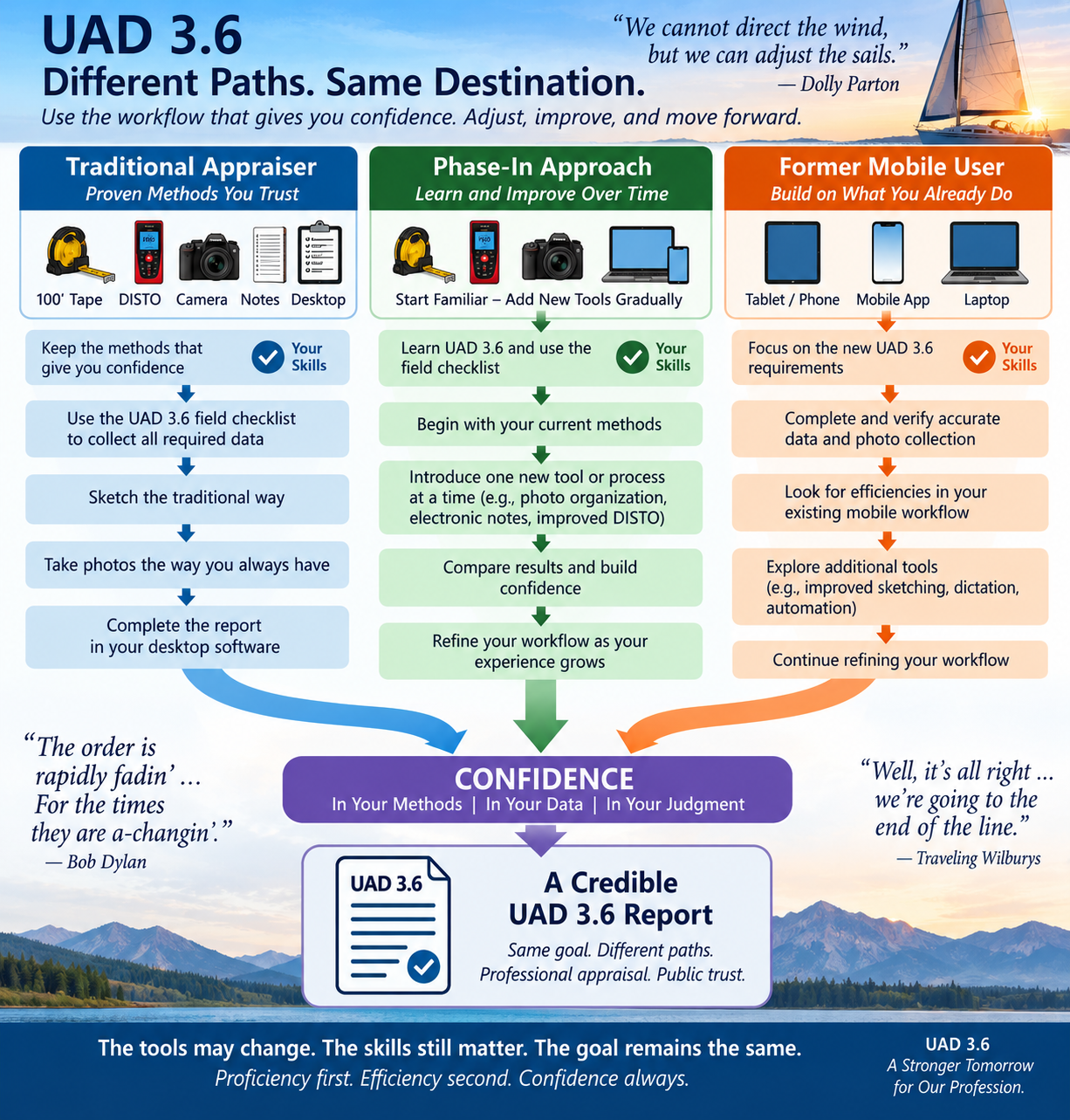
UAD 3.6 – A Phase-In Approach: Get the Report Done First
By Doug Smith, SRA
Editor’s Comments: It may be easier to follow the article below if you have Doug’s Excellent Graphic above to refer to. Doug is using the Phase-In approach so appraisers are not overwhelmed by UAD 3.6.Page 27, October, 2026
Doug used AI to generate the excellent image above. As you will read
below, he also includes when and how AI can be used by appraisers in many
aspects of appraising and appraisal business. He gives practical examples from what he does.
• Traditional Appraiser – Proven Methods – tape, Disto, Camera
• Phase-In Approach – Start with current methods and gradually add one new
tool or process at a time
• Former Mobile User – Focus on UAD 3.6 requirements, explore additional
tools (sketching, dictation, automation).
Much of the discussion about UAD 3.6 may be missing the central issue.
The concerns I keep hearing about software, tablets, measuring systems and
changing inspection procedures really come down to one thing:
confidence.
To read more about this topic, plus 2+ years of previous issues, subscribe to the paid Appraisal Today.
If this article helped you understand Learning to use UAD 3.6, it is worth the subscription price!
—————————————————————-
Not sure if you want to subscribe?
Sign up for monthly auto renewal for $8.25!
Cancel at any time for any reason!
You will receive a prorated refund.
$8.25 per month, $24.75 per quarter, and $89 per year (Best Buy)
or $99 per year or $169 for two years
Subscribers get FREE: past 18+ months of past newsletters
To purchase the Monthly Appraisal Today newsletter:
www.appraisaltoday.com/order or call 510-865-8041
What’s the difference between the Appraisal Today free Weekly email newsletters and the paid Monthly newsletter? Click here for more info
Cancel at any time for any reason!
You will receive a prorated refund.
$8.25 per month, $24.75 per quarter, and $89 per year (Best Buy)
or $99 per year or $169 for two years
Subscribers get FREE: past 18+ months of past newsletters
To purchase the Monthly Appraisal Today newsletter:
www.appraisaltoday.com/order or call 510-865-8041(Advisory Opinion)
==============================================
AO-41: TAF’s New Tech Guidance and What It Means
By Isaac Peck, Publisher WorkingRE
Excerpts: Every appraiser reading this is using technology tools in their assignments. MLS platforms, adjustment software, sketch tools like CubiCasa, data aggregation services, and increasingly, AI-powered platforms like Spark that do more of the analytical lifting. The question is not whether appraisers will use technology. The question is: what happens when a tool gets it wrong, and who is responsible?
In January 2026, the Appraisal Standards Board (ASB) at The Appraisal Foundation released an exposure draft of Advisory Opinion 41, Use of Technology in an Appraisal or Appraisal Review Assignment. AO-41 consolidates and replaces two existing Advisory Opinions: AO-18, which addressed AVMs in 1998, and AO-37, which addressed computer-assisted valuation tools in 2018. After two rounds of exposure and public comment, the ASB officially adopted AO-41 on April 23, 2026.
AO-41 is now the interpretive framework that state boards, regulators, GSEs, and opposing counsel will use when evaluating how an appraiser used technology in any assignment that comes under scrutiny.
Why AO-41 Exists
The ASB was direct about why AO-41 was necessary. In the introduction to the exposure draft, the Board wrote that “it is insufficient for appraisers to maintain only the skills and knowledge they possessed when they entered the profession” and that appraisers “must continuously improve their skills to remain proficient; this is especially true when new technological tools are introduced into the appraisal workflow.”
The existing guidance was built for a different era. AO-18 was published when AVMs were novel. AO-37 expanded the conversation to regression software and computer-assisted tools, but it predated generative AI, AI-powered adjustment software, and tools like CubiCasa. Neither anticipated the world appraisers are working in today.
One of the most practically important clarifications concerns what appraisers are not required to know. In Illustration Question 2 of the draft, the ASB states that “in most instances, an appraiser is not required to replicate or fully understand the technical algorithms underlying a statistical tool.” But you do need “sufficient knowledge and experience to use the tool competently, which means applying judgment in every case to interpret its output and determine whether reliance on it is appropriate.”
What This Means for Your Practice
For all the debate, AO-41 is not creating new liability out of thin air. It is putting into writing a standard of due diligence that thoughtful appraisers already follow. An appraiser who verifies a CubiCasa measurement against county records before relying on it is already doing what AO-41 describes. So is one who cross-checks adjustment software output against their own paired sales analysis, or who documents in the workfile why a particular adjustment was accepted or rejected.
To read more in this article, Click Here
To read AO-41, Click Here
My comments: Very comprehensive analysis of a topic where appraisers have wanted more guidance for a long time. Many thanks to Isaac Peck for writing this article!
The A0-41 document refers twice to the phrase “Artificial Intelligence”. I could not find any details, but they may be there somewhere.
==============================================
Certification 25 in UAD 3.6
Part 1 of 2 By Desiree Mehbod
Excerpts: Certification 25 made me realize that my refusal to participate in UAD 3.6 was justified long before I even knew what was buried in its certifications.
A peer sent me Phil Crawford’s new podcast episode this morning, and I opened it without thinking much of it because I had assumed his retirement from the show meant he was done weighing in on industry developments. I have been following the news and the chatter around 3.6, but I haven’t been preparing for it. I have not taken any UAD 3.6 classes, have not attended any seminars, have not tested the form, and have not sat down to study the certifications line by line
I know the broad strokes of 3.6 and I know exactly why I refuse to participate in it, but I have never examined the fine print. So when I started listening and heard Phil’s tone shift from casual conversation to genuine alarm, I realized immediately that he had found something significant. Once I saw the screenshots of Certification 25 and 26 that he was talking about, it became clear that I had missed a critical change simply because I had never looked closely at the new “form”.
Most appraisers who follow my writing already know that I will not touch UAD 3.6. I have said it repeatedly and without hesitation. I have written about the direction this profession is being pushed, the fixation on data extraction, and the slow dismantling of the appraiser’s role. I covered it in “Flags Over Facts: The Road to Obsolescence” and again in “The Appraisal Profession’s Perfect Storm: A Veteran’s Take on a Dying Craft“, and everything I wrote then feels even more relevant now. But even with all of that, I had not seen Certification 25. I had no idea that two sentences had been added that fundamentally alter the relationship between the appraiser, the report, and the data collected inside the home.
In UAD 2.6, Certification 21 already allowed lenders and agencies to distribute the appraisal report without the appraiser’s consent. It was broad and uncomfortable, but it did not breach USPAP confidentiality, so appraisers let it stand. The new version in 3.6 keeps that same language but adds something entirely different. It allows the entities who receive the appraisal report to store, copy, reproduce, analyze, use & distribute all of its data for internal or external purposes without ever obtaining the appraiser’s consent. It applies to the entire report, including assignment results and interior photographs. It is not limited to physical characteristics. It is not limited to non confidential information. It is not limited to facts. It is everything.
Phil’s reaction made sense. He pointed out that USPAP requires appraisers to take reasonable steps to protect confidential information, yet Certification 25 asks the appraiser to certify that once the report leaves their hands, the data can be replicated and redistributed indefinitely. He questioned how an appraiser could sign that and still claim to be compliant with the Ethics Rule. He also questioned how any appraiser could believe that the sentence claiming they have no liability for misuse of the report would actually protect them if something went wrong. A certification is not a contract. It is a unilateral statement. It does not shield you when a homeowner discovers their child’s bedroom photos circulating somewhere they never consented to.
To read more, watch Phil’s new Podcast video and read many appraiser comments, plus get more links, Click Here
=========================================
Cert 25 Dilemma: TAF Abdicates Its Role as Ethics Arbiter
(Part 2 of 2)
By Desiree Mehbod
With The Return of Phil Crawford’s Voice of Appraisal E276 – The Process and Politics of UAD 3.6! Certification #25
Excerpts: We finally have a direct written response from The Appraisal Foundation regarding the Cert 25 confidentiality crisis and it is a masterclass in bureaucratic buck passing.
A peer recently contacted TAF to ask how appraisers can remain compliant with the USPAP Ethics Rule while signing a form that opens the floodgates for data distribution. TAF basically hid under their desks. They claimed they cannot give legal advice and told us that questions about Cert 25 are best suited for Fannie Mae and Freddie Mac since they built the form.
For me, this episode confirmed what I have been saying for years. UAD 3.6 is not about clarity or modernization. It is about data. It is about building massive property information repositories that extend far beyond valuation. It is about turning appraisers into data collectors for systems that will outlive the assignment and outgrow the profession. Certification 25 is not a small tweak. It is a declaration that once the appraiser enters the home, everything they document can be stored, copied, reproduced, analyzed, used and redistributed without limitation.
Phil ended his episode by saying that if appraisers sign Certification 25 without challenge, they are agreeing to a new definition of confidentiality. I agree. This is not a technical update. It is a shift in the foundation of the profession. And if appraisers do not understand what they are certifying, they will find out later, when the consequences arrive, that they signed away far more than they realized.
To read more of this article, Click Here
To watch Phil Crawford’s Voice of Appraisal E276 – The Process and Politics of UAD 3.6! Certification #25, Click Here
My comments: Good to see Phil Crawford is finally back with his very interesting/controversial Youtube Podcasts!
A few days ago, a subscriber emailed me about Cert 25 problem. I had never heard about it at later checked appraisersblogs.com which had two recent articles about it – Labeled 1 and 2 above. Fortunately it had the text of Cert 25, included above, with the controversial section underlined.
==============================================
Analysis of 2026 ASC Appraisal License Data
By Chase Pursley
Excerpts: Last year we published ASC Data Analysis 2025: 66,715 unique active appraisers holding 91,290 licenses. This is the 2026 follow-up.
A September 2026 dump of the ASC Federal Registry shows 62,831 unique active appraisers holding 87,424 active licenses. Licenses are down 4.2% from 2025. The unique-person count is down 5.8%, but that is not a clean year-over-year comparison, because we rebuilt how “one appraiser” is counted (details below). Use the license count when comparing years.
National overview
2025 2026 Change
Active licenses 91,290 87,424 −3,866 (−4.2%)
Unique appraisers 66,715 62,831 −3,884 (−5.8%)*
Licenses per appraiser 1.37 1.39 +0.02
Most appraisers are still local: 93.9% hold licenses in one or two states (local), 5.4% in 3 to 9 states (regional), 0.7% in 10 or more (national). 16.1% hold licenses in more than one state, almost the same as last year’s 16.4%.
The profession did not shrink evenly. Certified General is essentially unchanged. The whole decline sits in residential: Certified Residential down almost 7%, Licensed down 11%. Licensed is now 6.6% of licenses, down from 7.2% last year.
Counted as people, by the highest license level each one holds, the mix looks more residential, because one Certified General appraiser often holds many state licenses.
The short version
• Fewer licenses (−4.2%), almost entirely residential. Certified General held steady.
• Florida grew and passed Texas in unique licensed appraisers. California shrank.
• The unique-person count is tighter, because Stage 1 splits same-name people when the file has a middle initial, home state, or suffix, and Stage 2 only folds pairs the model (or a human) trusts. Code: github.com/cpursley/asc_data .
• **effective_date** is not the year someone entered the profession. A long list of states reports the current renewal cycle instead.
• 32.5% of addressed licenses are out of state. DC is a reciprocity hub with a small resident workforce. California is local.
• Texas sends no addresses, so city and ZIP maps will keep misplacing Dallas and Houston until that changes.
• Residential appraisers live in suburban and rural ZIPs. The city-limit table is a commercial overlay.
To read a lot more details and analysis, Click Here
My comments: I am not surprised at the results. Residential lender is less appealing, expescially UAD 3.6. Many res appraisers are retiring or quitting. (Don’t forget to get E&O “tail coverage” from your E&O provider so you will be covered when you did appraisals prior to leaving appraisal.)
Thanks to Chase for doing this article. When I started appraising 50 years ago, no one knew how many appraisers there were. With licensing, it was easy to find out.
Licensing is only required for FRTs – Federally related transactions. This typically applies to lender appraisals.
California is not a mandatory state. For example, assessor appraisers are not required to be state licensed. Licensing is not required if you only do non-lender appraisals. But, there is some “talk” by the state regulator about including assessor appraisers (to increase income for the state regulator).
Many states are mandatory. All their appraisers must be state licensed.
The article includes many technical details as well as more analyses, top states and regions, and more.
I have known Chase for a long time. He is very savvy, has good analyses, and is very knowledgeable.
==============================================
MY UAD 3.6 UPDATE – Exceptions and Timeline, VA
I wrote abut the exceptions last week. But the notice went out early September 30, so had little time to research the topic.
I recently attended a webinar on exceptions. The speaker was Lyle Radke.
Sellers are lenders that sell their loans directly to to GSEs. There are about 1,200 of them. Exception requests are coming in fast, so there is no good data on how many will use it. Exception request requirements are strict and not easy to complete, especially if the lender is not ready to make loans yet.
Lenders, such as your local bank and small mortgage companies, are not Sellers and cannot sell their loans directly to the GSEs. I assume that they will sell their loans to one of the Sellers, who will sell their loans to the GSEs. I assume the lenders will tell their appraisers if they need 3.6 or 2.6 appraisals
Only about 50% of mortgage loans are sold to the GSEs, so there are many lenders today who will not using UAD 3.6 reports. Some lenders, such as credit unions, hold their loans in their portfolios, typically Home Equity loans and other similar loans.
Timeline:
• Nov 2, 2026 – May 19, 2027: Approved exception holders may submit legacy UAD 2.6 reports.
• March 1, 2027: Lenders still using UAD 2.6 face reduced functionality (e.g., risk score penalties) and lose representation/warranty relief.
• May 20, 2027: UAD 3.6 becomes strictly mandatory for all new appraisals.
• June 28, 2027: Complete retirement and cessation of UAD 2.6 processing.
What does this mean for appraisers?
Be sure your client is clear on what type of appraisal they need now: 2.6 or 3.6 and when it is needed. Will they need a 3.6 later if they need a 2.6 now? Get it in writing. Are they a Seller? Or plan to sell the loan to a Seller?
What about AMCs?
I don’t have any information now, but they will have to find out what type of appraisals their lender clients want.
How many 3.6 appraisals are being ordered now?
In the webinar above, with over 300 attendees, about 60% had not received any 3.6 requests. Why? Sellers and lenders are not ready. Most likely to be ready are the largest of the 1,200 Seller lenders.
Lenders are finding it difficult to find appraisers for all the locations where they work, especially if they are national lenders
Lenders Need Appraisers! Hopefully the “System” will start working to handle more Sellers.
Why have a deadline of November 2, 2026
Without a deadline, you will do less, per Radke.
Appraisers vs. lenders getting set up
Appraisers just have to learn how to use one UAD 3.6 software program. It usually takes doing 3-5 or so appraisals. For example: get a trial subscription to SFREP software which is relatively easy to learn. You don’t need an inspection app to get started. You can add it later. Do inspections the way you always have. Use the inspection checklists on my Paid subscriber web pages. SFREP may have an inspection checklist.
Lenders have the change their entire lending stystem to accomodate 3.6 and 2.6 appraisals, including reviews, deciding which type of appaisal to requests, etc.
—————————————————————
VA comments
Per Radke, VA was involved in a working group for 3.6. They have specfic needs and are a government agency. GSEs are not. The “VA Chief Appraiser said they plan to adopt but do not have a settled timeline”
” They do things at the own pace and way.”
FYI there are no issued with appraisal fees in VA appraisals. They set the fees in specific areas.
Another Radke comment
No 1004d – 3.6 already has inspection, repairs, and recertification of Value.
==============================================
HOW TO USE THE NUMBERS BELOW. Appraisals are ordered after the loan application. These numbers tell you the future for the next few weeks. For more information on how they are compiled, click here.
Note: I publish a graph of this data every month in my paid monthly newsletter, Appraisal Today. For more information or get a FREE sample go to www.appraisaltoday.com/order Or call 510-865-8041, MTW, 7 AM to noon, Pacific time.
My comments: Rates are going up and down in 2026.
Mortgage applications decreased 6.0 percent from one week earlier
WASHINGTON, D.C. (September 30, 2026) — Mortgage applications decreased 6.0 percent from one week earlier, according to data from the Mortgage Bankers Association’s (MBA) Weekly Mortgage Applications Survey for the week ending September 25, 2026.
The Market Composite Index, a measure of mortgage loan application volume, decreased 6.0 percent on a seasonally adjusted basis from one week earlier. On an unadjusted basis, the Index decreased 6 percent compared with the previous week. The Refinance Index decreased 9 percent from the previous week and was 56 percent lower than the same week one year ago. The seasonally adjusted Purchase Index decreased 4 percent from one week earlier. The unadjusted Purchase Index decreased 5 percent compared with the previous week and was 14 percent lower than the same week one year ago.
“Mortgage rates jumped to their highest level in almost three years, pushing borrowers to the sidelines. The 30-year fixed rate increased for the sixth consecutive week to 7.3 percent, the highest rate since November 2023,” said Joel Kan, CMB, MBA’s Vice President and Deputy Chief Economist. “Mortgage applications fell by 6 percent due to the recent surge in rates, with purchase and refinance applications both declining to their slowest weekly pace since 2025. Government refinances declined 13 percent, with both FHA and VA applications experiencing double digit decreases over the week.”
Added Kan, “ARM loans, with rates around 80 basis points lower than fixed rate loans, accounted for 10.3 percent of applications, the highest share since October 2025.”
The refinance share of mortgage activity decreased to 38.3 percent of total applications from 39.3 percent the previous week. The adjustable-rate mortgage (ARM) share of activity increased to 10.3 percent of total applications.
The FHA share of total applications remained unchanged at 16.7 percent from the week prior. The VA share of total applications decreased to 11.9 percent from 12.0 percent the week prior. The USDA share of total applications decreased to 0.5 percent from 0.6 percent the week prior.
The average contract interest rate for 30-year fixed-rate mortgages with conforming loan balances ($832,750 or less) increased to 7.30 percent from 7.12 percent, with points increasing to 0.75 from 0.73 (including the origination fee) for 80 percent loan-to-value ratio (LTV) loans. The effective rate increased from last week.
The average contract interest rate for 30-year fixed-rate mortgages with jumbo loan balances (greater than $832,750) increased to 7.27 percent from 7.15 percent, with points decreasing to 0.50 from 0.53 (including the origination fee) for 80 percent LTV loans. The effective rate increased from last week.
The average contract interest rate for 30-year fixed-rate mortgages backed by the FHA increased to 6.97 percent from 6.78 percent, with points increasing to 1.18 from 0.96 (including the origination fee) for 80 percent LTV loans. The effective rate increased from last week.
The average contract interest rate for 15-year fixed-rate mortgages increased to 6.56 percent from 6.43 percent, with points decreasing to 1.02 from 1.15 (including the origination fee) for 80 percent LTV loans. The effective rate increased from last week.
The average contract interest rate for 5/1 ARMs increased to 6.47 percent from 6.10 percent, with points increasing to 1.20 from 0.76 (including the origination fee) for 80 percent LTV loans. The effective rate increased from last week.
The survey covers U.S. closed-end residential mortgage applications originated through retail and consumer direct channels. The survey has been conducted weekly since 1990. Respondents include mortgage bankers, commercial banks, thrifts, and credit unions. Base period and value for all indexes is March 16, 1990=100.
==============================================
 Ann O’Rourke, MAI, SRA, MBA
Appraiser and Publisher Appraisal Today
1826 Clement Ave. Suite 203 Alameda, CA 94501
Phone: 510-865-8041
Email: ann@appraisaltoday.com
Online: www.appraisaltoday.com
We want to know what you think!! Please leave a comment.