
Newz: GSEs Request Feedback on UAD 3.6, Defending Adjustments
September 4 , 2026
What’s in This Newsletter (In Order, Scroll Down)
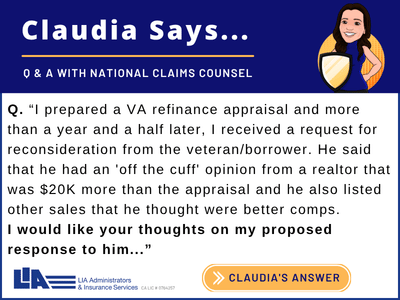
- LIA AD: Too Late for a Reconsideration of Value
- How to Defend Adjustments in Appraisal Reports
- $112 Million Laguna Beach Mansion With a Private Library and a Rotating Bed in Primary Suite Could Become Priciest Home Ever Sold in Orange County
- GSEs Request Appraiser Feedback on UAD 3.6
- MY AD: How AI Can Help Residential Appraisers and Why Appraisers Will Always be Needed By By David Galatto
- First the Borrower Fee. Now the Appraiser Compensation in Court By Kenneth J. Mullinix
- The part of the process appraisers never see, and the reason your file keeps coming back
- UAD 3.6 UPDATE – Inspection Checklist, New Survey: UAD 3.6 mandate is Nov. 2nd. Are you ready for it?,
- MBA STATS: Mortgage applications increased 0.8 percent from one week earlier
————————————————————————–
How to Defend Adjustments in Appraisal Reports
When someone questions an adjustment, many appraisers respond, “It’s based on market data” or “my experience in the market.” These statements might be true, but they don’t support the adjustment. They just state where it came from.
Appraisal reports are similar to scientific papers. A scientist can’t write “Based on my experiments, the hypothesis is correct” and expect peer review to accept it. Scientists need to share their methodology, summarize their analysis, and support their conclusions.
The same applies to appraisal adjustments. Saying you used market data is like saying you conducted an experiment. It’s just the starting point. Your report needs to summarize how you analyzed the data and how it supports that specific adjustment.
Without this documentation, you haven’t provided credible analysis. You’ve stated an unsupported opinion, regardless of your experience.
You need a clear path from market evidence to the number on your grid. Defending appraisal adjustments isn’t one perfect technique. It’s about using multiple, credible methods, explaining your logic, and sequencing your work so it aligns with how the market behaves and with USPAP.
Below is a practical, step-by-step approach you can put to work right away.
Start with the Right Sequence
Before you calculate any adjustment, get the order right. In practice, you should follow this sequence:
- Apply transactional adjustments:
- Real property rights conveyed
- Financing terms
- Conditions of sale
- Expenditures made after purchase
- Market conditions (time)
- Apply property adjustments:
- Location
- Physical characteristics (e.g., finished square footage, bathrooms, garages, condition, quality)
Transactional adjustments affect the overall transaction price, and each adjustment creates a new base for the next one. They answer the question, “What would this comparable have sold for under typical terms on my effective date?”
These adjustments normalize the sales by removing distortions from unusual financing, non-market conditions, or time differences.
Equalize Market Conditions Before You Compare
——————————————————————-
Appraiser Survey: Which Approach Is Most Effective for Explaining Adjustments?
The top two appraiser survey answers, by far, were “Backing adjustments with strong market data and analysis,” and “Writing detailed, transparent commentary within the report.” These results help reinforce the idea that defensible adjustments are all about good development and clear reporting. To read more, Click Here
My comments: Worth reading. Excellent article covering the important topics. The practical sections:“ Mini Example” and “Show Reviewers” are very good.
This article is updated from a 10/25 newsletter. I have never been questioned about an appraisal adjustment. Quit doing residential Lender appraisals in 2025.Read the full article to see a graph of Which Approaches are Effective” for more details.
—————————————————————–

$112 Million Laguna Beach Mansion With a Private Library and a Rotating Bed in Primary Suite Could Become Priciest Home Ever Sold in Orange County
Excerpts: 8 bedrooms, 12.5 baths, 14,443 sq.ft., 1.02 acres, Built in 1994Highlights found throughout the landmark compound include more than an acre of direct beachfront access, a Fred Briggs-designed primary residence, more than 2,000 feet of oceanfront terraces, and resort-inspired amenities, including a pool and spa.
Other lavish details include a gourmet kitchen with professional-grade appliances, a sculptural spiral staircase with glass floor leading to a library appearing to float above the Pacific, and a primary retreat “unlike any other” with a rotating bed tucked away “beneath an operable ceiling that opens to the stars.”
The 1.02-acre property also has a private cinema, a wine cellar, a wellness retreat with fitness studio, sauna, and rock waterfall, a two-bedroom guest house, an eight-car garage with catering kitchen, a private amphitheater, and an ocean-facing championship tennis court.
To read the listing with 60 photos, Click Here
———————————————————————
GSEs Request Appraiser Feedback on UAD 3.6
Are you ready for the transition to the Uniform Appraisal Dataset (UAD) 3.6 and the redesigned Uniform Residential Appraisal Report? Fannie Mae and Freddie Mac (the GSEs) are surveying appraisers to better understand current readiness across the industry.
Please complete the survey by Friday, Sept. 11, 2026.
To Take the Survey, Click Here
Share Your Feedback
Thank you for your time and partnership.
The GSEs
Doug Smith Comments: The questions are very revealing. I think this is a clear indication they will announce a moratorium and November 2 is no longer the deadline! My question is did they send a version to the lenders.
My comments: See the recent Survey results in the UAD UPDATE at the end of this newsletter. Very interesting results!
I took the GSE survey. Does not take very long. They got the important questions of what appraisers think. I hope we get the results.In my last weekly newsletter, the subject line included No Body is Ready for UAD 3.6, a report on the recent National Conference. Well written.
To read the No Body Is Ready article, Click Here
————————————————————–
Are you getting too many ad-only emails?
4 ways to get only the FREE email newsletters and NOT the ad-only emails.
1. Twitter: https://twitter.com/appraisaltoday Posted by noon Friday
2. Read on blog www.appraisaltoday.com/blog Posted by noon Friday. You can subscribe to the blog in the upper right of each blog page. NOTE: the popular ads with liability tips are below the first topic on my blog posts.
3. Email Archives: https://appraisaltoday.com/archives(posted by noon Friday) The link is above and to the left of the big yellow email signup form. Newsletters start with “Newz.” Contains all recent emails sent.
4. Link to the 10 most recent newsletters (no ads) at www.appraisaltoday.com. Scroll down past the big yellow signup block.
The newsletters have abbreviated titles, taken from their blog posts.
To read more about the 4 ways, plus information on why I take ads, etc. Click here
————————————————–
If you are a paid subscriber and did not receive the September 2026 issue emailed on Tuesday September 2, 2026 please email info@appraisaltoday.com, and we will send it to you.
You can also hit the reply button. Be sure to include a comment requesting it. Or, call 510-865-8041
———————————————————–

First the Borrower Fee. Now the Appraiser Compensation in Court
By Kenneth J. Mullinix, a California Certified Residential Appraiser
Most appraisal disputes examine only one part of the transaction. Two pending lawsuits involving Class Valuation, LLC approach the appraisal process from opposite directions. One asks whether staff appraisers were properly compensated for overtime. The other asks whether a homeowner was properly informed about how an appraisal-related fee was divided.
The cases are legally separate. They involve different plaintiffs, statutes, and courts, and neither has produced a finding that Class Valuation violated the law. Viewed together, however, they raise a question the appraisal profession has asked for years: When a borrower pays one appraisal-related fee, how much reaches the appraiser, how is the appraiser compensated, and how clearly is the remaining charge explained?
Accessing Online Public Court Records
For La Rica Golar, those questions moved beyond professional frustration and into federal court. Her lawsuit under the Fair Labor Standards Act seeks relief for herself and other similarly situated Class Valuation staff appraisers. La Rica Golar’s Lawsuit Golar v. Class Valuation, LLC was filed March 12, 2026, in the U.S. District Court for the Northern District of Georgia.
The complaint seeks to proceed as an FLSA collective action and alleges that Class paid staff appraisers under salary and production or piece-rate arrangements, exercised substantial control over their schedules and assignments, maintained records relating to their work, and failed to pay the overtime compensation allegedly required for hours exceeding 40 in a workweek.
To read more, Click Here
My comments: Many details of other issues included in article.
—————————————————————-
The part of the process appraisers never see, and the reason your file keeps coming back (Review!)
By Joe Pravettone, AMC Chief Appraiser
Excerpts: To upload the report, hit send, and head to the next inspection. As far as you’re concerned, the job’s finished. Truth is, it’s only finished on your end.
From there, your report starts a journey most appraisers never get to see. It lands in an AMC review queue, gets picked apart by automated QC looking for anything that doesn’t match MLS or public records, gets compared against a title report you probably never saw, and eventually lands on an underwriter’s desk, where every assumption has to be documented and defended.
That’s four different checkpoints, and every one of them has the power to kick the file back.
If you’ve never sat on the other side of that process, you’re working with a blind spot. I’ve been lucky, or unlucky, depending on how you look at it. I’ve worked those seats. I know what reviewers are looking for, what underwriters worry about, and why perfectly good appraisals sometimes turn into three days of revision requests, frustrated loan officers, and unnecessary headaches for everyone involved.
Revisions versus credibility problems
Here is a distinction that matters more than the appraisal community likes to admit. Some things that come back are clerical. It’s a missing photo, a soft explanation, an exhibit that did not upload. These things are annoying, but fast to fix, often forgotten by Friday.
Other things that come back are credibility problems, and those follow you.
Condition ratings are probably the biggest one. vice on how to avoid common pitfalls so your appraisal can sail through the process and you can move on to the next job.
To read more, Click Here
My comments: Worth reading. Advice from an appraiser who has been on both sides.
———————————————————
UAD 3.6 UPDATE – Inspection Checklist, Appraiser Survey – Are you ready for Nov. 2?
This is by far the best checklist I have seen so far. It is so good, some may be able to use this instead of mobile.
For appraisers concerned that UAD 3.6 requires taking a tablet into the field, this excellent UAD 3.6 Property Inspection Field Checklist — Beginner Edition demonstrates otherwise. It organizes the required observations into a practical paper-based workflow—Always, If Applicable, and Verify Later—that can be completed in the field and transferred to desktop software afterward.
The author of the Checklist is Matt Barczewski, a Certified Residential Real Property Appraiser based in Milford, DelawareI joined my father’s practice as a trainee in 2016, continuing a family appraisal tradition that includes my grandfather, a Realtor and MAI, and my father, who has more than 40 years of appraisal experience. He is also a Realtor and recently completed his term as head of the Delaware appraisal council.To download the PDF Checklist: Click Here
————————————————————–
Appraisal Buzz Survey UAD 3.6 mandate is Nov. 2nd. Are you ready for it?
Editor’s Note: only a pie chart image with no percentages indicated in the original version.
By Doug Smith:
I was able to calculate the approximate percentages from the pie chart in the Appraisal Buzz poll:1.6% — Yes, I’m already doing them.7.0% — Yes, I just need my first order.24.7% — No, but I will be when the mandate comes.66.7% — No, I’m banking on them moving it to next year anyway.The percentages are calculated from the proportions of the published pie chart, so they are estimates rather than numbers supplied by Appraisal Buzz.The interesting takeaway is that only about 8.6% appear ready now, while 91.4% say they are not yet ready. Most striking, about two-thirds are banking on the November 2 mandate being moved.
——————————————————————
HOW TO USE THE NUMBERS BELOW. Appraisals are ordered after the loan application. These numbers tell you the future for the next few weeks. For more information on how they are compiled, Click Here.
Note: I publish a graph of this data every month in my paid monthly newsletter, Appraisal Today. For more information or get a FREE sample go to www.appraisaltoday.com/order Or call 510-865-8041, MTW, 7 AM to noon, Pacific time.
My comments: Rates are going up and down. We are all waiting for rates to drop lower in 2027.
Mortgage applications increased 0.8 percent from one week earlier
WASHINGTON, D.C. (September 2, 2026) — Mortgage applications increased 0.8 percent from one week earlier, according to data from the Mortgage Bankers Association’s (MBA) Weekly Mortgage Applications Survey for the week ending August 28, 2026.
The Market Composite Index, a measure of mortgage loan application volume, increased 0.8 percent on a seasonally adjusted basis from one week earlier. On an unadjusted basis, the Index decreased 1 percent compared with the previous week. The Refinance Index decreased 1 percent from the previous week and was 19 percent lower than the same week one year ago.
The seasonally adjusted Purchase Index increased 2 percent from one week earlier. The unadjusted Purchase Index decreased 0.3 percent compared with the previous week and was 0.2 percent lower than the same week one year ago.
“Mortgage rates reached their highest levels in four weeks as investors’ concerns about inflation and growing deficits push yields higher across the globe,” said Mike Fratantoni, MBA’s SVP and Chief Economist. “Refinance volume dropped in response, but purchase volume increased modestly over the week and was slightly below last year’s level. In many local markets, potential buyers have plenty of homes to choose, and this is likely supporting transaction volume. Another trend we’re monitoring is more borrowers choosing ARMs, with the ARM share back to 8 percent last week, its highest level in 5 weeks.”
The refinance share of mortgage activity decreased to 41.8 percent of total applications from 42.0 percent the previous week. The adjustable-rate mortgage (ARM) share of activity increased to 8.0 percent of total applications.
The FHA share of total applications decreased to 15.9 percent from 16.2 percent the week prior. The VA share of total applications increased to 13.6 percent from 12.8 percent the week prior. The USDA share of total applications remained unchanged at 0.5 percent from the week prior.
The average contract interest rate for 30-year fixed-rate mortgages with conforming loan balances ($832,750 or less) increased to 6.79 percent from 6.78 percent, with points decreasing to 0.65 from 0.66 (including the origination fee) for 80 percent loan-to-value ratio (LTV) loans. The effective rate increased from last week.
The average contract interest rate for 30-year fixed-rate mortgages with jumbo loan balances (greater than $832,750) increased to 6.76 percent from 6.73 percent, with points decreasing to 0.40 from 0.50 (including the origination fee) for 80 percent LTV loans. The effective rate decreased from last week.
The average contract interest rate for 30-year fixed-rate mortgages backed by the FHA increased to 6.49 percent from 6.46 percent, with points remaining unchanged at 0.82 (including the origination fee) for 80 percent LTV loans. The effective rate increased from last week.The average contract interest rate for 15-year fixed-rate mortgages increased to 6.14 percent from 6.10 percent, with points decreasing to 0.86 from 0.90 (including the origination fee) for 80 percent LTV loans. The effective rate increased from last week.
The average contract interest rate for 5/1 ARMs decreased to 5.94 percent from 5.98 percent, with points decreasing to 0.66 from 0.88 (including the origination fee) for 80 percent LTV loans. The effective rate decreased from last week.
The survey covers U.S. closed-end residential mortgage applications originated through retail and consumer direct channels. The survey has been conducted weekly since 1990. Respondents include mortgage bankers, commercial banks, thrifts, and credit unions. Base period and value for all indexes is March 16, 1990=100.
————————————————————–
 Ann O’Rourke, MAI, SRA, MBA
Publisher Appraisal Today
1826 Clement Ave. Suite 203 Alameda, CA 94501
Phone: 510-865-8041
Email: ann@appraisaltoday.com
Online: www.appraisaltoday.com
We want to know what you think!! Please leave a comment.