
Newz: Appraiser AMC Survey, AMCs: How Tech Quietly Sabotages Appraisers
November 6, 2026
ARTICLE LIST – In order, Scroll down to read
- LIA AD: Read The Fine Print
- Independent Appraiser Voices plus Survey: More in Common Than We Think
- Inside a Marvel Showrunner’s $2.4 Million Topanga California Compound Featuring a 1970s Geodesic Dome and Private Oak Grove
- Helping Appraisers Get Paid for What They’ve BuiltBy Isaac Peck, Publisher, WorkingRE
- My Ad: Major Changes in Fannie Mae’s HBU Property Eligibility Requirements (Effective With UAD 3.6), By Denis Desaix, MAI, SRA
- Countdown in Chicago: UAD 3.6, AI, and Rates Going Up? MBA 2026 Recap, By Jim Morrison
- The Full Measure: October 2026 Housing Market Update, By Kevin Hecht, Appraiser and Economist
- The Ghost in the Machine: How Tech Quietly Sabotages Appraisers, By Desiree Mehbod
- Appraisers face stagnant pay and rising costs as AMCs defend their fees and new technology reshapes the industry
- Mortgage Applications Decrease 1.2 Percent in Latest MBA Weekly Survey
Thanks to our Sponsor!!!
Very reasonable prices and good open rates!

———————————————————————–
Independent Appraiser Voices: More in Common Than We Think and and AMC Appraiser Survey
Independent Appraiser Voices is breaking the silence on unfair AMC fees and UAD 3.6 struggles to prove that while we may work independently, we don’t have to face these industry battles alone.
Excerpts: Independent Appraiser Voices is breaking the silence on unfair AMC fees and UAD 3.6 struggles to prove that while we may work independently, we don’t have to face these industry battles alone.
If you’ve been an independent appraiser for any length of time, you’ve probably asked yourself, more than once, “How much more am I expected to take on without being compensated for it?”
Between rising business expenses, increasingly complex assignments, unrealistic deadlines, and AMC fees that often seem disconnected from the work involved, there’s plenty to be frustrated about.
And now we have UAD 3.6. We can probably all agree that the UAD 2.6 forms were due for an update, but is this really the improvement we needed?
We know these frustrations because we’re dealing with them, too. And they’re exactly what inspired Independent Appraiser Voices (IAV). BookAppraisals
IAV is a brand-new, independent grassroots initiative created by working appraisers who believe it’s time to do more than vent about these problems individually. We’re boots-on-the-ground appraisers, just like you, trying to make a living while navigating the same challenges.
There are already people around the country advocating for change in our profession, and we share those goals. We want to bring independent appraisers together, identify the concerns we have in common, and turn our shared experiences into a stronger, more unified voice.
Our first step is the 2026 Independent Appraiser Survey: UAD 3.6, AMC Fees & Industry Concerns.
The survey is anonymous and covers compensation, UAD 3.6, AMC practices, unpaid time, and other industry concerns. There’s no membership, no fee, and nothing being sold. We simply want to hear directly from appraisers across the country.
The survey is anonymous and covers compensation, UAD 3.6, AMC practices, unpaid time, and other industry concerns. There’s no membership, no fee, and nothing being sold. We simply want to hear directly from appraisers across the country.
Our intention is to use the findings to document common concerns, support advocacy for meaningful change, and encourage greater cooperation among independent appraisers. We’ll share the results with the appraisal community and be transparent about what the data does and doesn’t tell us.
To read more, Click Here
To take the survey, Click the link in the article.
My comments: The survey seems like a good idea. I always like to read the survey results. I have never worked for an AMC so did not take the survey.

Inside a Marvel Showrunner’s $2.4 Million Topanga California Compound Featuring a 1970s Geodesic Dome and Private Oak Grove
Excerpts: 4 bedrooms, 4 baths, 1,547 sq.ft., 0.76 acre lot, Built in 1935
Built in 1935, the “thoughtfully cared for” 1,547-square-foot sanctuary boasts stone pathways, footbridges, and a seasonal creek. It is located in the Post Office Tract near Topanga State Park.
“What makes this property so special is its setting within a private oak grove,” says listing agent Nina Kurtz of Compass. “It genuinely feels like having your own private park.”
That private-park feel extends across the compound, which includes a two-bedroom primary residence and additional living space.
According to public records, the four-bedroom property is currently owned by Hollywood writer and producer Andrew Guest, co-creator, showrunner, and executive producer of Marvel’s “Wonder Man.” Guest purchased the property for $2.75 million in 2022.
Expansive windows were designed to frame the lushly landscaped lot and bring the outdoors into the living spaces.
To see the listing with an aerial view and 54 photos, Click Here
My comment: I would love to live in a private Oak Grove fully landscaped with a seasonal creek, house, and a Geodesic Dome. Before the Gold Rush from 1848 to 1855 my city was full of oak trees. Over time, most were torn down and Alameda became a suburb of San Francisco, 10 miles away with access via ferry boats.
I often think of the original native inhabitants, the Ohlone, who traveled to Alameda for oak tree acorns and access to San Francisco Bay with fish and shellfish.
Our pickleball courts are in a park and used to have a large oak tree that offered shade when it was hot. A large branch broke off and fell on part of our courts. We miss the large oak branch with the shade it provided. Large umbrellas are not the sameI
————————————————————-
Helping Appraisers Get Paid for What They’ve Built
by Isaac Peck, Publisher, WorkingRE
Excerpts: Most appraisal shops are one-person operations. The specter of the lone appraiser running their business in a spare bedroom and not socializing much with their peers has persisted for decades — and there’s certainly some truth to it.
However, one of the downsides to a solo-operator business model, especially with service businesses like appraisal, is that when it comes time to retire, these types of businesses are rarely saleable. With no (or few) assets, no staff and little goodwill outside of the name of the principal, most solo appraisers build their businesses for decades and then simply flip the light switch and shut the door on their business.
Bryan Reynolds wants to change all that.
A certified general appraiser, partner at Appraiser eLearning, host of The Appraisal Update Podcast, owner of Reynolds and Associates, and a partner at his two newest ventures — Legacy Appraisal and Consulting and Legacy Advisors and Consulting — Reynolds is a serial entrepreneur.
His latest ventures are particularly interesting and arguably well-timed, given everything the profession is facing.
Entering and Exiting the Profession
Reynolds sees real opportunity in simultaneously helping folks enter the profession, as well as working with appraisers who are about to step back and retire.
“Our vision is to help appraisers enter the profession and exit the profession,” Reynolds says. “What do most appraisers do when they’re ready to retire is they turn their light off and close the door. Their book of business, which in many cases represents 30 to 40 years of careful nurturing, just evaporates. They don’t get paid for it or rewarded in any way. We would like to help keep their legacies alive.”
Instead of just shutting the door, Reynolds explains that Legacy Advisors and Consulting is working with appraisers to set up an exit strategy that allows them to receive compensation for the first three to five years of retirement.
“We will ask them to stay with the company for a prescribed period of time,” Reynolds says. “Then we will put someone in their market, as well as our administrative and support team based out of western Kentucky. Basically, we want to see another appraiser step in and become them in that local market.”
Reynolds’ strategy requires the exiting appraiser to remain with the company for 12 to 18 months. If they want to retire, however, Reynolds requests they call a year in advance. Several interested appraisers have already reached out.
“I just talked to an appraiser who asked me, ‘What about the VA? I’m a VA appraiser. VA selects me to do the appraisal. How can I transition this business?’” Reynolds says. “Our position is that for every problem there is a solution.
Helping Train New Appraisers, Too
Reynolds also wants to help new entrants to the profession find their feet and get started. Legacy Advisors and Consulting is also licensing Melissa Bond’s MPact Practicum coursework, a successful appraiser curriculum.
Appraisers thinking about an exit strategy, and anyone looking at the training pathway, can find more at LegacyAppraisalandConsulting.com and LACappraiserpathway.com, or email info@LACappraiserpathway.com. Reynolds can be reached directly at Bryan@theLegacyAG.com.
To read more, Click Here
My comments: When I have written about selling your appraisal business (or spoken with appraisers), I have always said the best people are those working for you. Selling a one person appraisal business seldom happens. Sometimes if you’re in a vacation location an appraiser may be interested in locating. Or, a competitor may want to purchase it.
I have spoken with buyers and sellers of appraisal businesses. It is not easy for the buyer or the seller, even if you have employees and are well established. Staying over for a transition period is very common.
Selling a Commercial may be easier than residential. Over the years I have seen many larger commercial appraisal companies that expand by buying (or merging with) other local commercial appraisal companies.
Since I have been writing about this, over time several national appraisal firms merged with other commercial appraisal firms.
————————————————————-
Are you getting too many ad-only emails?
4 ways to get only the FREE email newsletters and NOT the ad-only emails.
1. Twitter: https://twitter.com/appraisaltoday posted by noon Friday – all recent newsletters
2. Read on blog www.appraisaltoday.com/blog Posted by noon Friday. You can subscribe to the blog in the upper right of each blog page.
3. Email Archives: https://appraisaltoday.com/archives
(posted by noon Friday) The link is above and to the right of the big yellow email signup form. Newsletters start with “Newz.” Contains all recent emails sent.
4. Link to the 10 most recent weekly newsletters (no ads) at www.appraisaltoday.com. Scroll down past the big yellow signup block.
To read more about the 4 ways, plus information on why I take ads, etc. Click here
———————————————————
Major Changes in Fannie Mae’s HBU Property Eligibility
Requirements (Effective With UAD 3.6),
By Denis Desaix, MAI ,SRA
In the November 2026 issue of Appraisal Today
Excerpts: In September of 2026, Fannie Mae (FNMA) announced major changes in their property eligibility standards regarding highest and best use (HBU) conclusions reported in the appraisal.
I was asked by Fannie to be a Policy Advisor on this matter and had a preview of the changes that have since been announced. I say this so I can affirm, with credibility, that a lot of thought has gone into the changes and
how they affect not only the appraisal process but the entire 1- to 4-unit residential lending production process.
In this article, I will discuss the new HBU policy and review the examples that Fannie uses to illustrate how the new policy can affect property eligibility which, in turn, can affect how we analyze and report our value opinions in our appraisal reports.
Please note that these changes apply to UAD 3.6 Appraisal Assignments only!!
The impact on lending is easy to describe: Certain properties that were previously ineligible for Fannie purchase are now eligible.
The impact on appraisers is also easy to describe:
To conclude a credible HBU opinion for some properties, a deeper level of analysis will be necessary.
This is not a bad thing for appraisers as the more complex the property, the less likely an alternative valuation tool can be used
To read more about this new UAD 3.6 change, plus 2+ years of previous issues, subscribe to the paid Appraisal Today.
If this article helped you understand this Fannie change, it is worth the subscription price!
—————————————————————-
Not sure if you want to subscribe?
Sign up for monthly auto renewal for $8.25!
Cancel at any time for any reason!
You will receive a prorated refund.
$8.25 per month, $24.75 per quarter, and $89 per year (Best Buy)
or $99 per year or $169 for two years
Subscribers get FREE: past 18+ months of past newsletters
To purchase the Monthly Appraisal Today newsletter:
www.appraisaltoday.com/order or call 510-865-8041
What’s the difference between the Appraisal Today free Weekly email newsletters and the paid Monthly newsletter? Click here for more info
Cancel at any time for any reason!
You will receive a prorated refund.
$8.25 per month, $24.75 per quarter, and $89 per year (Best Buy)
or $99 per year or $169 for two years
Subscribers get FREE: past 18+ months of past newsletters
To purchase the Monthly Appraisal Today newsletter:
www.appraisaltoday.com/order or call 510-865-8041
————————————————–
Countdown in Chicago: UAD 3.6, AI, and Rates Going Up? MBA 2026 Recap – October 11-14, 2026
By Jim Morrison
Excerpts: he Mortgage Bankers Association Annual is always one of the best places to find out what is coming for the industry.
This year in Chicago, one topic was on almost every agenda: UAD 3.6. With the mandate only weeks away, lenders, GSEs, AMCs, and technology providers spent the week comparing notes on what is working, what isn’t, and what happens next. Add a market that still hasn’t turned the corner, a lot of conversation about AI, and a former President on the main stage, and it made for a busy few days.
Here are the sessions that matter most for lenders and appraisers. On UAD 3.6, Williamson confirmed November 2nd is still the date, but lenders that need more time can request an exception. About 25,000 UAD 3.6 appraisals have been submitted so far, roughly 10% of October volume.
Readiness Check: A Countdown to UAD 3.6
Low volume has been the biggest readiness gap. Some appraisers have been running test files on their own homes because the orders haven’t come in yet. Downing said appraisers typically see efficiency gains after three to five reports and are back on par with UAD 2.6 after about ten.
Review teams are learning too. Scarpa said his reviewers had never seen a 3.6 report and are training on the software alongside appraisers….
AI came up in almost every room. The largest lenders are leading the investment, and some are building custom models to help with review. Scarpa shared a story from another lender where a loan was nearly closed before they discovered the house was condemned and the photos had been generated by AI. Lenders now need to verify that images haven’t been altered, and appraisers need to protect the integrity of their own work.
To read more, Click Here
My comments: In the past, I went to several of the MBA National conferences as a reporter. I hung out in the reporters room with free lunch and snacks and had dinner with other reporters. It was definitely worthwhile attending as an appraiser to see what the speakers say.
————————————————————-
The Full Measure: October 2026 Housing Market Update
By Kevin Hecht, Appraiser and Economist
The rate is the headline. The spread is the story.
October brought a sharper version of the challenge that has defined the housing market all year: buyers are still interested, but payments are setting a hard limit on what many can buy.
Sales haven’t stopped, and prices haven’t moved in one national direction. Yet higher financing costs are giving buyers more leverage, increasing the importance of concessions, and making sellers and builders work harder to meet the market.
Topics include:
• The Mortgage Rate Is More Than a Treasury Yield
• The Fed Held, but Mortgage Rates Follow a Different Market
• The Economy Is Providing Support, But Not a Free Pass
• Existing Homes: More Choice, More Negotiation
• New Construction Has Its Own Price Signal
• Policy May Help at the Margin, But It Does Not Reset Today’s Market
For appraisers, the headline is not simply that the 30-year mortgage rate remains above 7%. The more useful question is why a mortgage rate can remain elevated even when the 10-year Treasury yield is lower.
The Appraiser’s Assignment
The market rewards an approach that is both current and specific.
• Review the financing terms and concessions, not just the sale price.
• Track whether competing listings are accumulating, expiring, or selling after reductions.
• Separate a price cut from a rate buydown.
• Identify whether new construction is competing directly with the subject or simply sharing the same broad geography.
• The appraiser’s job is not to force a national rate story onto a neighborhood. It is to determine how that neighborhood is responding to the financing environment using the best available evidence as of the effective date.
The national message is clear: the economy still offers support, but mortgage pricing is tightening the market’s filter. The local conclusion will depend on which properties still pass through it.
My comments: READ THIS ARTICLE! This is the only real estate market comments I read every month because it is written by an appraiser/economist for appraisers. You have probably had people (and clients) ask you about the topics above because you are an appraiser.
I took a economics class as preparation for my MBA classes. I had been appraising for 5 years. I was a much better appraiser after taking just the economics class. After I got my MBA I was an even better appraiser.
To read more, Click Here
—————————————————————-
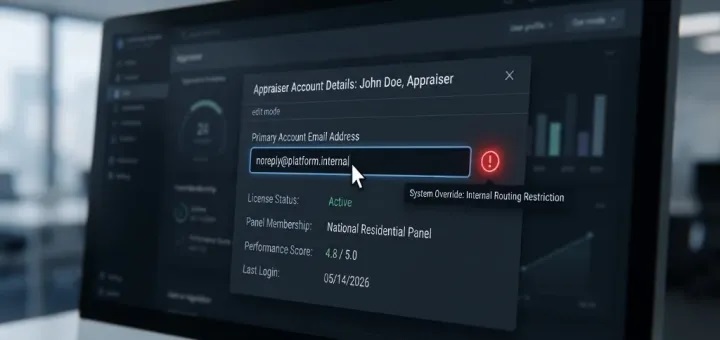
The Ghost in the Machine: How Tech Quietly Sabotages Appraisers
By Desiree Mehbod
The real estate appraisal industry is being quietly rewritten by corporate tech platforms that automate blacklisting and manipulate home values behind the scenes.
Excerpts: For anyone working on the ground in the appraisal industry today, the real estate market does not feel like a fair playing field. It feels like an automated ecosystem designed to squeeze out local expertise in favor of corporate volume. While outsiders look at recent data and express shock, those of us in the trenches know the truth: bias, exploitation, and automated blacklisting are literally hardcoded into the platforms we are forced to use every day. BookAppraisals
To understand how broken things have gotten, you only have to look at what happened to a seasoned independent appraiser out West. After years of building direct relationships with lenders, his entire workflow evaporated into thin air over a matter of days. For six grueling months, his phone stopped ringing, and no new appraisal requests came through. He reached out to a trusted lender he had done business with for years, only to receive a shocking answer: “We have been sending you work orders for months, but you never responded. We thought you were ghosting us, so we removed you from our panel.”
What actually happened was not a lack of interest or an economic downturn. It was deliberate, systemic sabotage.
The appraiser had grown tired of receiving a nonstop, daily barrage of automated AMC bid spam flooding his inbox. When he pushed back against the platform handling the communications, an employee at the appraisal tech platform retaliated by quietly changing his account’s primary email contact to an internal “noreply” address. Because the system never sent out a bounced notification, lenders genuinely believed he was ignoring them. A single unlicensed tech employee effectively deactivated a small business with a few clicks, and it took a random, autopopulated form months later for the appraiser to discover the truth.
This is not just a horror story about bad tech support. It is a window into the unchecked power that tech platforms and Appraisal Management Companies (AMCs) hold over our livelihoods.
The software running this industry is built to control and discipline independent appraisers. Take the concept of appraiser grading metrics.
Appraisers are under the illusion that their performance ratings are private between them and an individual client. In reality, bad star ratings or panel removals from a single vindictive AMC are secretly shared across wider platform networks, like Mercury via the VMP suite. It creates a permanent, hidden anchor that ruins future work opportunities with other clients, with no shelf life expiration date and zero opportunity for a fair rebuttal.
This infrastructure directly explains the numbers people are starting to notice. A recent National Mortgage Professional article highlighted a stat showing that AMC appraisals are more likely to match a home’s contract price exactly, hitting it at 26.41% compared to 22.67% for non-AMC appraisals. To a data scientist, that might look like a statistical anomaly. To an independent appraiser, it is just Tuesday. See below for more information on the National Mortgage Professional Article see below.
To read more of the article above and read the appraiser comments,
My comments: I remember when AMCs took over appraisal management after the 2008 housing crash. A hot appraisal topic was how to be taken off the AMCs “do not use list”. Before AMCS took over lenders managed their own appraisal lists, often for overflow from their staff appraisers. Reportedly they shared their l “Do not Use” lists.
===========================================================
Appraisers face stagnant pay and rising costs as AMCs defend their fees and new technology reshapes the industry
From National Mortgage News
TOPICS:
- Where The Appraisal Fee Goes
- How AMCs Became The Status Quo
- The Bidding Process
- A New Appraisal Format, An Old Fight Over Fees
- Who Manages The Work?
- Outsourcing The Work Doesn’t Outsource the Responsibility
- What Does The Research Say About Quality?
A few quotes:
“Appraisal management companies — although they’ve been around for many, many years — have morphed into this cottage industry.”
Marc Savitt, president of NAIHP and former NAMB president
—————————————————————–
“Appraisers are just getting nickeled and dimed, and we have no way to fight back.”
Joshua Tucker, chairman and co-founder of the
Appraisal Regulation Compliance Council
To read this article, Click Here
My comments: One appraiser’s AMCs story and comprehensive analysis of Where The Appraisal Fee Goes.HOW TO USE THE NUMBERS BELOW. Appraisals are ordered after the loan application. These numbers tell you the future for the next few weeks. For more information on how they are compiled, click here.
Note: I publish a graph of this data every month in my paid monthly newsletter, Appraisal Today. For more information or get a FREE sample go to www.appraisaltoday.com/order Or call 510-865-8041, MTW, 7 AM to noon, Pacific time.
My comments: Rates are going up and down in 2026 and probably in 2027 but no one knows for sure.
Mortgage Applications Decrease in Latest MBA Weekly Survey
WASHINGTON, D.C. (November 4, 2026) — Mortgage applications decreased 1.2 percent from one week earlier, according to data from the Mortgage Bankers Association’s (MBA) Weekly Mortgage Applications Survey for the week ending October 30, 2026.
The Market Composite Index, a measure of mortgage loan application volume, decreased 1.2 percent on a seasonally adjusted basis from one week earlier. On an unadjusted basis, the Index decreased 2 percent compared with the previous week. The Refinance Index increased 0.1 percent from the previous week and was 60 percent lower than the same week one year ago. The seasonally adjusted Purchase Index decreased 2 percent from one week earlier. The unadjusted Purchase Index decreased 4 percent compared with the previous week and was 19 percent lower than the same week one year ago.
“Mortgage rates drifted down to their lowest level since September 2026 last week in the wake of the Federal Reserve’s decision to hold on additional rate hikes at its October meeting,” said Mike Fratantoni, MBA’s SVP and Chief Economist. “While the 30-year rate declined to 7.3 percent, activity is still quite slow, with purchase application volume down for the week and refinance volume effectively flat at a very low level. As we have highlighted in recent weeks, more borrowers are choosing ARMs in this environment to lower their initial payments, with the ARM share at its highest level since September 2025.”
The refinance share of mortgage activity increased to 39.8 percent of total applications from 38.9 percent the previous week. The adjustable-rate mortgage (ARM) share of activity increased to 11.4 percent of total applications.
The FHA share of total applications decreased to 16.0 percent from 16.6 percent the week prior. The VA share of total applications increased to 11.2 percent from 11.0 percent the week prior. The USDA share of total applications increased to 0.6 percent from 0.5 percent the week prior.
The average contract interest rate for 30-year fixed-rate mortgages with conforming loan balances ($832,750 or less) decreased to 7.30 percent from 7.37 percent, with points decreasing to 0.75 from 0.76 (including the origination fee) for 80 percent loan-to-value ratio (LTV) loans. The effective rate decreased from last week.
The average contract interest rate for 30-year fixed-rate mortgages with jumbo loan balances (greater than $832,750) decreased to 7.20 percent from 7.28 percent, with points decreasing to 0.48 from 0.64 (including the origination fee) for 80 percent LTV loans. The effective rate decreased from last week.
The average contract interest rate for 30-year fixed-rate mortgages backed by the FHA decreased to 7.02 percent from 7.12 percent, with points remaining unchanged at 1.07 (including the origination fee) for 80 percent LTV loans. The effective rate decreased from last week.
The average contract interest rate for 15-year fixed-rate mortgages increased to 6.76 percent from 6.70 percent, with points increasing to 0.98 from 0.85 (including the origination fee) for 80 percent LTV loans. The effective rate increased from last week.
The average contract interest rate for 5/1 ARMs decreased to 6.29 percent from 6.41 percent, with points decreasing to 1.00 from 1.20 (including the origination fee) for 80 percent LTV loans. The effective rate decreased from last week.
The survey covers U.S. closed-end residential mortgage applications originated through retail and consumer direct channels. The survey has been conducted weekly since 1990. Respondents include mortgage bankers, commercial banks, thrifts, and credit unions. Base period and value for all indexes is March 16, 1990=100.
———————————————–
 Ann O’Rourke, MAI, SRA, MBA
Appraiser and Publisher Appraisal Today
1826 Clement Ave. Suite 203 Alameda, CA 94501
Phone: 510-865-8041
Email: ann@appraisaltoday.com
Online: www.appraisaltoday.com
We want to know what you think!! Please leave a comment.