Scatter Charts for Appraisers

Newz: Scatter Charts, Do Not Use List, UAD 3.6 Key Changes and Resources

March 30, 2026

What’s in This Newsletter (In Order, Scroll Down)

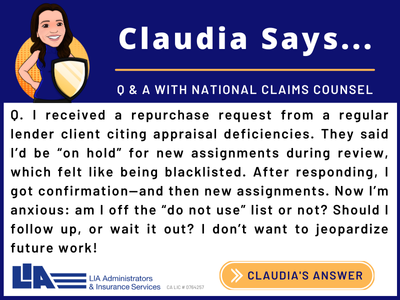
  • LIA AD: Am I Still on the ‘Do Not Use’ List
  • The Power of Scatter Charts: Bringing Objectivity to Appraisals
  • by Scott Cullen
  • 1780 Tiny Home That Was Built by a British Sea Captain Hits the Market in Georgetown for $1,198,000
  • MY AD: Highest and Best Use of the Cost Approach
  • The housing market so far in 2026 By Ryan Lundquist, March 11, 2026
  • Trump’s Executive Order on Access to Home (including appraisers)
  • MBA Origination Stats: Mortgage applications decreased 10.9 percent from one week earlier
 

Click here to subscribe to our FREE weekly appraiser email newsletter and get the latest appraisal news

————————————————

The Power of Scatter Charts: Bringing Objectivity to Appraisals

by Scott Cullen

Excerpts:

“Objectivity is isolating the effect of individual variables on value.”

Once upon a time, in a suburban neighborhood not so far away, an appraiser came across a pure pair, two homes that seemed almost identical. They shared the same neighborhood, lot size and condition. The only difference was size. One house had 2,500 square feet of above grade finished area and the other had 2,300. The first sold for $460,000, the second for $446,000. The difference in price was $14,000. The difference in area was 200 square feet—producing an adjustment of $70 per square foot.

Traditionally, an appraiser might document this relationship as a simple table, noting the difference in sale price and living area. Unfortunately, pure pairs are so rare that they often seem like a fairytale—something every appraiser dreams of finding but seldom does. In the real world, properties rarely align so neatly. Markets shift, concessions appear, and location nuances creep in. Yet there is hope. By learning to use scatter charts, embracing adjusted pairs, and understanding sensitivity analysis, appraisers can move closer to true objectivity in their valuation work.

From Paired Sales to Sensitivity Analysis

The Appraisal of Real Estate, 15th Edition defines paired data and grouped data as forms of sensitivity analysis—a method used to isolate the effect of individual variables on value. Sensitivity analysis is the overarching principle that allows us to quantify how much one variable contributes to price, while holding others constant (Appraisal Institute, 2020, p.371). Scatter charts are among the most powerful tools available to visualize and calculate these relationships.

Why Visualization Matters

Scatter charts do more than calculate—they communicate. They combine mathematical precision with the clarity of visualization. For appraisers, this means turning abstract numbers into evidence that both clients and reviewers can see.

A well-constructed scatter chart illustrates the logic behind the adjustment and lends weight to the appraiser’s conclusions. It reinforces transparency: others can replicate the math, verify the trendline, and confirm that the adjustments are derived from observable market behavior.

As the saying goes, “A picture is worth a thousand words.” In appraisal, it’s also worth credibility. Scatter charts bring statistical discipline to the craft of valuation, grounding professional judgement in data.

To read more, Click Here

My comments: Read more to see scatter chart samples and how they are used.

Read more!!

Cost Approach – When to Use in Appraisals

Fannie Mae and the Cost Approach

Excerpt: We often receive questions from appraisers regarding Fannie Mae and the cost approach. For example: “I’m appraising a property and have been instructed to comply with Fannie Mae guidelines. I understand that Fannie Mae requires the sales comparison approach, but what if there aren’t enough good comps? Can I use the cost approach as the primary method of valuation?”

Answer: No!

In order to comply with Fannie Mae guidelines, the sales comparison approach must be the primary method used to determine the value. In fact, Fannie Mae will not purchase a mortgage on a property if the cost approach is the primary or only method of valuation used.

Quite simply, if there isn’t enough data for the appraiser to develop a reliable opinion of value by the sales comparison approach, the mortgage will not be marketable to Fannie Mae.

However…

To read more, click here

My comment: I included this article plus the one below, which both address the Cost Approach’s common appraisal questions.

—————————————————————————-

The Cost Approach: An Underutilized Approach to Value

Excerpt: In residential appraising, the cost approach and the income approach have in many cases become less utilized in favor of sole reliance on the sales comparison approach.

There are occasions when the income approach can be the primary indicator of value for residential properties, such as developments with a high percentage of homes owned by investors.

The fact that Fannie Mae won’t accept reports that rely solely on the cost approach, with a few rare exceptions, doesn’t mean that approach can’t be the primary indicator of value. It just means Fannie Mae won’t buy that loan.

To read more, click here 

My comments: I started with an assessor’s office in the 1970s. At that time, my county was changing from only using the Cost Approach for decades to a sales-based approach. I never liked to use only the Cost Approach when I started doing fee appraisals.

In my area, there are very few land sales. There has not been one for over 20 years in my city. Depreciation is always iffy when appraising Victorian homes built before 1915.

But, I always use the Cost Approach for new construction to determine the financial feasibility of custom homes. I use a few land sales from other cities. If the new proposed home is on a vacant parcel, I go back to when the parcel was purchased, sometimes many years ago, and do a market condition adjustment.

—————————————————————————

So Many Appraisal Cost Approach Questions

Appraisal Business Tips 

Humor for Appraisers

Click here to subscribe to our FREE weekly appraiser email newsletter and get the latest appraisal news!!

To read more of this long blog post with many topics, click Read More Below!!

NOTE: Please scroll down to read the other topics in this long blog post on Bias complaint, George Dell, Get a Google Business Profile, unusual homes, mortgage origination stats, etc.

Read more!!

Appraising vs. the Public Good?

Has Appraising Failed the Public Good?

by Steven R. Smith, MSREA, MAI, SRA

Excerpts: The term Public Good is in the opening paragraph of the Uniform Standards of Professional Appraisal Practice (USPAP). An appraiser friend once wrote that our regulations and guidelines are intentionally ambiguous—and that may be. But what is crystal clear to me is that the industry has put the interests of its clients before the public good.

The Public Trust statement and the Ethics Rule have been largely ignored over the years with loan production put first…

What can an individual appraiser do to support the public good, even before they start an assignment? For me, the answer always has been to appraise the client and the appraisal assignment. There are some clients and assignments that simply should be avoided because of the wants, needs and desires of the client, with respect to the assignment results.

To read more, click here

My comments: I have known Steve Smith for a long time. To read more comments from Steve and other savvy appraisers, join the National Appraisers Forum, an email discussion group. I have been a member since it started. It is my “go-to” resource for appraisal topics. Moderated. Very different from Facebook and other appraiser online discussion groups where filling out forms and dealing with AMCs are discussed.

The future of residential appraising

Appraisal Business Tips 

Humor for Appraisers

Click here to subscribe to our FREE weekly appraiser email newsletter and get the latest appraisal news!!

To read more of this long blog post with many topics, click Read More Below!!

NOTE: Please scroll down to read the other topics in this long blog post on unusual homes, appraiser diversity, Cost Approach, liability, mortgage origination stats, etc.

Read more!!

So Many Appraisal Cost Approach Questions

So Many Appraisal Cost Approach Questions!
So Few Answers! Such Low Fees!

By Tim Andersen, MAI

Excerpt: It is clear most appraisers do not like to do the Cost approach. Generally, we are not too familiar with it. So, it is clear that most appraisers, because of this, do not appreciate the deep analytical power the Cost approach really has. So Many Appraisal Cost Approach Questions!

Therefore, I’m going to ask you 10 questions on the Cost approach (and stuff related to it). After you’ve finished reading them, you probably will still not like to tackle the Cost approach. Nevertheless, you just may have a better understanding of, and appreciation for, its powerful analytical capacities.

First Question: On the 1004 form is the indication that Fannie Mae does not require the Cost Approach to Value. Where does the form instruct the appraiser not to complete the analytics of the Cost approach?

To read the other questions and answers click here

My comment: Appraisers, including myself, seem to have a love/hate relationship with the Cost Approach. But, it can be useful. Tim’s much longer article “But Fannie Mae says I don’t have to do the Cost Approach!!” will be in the September issue of the paid Appraisal Today.

Appraisal Process Challenges(Opens in a new browser tab)

Which Appraisal Clients are used the most?(Opens in a new browser tab)

Read more!!

Statute of Limitations for Suing an Appraiser

What’s the Statute of Limitations for Suing a Real Estate Appraiser?

by Peter Christensen

Excerpt: This is a common question that I’m asked because many lawsuits against appraisers are filed years after the appraisal was performed by the appraiser, sometimes 10 or more years later.

The reason for this is that the plaintiff suing an appraiser may not have known there was a problem with the appraisal at the time it was received or may not have suffered any damages as a result of the alleged appraisal error until a loan default or other event has occurred years down the road.

This plaintiff might be a lender who recently foreclosed on a loan or might be a borrower who believes they paid too much or borrowed too much based on a deficient appraisal.

For more info, click here

My comment: Blog post includes a link to all 50 states for statues of limitation. Knowing about the Statute of Limitations for Suing an Appraiser can really help if you receive a letter from an attorney.

Appraisal Business Tips 

Humor for Appraisers

Covid-19 Residential Appraisers Tips on Staying Safe

Statute of limitations for appraisals

To read more of this long blog post, click Read More Below!!

Read more!!