Fannie Appraiser Update Q1 2026

Newz: Fannie Appraiser Update Q1, Suspended AMC, Bias

March 27, 2026

What’s in This Newsletter (In Order, Scroll Down)

  • LIA AD: Should I consider this an actual claim?
  • Fannie Appraiser Update Q1
  • 126-Year-Old Gentlemen’s Estate That Epitomizes Gilded Age Opulence Lists in the Berkshires for $8 Million
  • Suspended: The AMC That Turned “Review” Into a Value Demand
  • Retirement: To Stay, To Go, or Can’t Decide? That is the Question!
  • AQB Releases Job Analysis Report
  • A Baseless Bias Claim Turns Into a State Appraisal Crusade
  • MBA: Mortgage applications decreased 10.5 percent from one week earlier

———————————————————-

————————————————————————–

Fannie Appraiser Update Q1

Email Message 3/19/26

Welcome to the first Appraiser Update of 2026. This edition delivers timely information to help you stay competitive and ready for what’s next, including:

Preparing for the fast-approaching Uniform Appraisal Dataset (UAD) 3.6 and Forms Redesign mandate on Nov. 2, 2026;

Understanding Appraisal Quality Monitoring letters to appraisers related to time adjustments; and

Embracing expanded eligibility for manufactured housing and accessory dwelling units – available only for UAD 3.6 submissions.

Topics list

  • UAD 3.6 articles
  • Appraisal Software Selection
  • Treatment of Location and View
  • Market Conditions Analysis Letters
  • MH Policy Changes
  • ADU Policy Changes

To read the update, Click Here

My comment: Worth reading, of course. Always a very popular link!

———————————————————-

126-Year-Old Gentlemen’s Estate That Epitomizes Gilded Age Opulence Lists in the Berkshires for $8 Million

Excerpts: 8 bedrooms, 6.5 baths, 9,364 sq.ft., 11.45 Acre lot, Built in 1900

A historical Gilded Age “cottage” that was conceived as a gentleman’s escape during the height of Manhattan’s most opulent era has hit the market in Massachusetts for $7.97 million—more than 120 years after it was built.

Located in Lenox, the heart of the Berkshires, the eight-bedroom residence is far grander than “cottage” might suggest; the word was used as a common misnomer for the extravagant country estates built in the area during the Gilded Age.

Unlike the petite properties that many associate with the word today, the sprawling home at 399 Under Mountain Road was built in 1900 as a gentleman’s equestrian estate and, despite having undergone a recent—and very extensive—renovation, it still bears many of the most elegant hallmarks of its heyday. Inside, the restoration highlights the home’s original details. Lead-glass windows frame views of rolling lawns and mature trees, while rich walnut paneling, intricate moldings, and classic pocket doors add a level of warmth rarely found in modern construction.

Ten fireplaces are scattered throughout the manor, many with ornately carved mantels.

“Every detail has been curated to embody warmth and sophistication, creating an inviting ambiance that is both refined and welcoming,” the description continues.

The extent of the property is also reflected in the home’s price tag. Having last changed hands in 2022 for $4.84 million, the dwelling is now back on the market just over four years later with a significant 65% increase on that price.

To read the listing, Click Here

My comments: Very interesting history and 50 photos.

————————————————————–
Suspended: The AMC That Turned “Review” Into a Value Demand

Financial Asset Services and its chief appraiser did not just cross the line of appraiser independence, they marched past it so boldly that the Virginia Board suspended them both. In a rare twist involving a reverse mortgage, the push for a lower value became so aggressive that the Board ultimately issued a second suspended license to drive the point home.

The Virginia Coalition of Appraiser Professionals recently highlighted a case that should make every appraiser pause. Financial Asset Services (FAS) was hired to manage a reverse mortgage appraisal, a product where the pressure often runs in the opposite direction. Instead of pushing for a higher value, the lender benefits from a lower one. The case files make that dynamic unmistakable.

The assignment went to a certified residential appraiser who delivered a well supported value of $385,000. FAS requested multiple revisions, none of which changed the value. Then came the lender supplied comparable sale from June 2023, well outside the twelve month window stated in the engagement letter. The appraiser agreed to analyze it, and ultimately included it in a later revision, but still found no basis to alter the value.

That is when the communication shifted. On March 21, 2025, FAS relayed that FHA and the lender considered the appraisal “high risk for overvaluation” and wanted the appraiser to revisit his reconciliation. The message insisted that the dated comparable was the best indicator of value and encouraged him to reconsider his conclusion.

To read more, Click Here

My comment: I wonder how often this occurs with AMCs that were supposed to stop this from happening?

———————————————————–

Are you getting too many ad-only emails?

4 ways to get only the FREE email newsletters and NOT the ad-only emails.

1. Twitter: https://twitter.com/appraisaltoday Posted by noon Friday

2. Read on blog www.appraisaltoday.com/blog Posted by noon Friday. You can subscribe to the blog in the upper right of each blog page. NOTE: the popular ads with liability tips are below the first topic on my blog posts.

3. Email Archives: https://appraisaltoday.com/archives

(posted by noon Friday) The link is above and to the left of the big yellow email signup form. Newsletters start with “Newz.” Contains all recent emails sent.

4. Link to the 10 most recent newsletters (no ads) at www.appraisaltoday.com. Scroll down past the big yellow signup block. The newsletters have abbreviated titles, taken from their blog posts.

To read more about the 4 ways, plus information on why I take ads, etc.

Click here

————————————————

Retirement: To Stay, To Go, or Can’t Decide? That is the Question!

In the January 2024 issue of Appraisal Today

Many appraisers are retiring due to stress (not much business, AMC

hassles, etc.) and increasing age. In the past, prior to licensing, most appraisers were staff appraisers for lenders. Many retired with a pension and continued to do appraisals for additional income. Now most of my retired friends with pensions are teachers or government employees.

Don’t let your E&O insurance coverage lapse. You have to renew every year

before your policy runs out. If there is a lapse in coverage you could lose your

PRIOR ACTS, which means you lose your coverage history and you won’t be

covered for the appraisals you have done in the past.

If you are retiring or quitting appraising, speak to the broker about TAIL

COVERAGE. Just because you are no longer preparing new appraisal reports

doesn’t mean you can’t be sued. You still have assets that need to be protected, so you should keep your E&O insurance in place.

Appraisers and “retirement”

In this article, I focus on appraisers approaching retirement and discuss what it means for fee appraisers.

But it is helpful for younger appraisers so they can see their future and plan.

There is lots of financial and personal advice for planning retirement available to read for younger appraisers.

To read the full article, plus 3+ years of previous issues, subscribe to the paid Appraisal Today at www.appraisaltoday.com/order.

Not sure if you want to subscribe?

Sign up for monthly auto renewal for $8.25!

Cancel at any time for any reason! You will receive a prorated refund.

$8.25 per month, $24.75 per quarter, and $89 per year (Best Buy)

or $99 per year or $169 for two years

Subscribers get FREE: past 18+ months of past newsletters

—————————————————-

What’s the difference between the Appraisal Today free Weekly email newsletter and the paid Monthly newsletter? Click here for more info.

Subscribe to Monthly Newsletter

————————————————

If you are a paid subscriber and did not receive the

March, 2026 issue emailed on

Monday March 2, 2026 please email info@appraisaltoday.com, and we will send it to you. You can also hit the reply button. Be sure to include a comment requesting it. Or, call 510-865-8041

———————————————————–

AQB Releases Job Analysis Report 3-19-26

Excerpts: AQB National Uniform Licensing and Certification Examinations Certified General, Certified Residential, and Licensed Residential Appraisers

“The AQB took a huge step to provide better transparency and clarity around our ongoing work,” said AQB Chair Jerry Yurek. “This is a key step in our modern decision-making processes as the Criteria reassessment project continues. The Job Analysis Report is a useful resource for stakeholders and the public alike to understand some of the critical data informing the AQB’s effectiveness.

This document is a comprehensive job analysis and exam development report for the AQB National Uniform Licensing Certification Examinations for appraisers.

Job Analysis and Examination Development Overview

This report details the comprehensive process used by PSI Services LLC to update the licensing examinations for real estate appraisers, ensuring content validity and alignment with current industry practices.”

To read the report, Click Click Here

My comments: Long report (89 pages), but worth reading and/or skimming the contents list on Page 1.

—————————————————————

A Baseless Bias Claim Turns Into a State Appraisal Crusade

Excerpts: This is the story of how a false bias allegation became the basis for an aggressive, unjustified prosecution by the state appraisal board.

My name is Steve Orlowski, and I am a retired Illinois Certified Residential Real Estate Appraiser. In November 2020, I conducted a property appraisal. The owner deemed my value low by more than $100,000. He only complained to the State of Illinois Department of Real Estate and filed a racism complaint with HUD; he didn’t submit a reconsideration of value.

Following an informal hearing, the State of Illinois Appraisal Board required me to acknowledge my wrongdoing, complete 35 hours of coursework, submit to public discipline, and pay a fine. I hired an attorney and declined. My attorney asked me to find an expert witness. I contacted two MAI-designated appraisers. Both MAI-designated appraisers confirmed that my appraisal seemed well-developed, but they declined to represent me due to their fear of retaliation from the appraisal board.

Looking through recent real estate listings, I discovered that the property that has been causing me so much distress recently sold for $185,000. I appraised the property in November 2020 for $164,000. It seems my estimate was accurate given the slight rise in area values over the previous five years.

The shocking part of this story is how completely unaccountable the state appraisal board is. They prosecuted me without valid cause. I understand the federal government is the only entity that can discipline a state appraisal board.

To read more, Click Here

My comment: Will this bias fiasco ever end?

——————————————————-

HOW TO USE THE NUMBERS BELOW. Appraisals are ordered after the loan application. These numbers tell you the future for the next few weeks. For more information on how they are compiled, Click Here.

Note: I publish a graph of this data every month in my paid monthly newsletter, Appraisal Today. For more information or get a FREE sample go to www.appraisaltoday.com/order Or call 510-865-8041, MTW, 7 AM to noon, Pacific time.

My comments: Rates are going up and down. We are all waiting for rates to drop lower in 2026.

——————————————————————-

Mortgage applications decreased 10.5 percent from one week earlier

WASHINGTON, D.C. (March 25, 2026) — Mortgage applications decreased 10.5 percent from one week earlier, according to data from the Mortgage Bankers Association’s (MBA) Weekly Mortgage Applications Survey for the week ending March 20, 2026.

The Market Composite Index, a measure of mortgage loan application volume, decreased 10.5 percent on a seasonally adjusted basis from one week earlier. On an unadjusted basis, the Index decreased 10 percent compared with the previous week. The Refinance Index decreased 15 percent from the previous week and was 52 percent higher than the same week one year ago. The seasonally adjusted Purchase Index decreased 5 percent from one week earlier. The unadjusted Purchase Index decreased 5 percent compared with the previous week and was 5 percent higher than the same week one year ago.

“The threat of higher-for-longer oil prices continued to keep Treasury yields elevated, and mortgage rates finished last week higher. The 30-year fixed rate rose to 6.43 percent, more than 30 basis points higher than at the end of February and at its highest level since October 2025,” said Joel Kan, MBA’s Vice President and Deputy Chief Economist. “Given this period of increasing mortgage rates and diminishing refinance incentives, refinance applications decreased 15 percent as applications across all loan types declined. Purchase applications were also down last week, as higher mortgage rates, coupled with affordability constraints and economic uncertainty, pushed some potential homebuyers to the sidelines.”

The refinance share of mortgage activity decreased to 49.6 percent of total applications from 52.3 percent the previous week. The adjustable-rate mortgage (ARM) share of activity increased to 8.1 percent of total applications.

The FHA share of total applications increased to 19.7 percent from 19.4 percent the week prior. The VA share of total applications decreased to 15.9 percent from 16.7 percent the week prior. The USDA share of total applications increased to 0.5 percent from 0.4 percent the week prior.

The average contract interest rate for 30-year fixed-rate mortgages with conforming loan balances ($832,750 or less) increased to 6.43 percent from 6.30 percent, with points increasing to 0.65 from 0.63 (including the origination fee) for 80 percent loan-to-value ratio (LTV) loans. The effective rate increased from last week.

The average contract interest rate for 30-year fixed-rate mortgages with jumbo loan balances (greater than $832,750) increased to 6.45 percent from 6.39 percent, with points increasing to 0.56 from 0.34 (including the origination fee) for 80 percent LTV loans. The effective rate increased from last week.

The average contract interest rate for 30-year fixed-rate mortgages backed by the FHA increased to 6.15 percent from 6.08 percent, with points increasing to 0.75 from 0.70 (including the origination fee) for 80 percent LTV loans.  The effective rate increased from last week.

The average contract interest rate for 15-year fixed-rate mortgages increased to 5.83 percent from 5.66 percent, with points increasing to 0.80 from 0.73 (including the origination fee) for 80 percent LTV loans. The effective rate increased from last week.

The average contract interest rate for 5/1 ARMs increased to 5.75 percent from 5.65 percent, with points increasing to 0.68 from 0.67 (including the origination fee) for 80 percent LTV loans. The effective rate increased from last week.

If you would like to purchase a subscription of MBA’s Weekly Applications Survey, please visit www.mba.org/WeeklyApps, contact mbaresearch@mba.org or click here.

The survey covers U.S. closed-end residential mortgage applications originated through retail and consumer direct channels. The survey has been conducted weekly since 1990. Respondents include mortgage bankers, commercial banks, thrifts, and credit unions. Base period and value for all indexes is March 16, 1990=100.

—————————————————————–

Ann O’Rourke, MAI, SRA, MBA

Appraiser and Publisher Appraisal Today

1826 Clement Ave. Suite 203 Alameda, CA 94501

Phone: 510-865-8041

Email:  ann@appraisaltoday.com

Online: www.appraisaltoday.com
Scatter Charts for Appraisers

Newz: Scatter Charts, Do Not Use List, UAD 3.6 Key Changes and Resources

March 30, 2026

What’s in This Newsletter (In Order, Scroll Down)

  • LIA AD: Am I Still on the ‘Do Not Use’ List
  • The Power of Scatter Charts: Bringing Objectivity to Appraisals
  • by Scott Cullen
  • 1780 Tiny Home That Was Built by a British Sea Captain Hits the Market in Georgetown for $1,198,000
  • MY AD: Highest and Best Use of the Cost Approach
  • The housing market so far in 2026 By Ryan Lundquist, March 11, 2026
  • Trump’s Executive Order on Access to Home (including appraisers)
  • MBA Origination Stats: Mortgage applications decreased 10.9 percent from one week earlier


Click here to subscribe to our FREE weekly appraiser email newsletter and get the latest appraisal news

————————————————

The Power of Scatter Charts: Bringing Objectivity to Appraisals

by Scott Cullen

Excerpts:

“Objectivity is isolating the effect of individual variables on value.”

Once upon a time, in a suburban neighborhood not so far away, an appraiser came across a pure pair, two homes that seemed almost identical. They shared the same neighborhood, lot size and condition. The only difference was size. One house had 2,500 square feet of above grade finished area and the other had 2,300. The first sold for $460,000, the second for $446,000. The difference in price was $14,000. The difference in area was 200 square feet—producing an adjustment of $70 per square foot.

Traditionally, an appraiser might document this relationship as a simple table, noting the difference in sale price and living area. Unfortunately, pure pairs are so rare that they often seem like a fairytale—something every appraiser dreams of finding but seldom does. In the real world, properties rarely align so neatly. Markets shift, concessions appear, and location nuances creep in. Yet there is hope. By learning to use scatter charts, embracing adjusted pairs, and understanding sensitivity analysis, appraisers can move closer to true objectivity in their valuation work.

From Paired Sales to Sensitivity Analysis

The Appraisal of Real Estate, 15th Edition defines paired data and grouped data as forms of sensitivity analysis—a method used to isolate the effect of individual variables on value. Sensitivity analysis is the overarching principle that allows us to quantify how much one variable contributes to price, while holding others constant (Appraisal Institute, 2020, p.371). Scatter charts are among the most powerful tools available to visualize and calculate these relationships.

Why Visualization Matters

Scatter charts do more than calculate—they communicate. They combine mathematical precision with the clarity of visualization. For appraisers, this means turning abstract numbers into evidence that both clients and reviewers can see.

A well-constructed scatter chart illustrates the logic behind the adjustment and lends weight to the appraiser’s conclusions. It reinforces transparency: others can replicate the math, verify the trendline, and confirm that the adjustments are derived from observable market behavior.

As the saying goes, “A picture is worth a thousand words.” In appraisal, it’s also worth credibility. Scatter charts bring statistical discipline to the craft of valuation, grounding professional judgement in data.

To read more, Click Here

My comments: Read more to see scatter chart samples and how they are used.

Read more!!

How to Appraise Basements

Newz: Appraising Basements, AMCs,

Who is doing UAD 3.6 appraisals?

February 20, 2026

What’s in This Newsletter (In Order, Scroll Down)

  • LIA AD: Limiting Liability to Third Parties
  • Basement Appraisals: Understanding Contributory Value (Updated for UAD 3.6)
  • Fascinating ‘Basement Home’ That Rises Just Inches Above the Ground Hits the Market for Less Than $160K
  • The AMCs: Coming Soon to a Lawsuit Near You
  • MY AD: The Cost Approach for Appraisers is not popular, by Tim Andersen, MAI
  • 26% of Appraisers Feel Ready: What UAD 3.6 Demand
  • Mortgage applications increased 2.8 percent from one week earlier
  • Have you received a UAD 3.6 order yet? Survey.
  • MBA: Mortgage applications increased 2.8 percent from one week earlier

Basement Issues and Values

Click here to subscribe to our FREE weekly appraiser email newsletter and get the latest appraisal news


Basement Appraisals: Understanding Contributory Value (Updated for UAD 3.6)

Excerpts: While homeowners may ask, “Does a finished basement add value to my appraisal?” you know the answer is a bit more complicated. A basement may impact a residential property’s value, and as an appraiser, you’ll need to evaluate its significance.

While determining the contributory value of basements isn’t overly complex, it does pose challenges. To help you out, we’ll outline essential steps and provide tips for evaluating a basement’s contributory value.

Summary

Determining how a basement contributes to a residential property’s value requires an appraiser to identify the basement type, its level of finishing, and any common concerns, like signs of mold or structural issues. Following best practices is key. This includes separating the basement from the above-grade finished area, understanding the intended use of the space, and completing comprehensive market research. By doing so, you can evaluate the basement’s contributory value more accurately

Topics include:

Types of basements (partial list)

Cellars

Partial Basements

Walk-Up Basements

How Is the Basement Finished? Determining Levels

Know the Intended Use and Client Requirements

To read more, Click Here

My comments: The best analysis and advice on basements I have seen. Watch the 7 minute video on Understanding Q/C ratings (UAD 3.6) Where I work the ground does not freeze. In my Island city there is no cemetery as the ground water from San Francico Bay is very high. Basements need pumps to remove salt water. Basement walls are not used to support the home. Sometimes there are above ground basements, basements dug out of the ground, and many other types of basements. In steep hillside areas what is a “basement” can be controversial.

In Alameda, my city, native American burials, primarily from the Ohlone people, are heavily concentrated in former shellmounds (ancient cemeteries) throughout Alameda. Almost were removed many years ago, similar to other Bay area cities close to the Bay.

Read more!!

UAD 3.6 Appraisal Fees

New URAR and UAD 3.6 Appraisal Fees, AMC Tech Fees

February 6, 2026

What’s in This Newsletter (In Order, Scroll Down)

  • LIA AD: Using trainees – the safe way
  • Will the New URAR and UAD 3.6 Impact Appraisal Fees?
  • It looks like an SF apartment complex. It’s actually a $32M estate.
  • From Dealerships to AMCs: Tech Fees as the New Normal by Desiree Mehbod
  • MY AD: New in the February 2026 issue of Appraisal Today. Book Review: Mein Comp: The Last Appraiser
  • “Because Houses Are Human” AI and Appraisers By David Hyman
  • Architecture Is About to Grow a Nervous System
  • Buildings that are alive
  • MBA: Mortgage applications decreased 8.5 percent from one week earlier

Click here to subscribe to our FREE weekly appraiser email newsletter and get the latest appraisal news


———————————————————-

Will the New URAR and UAD 3.6 Impact Appraisal Fees?

Excerpts: With the new URAR and UAD 3.6 rolling out this year, you may be wondering what effect this will have on your fees. While there’s still a lot of uncertainty and speculation around this question, we’re sharing the opinions of professional real estate appraisers who answered our survey, “How do you anticipate the new URAR/UAD 3.6 changes will impact your appraisal fees?”

FEE INCREASES

Over 40% of respondents said they expect their appraisal fees to increase. Still, many respondents (28%) said they anticipate that fees will remain static, and 31% said they are not sure yet. Read their comments below to learn why or why not some appraisers believe their fees will increase with the new URAR and UAD 3.6.

APPRAISER RESPONSES

I Expect Fees to Increase” (41%)

“I have had ample time to practice the new 3.6 through my software and the inspection time will be increasing substantially…. Inspections are going to take some time especially if the dwelling is more than 1,000sf, which most in my market area are well above that. The report cannot be submitted until all sections are 100% complete, so there will be more time contacting agents, homeowners, town facilities, etc. Hoping the learning curve will be quicker than it appears at this point in time.”

I Expect Fees to Stay About the Same” (28%)

FEES REMAIN THE SAME

“I think it will be more labor intensive in the field but easier once you get back to the office.”

“I expect fees to stay the same. There may be less form filling; however, the analysis will remain the same. It’s not about the form or the analytics tools we use; it’s the analysis itself.”

The Bottom Line

While many appraisers anticipate that UAD 3.6 and the new URAR will initially require more time, tighter workflows, and new technology investments, the longer-term outlook is more balanced and, in many ways, promising.

Transitions of this scale often come with short-term growing pains, but clearer data standards, more structured reporting, and modernized tools are designed to create greater consistency and efficiency once the learning curve levels out. As several respondents pointed out, it will take real-world experience to understand where timelines and workloads ultimately settle.

At the same time, the new form offers appraisers a stronger platform to demonstrate the depth of their analysis, judgment, and market expertise.

To read more, Click Here

My comments: THIS IS THE HOTTEST TOPIC IN RESIDENTIAL LENDER APPRAISING. Appraiser opinions are useful but we all want to know what AMCs are planning for fees. I anticipate higher fees by AMCs, borrowers and direct lenders. I have been writing about what is happening since early this year, including details of all the “questions” and uncertainties on the SFR report.

Another significant fee factor is that many appraisers are retiring or quitting because they don’t want to learn the UAD 3.6 for appraisers. Those who stay will have lots of appraisal work as the 11-2-26 mandatory deadline approaches.

UAD 3.6 is not mandatory until November 2, 2026. The Legacy forms will be used during the transition. Will it be done by 11-2-26? Now, software vendors and lenders are way behind. 11-2-27 new mandate date???

On the plus side, 41% of appraisers said fees would go up and are positive about the new reports.

Read more!!

Appraising with Limited Comps

Newz: Limited Comps, Freddie Mac: Property Data Collection, Avoiding ourt

January 23, 2026

What’s in This Newsletter (In Order, Scroll Down)

  • LIA AD: Avoiding Court
  • Arriving at a Credible Appraisal When Comparable Sales Are Limited By Kevin Hecht
  • MAPPED: The Most Expensive Home Sales of 2025—From Palantir CEO’s Record-Breaking Ranch to Florida’s Priciest Mansion
  • MY AD: The AMC Conundrum in the Appraisal Business by Dave Towne
  • From Data to Value: How Mass Appraisal Delivers Fair Market Assessments
  • Freddie Mac. Insight Articles: Property Data Collection: An Overview
  • Housing Market Predictions for 2026
  • MBA: Mortgage applications increased 14.1 percent from one week earlier

———————————————————————–

Click here to subscribe to our FREE weekly appraiser email newsletter and get the latest appraisal news


Arriving at a Credible Appraisal When Comparable Sales Are Limited
By Kevin Hecht

Excerpts: Limited sales activity is common in rural markets, custom-home neighborhoods, and low-turnover areas. When comps are few, the appraiser’s task is not to find perfect matches, but to show that the selected sales are the best available indicators of value and that all departures from ideal data are well supported.

In this article, we’ll answer questions like: How far back do appraisers look for comps? How far out geographically? What other tips and tricks do appraisers use to arrive at a credible appraisal, even when comps are limited? Additionally, we’ll share some insights from appraisers who answered our survey question, “What do you do when appraisal comps are few?”

When recent, proximate, and similar sales are unavailable, appraisers typically rely on some combination of the “Three D’s” to broaden their search for comparable property sales:

Dated – Search for older sales within the subject neighborhood.Distant – Search for similar sales farther away in competing neighborhoods.

Dissimilar – Search for dissimilar sales within the subject neighborhood by widening the parameters for improvements (GLA, age, features, etc.).

How Far Back Do Appraisers Look for Comps?

Time adjustments draw scrutiny. Most agency assignments expect appraisers to use the most recent closed sales available, typically within the prior 12 months when possible.1 When older sales are used, market conditions adjustments often become central to the analysis.

Time adjustments should be supported with clear data, applied consistently, and reconciled logically. Underwriters pay close attention to whether these adjustments reflect documented market behavior rather than assumptions, particularly in shifting markets.

We surveyed our appraisal community to find out, “What do you do when appraisal comps are few?” The following comments show how individual appraisers often put their own spin on the “Three D’s” when expanding the search for comparable sales:

“Time and distance. My preference is to go back farther in time within the same neighborhood and/or market area and make market condition adjustments. If that still doesn’t provide enough comps, I expand the market area, looking for more recent sales with similar characteristics to the subject property.”

“First consider a broader time frame. Market conditions adjustments are very supportable.”

“Expand search to other competitive neighborhoods. Next, go back in time.”

To read more, Click Here

My comments: I usually go back in time sometimes several years or longer if needed. Of course, I don’t do GSE appraisals with their restrictions…


Read more!!

Q4 2025 Fannie Mae Appraiser Update – AMC Risk, UAD 3.6

Newz: 12 Days of Appraiser Christmas,
Q4 2025 Fannie Mae Appraiser Update –AMC Risk, UAD 3.6

December 19, 2025

What’s in This Newsletter (In Order, Scroll Down)

  • LIA AD: A Family Feud and Intended Use
  • Q4 2025 Fannie Mae Appraiser Update – AMC risk, UAD 3.6
  • 12 Days of Appraiser Christmas
  • Santa’s House is Back on Zillow with a Bold New Holiday Look
  • Highest and Best—and the Highest Value By Richard Hagar
  • AQB Proposed Changes in New Appraiser Requirements
  • MBA: Mortgage applications decreased 3.8 percent from one week earlier
  • ————————————————————

Click here to subscribe to our FREE weekly appraiser email newsletter and get the latest appraisal news


——————————————————

Q4 2025 Fannie Mae Appraiser Update

As the year wraps up, we’re focused on what matters most to your success: clarity, consistency, and confidence in every appraisal. This edition gives you practical insights to stay ahead:

  • Several deep-dive articles on Uniform Appraisal Dataset (UAD) 3.6, focused on condition/quality ratings, the inspection component of Scope of Work, disaster mitigation, energy efficiency, and training and resources;
  • Why time adjustments matter—and how to apply them effectively; and
  • Our approach to managing Appraiser Management Company (AMC) risk for stronger compliance and reliability. Excerpts: In Jul. 2025, Fannie Mae began sending letters to AMCs detailing appraisal quality issues identified through Fannie Mae loan quality reviews completed in 2024. Each letter contains a comprehensive list of the issues identified for appraisals associated with that AMC.

To read more, Click Here

My comments: Worth reading. First time I have ever seen comments on AMCs. Good to see that GSEs are looking at AMCs.

————————————————————–

12 Days of Appraiser Christmas

NOTE on video: Click on image and it opens in Youtube.

Very funny!! 3.5 minute video

Sample appraisal requests:

On the fourth day of Christmas my best client sent to me falling

Shacks, three field reviews, two double wides, and a drive by single family.

On the tenth day of Christmas, my best client sent to me 10 tax appeals and eight Mega Mansions.

Singer in this video is comedian David Cassel as the Ukulele Bandito http://www.theukulelebandito.com / (he is not a Portland appraiser, but he is funny)

Many thanks to Gary F. Kristensen, SRA, ASA, AGA at A Quality Appraisals in Portland, Oregon.

My comment: I love this FUN video ;>

Read more!!

Few comps in 2026 for Appraisers

Newz: Few comps in 2026, NAR Revises Nonmember Broker/Appraiser Access Policy

December 12, 2025

What’s in This Newsletter (In Order, Scroll Down)

  • LIA AD: Can’t Certify the Work
  • The problem with comps in 2026 (and the good news)
  • Gravity-Defying Colorado Mansion Designed by a Rocket Scientist Hits the Market for $2.7 Million
  • Creating a Histogram in Excel: A Guide for Appraisers
  • My ad: The AMC Conundrum in the Appraisal Business, By Dave Towne
  • NAR Revises Nonmember Broker/Appraiser Access Policy Language
  • MBA Mortgage applications increased 4.8 percent from one week earlier

Appraisers and Local Market Analysis

Click here to subscribe to our FREE weekly appraiser email newsletter and get the latest appraisal news

——————————————————


——————————————————-

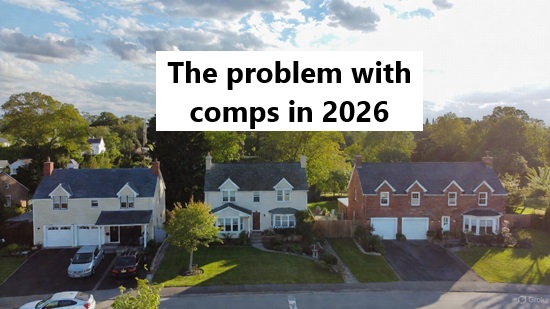
The problem with comps in 2026 (and the good news)

By Ryan Lundquist

Excerpts: We have a problem with comps in real estate. There just aren’t that many, and it’s made it much more challenging to figure out value. Yet, this could get a little better in 2026.

WE’VE HAD A COMP PROBLEM FOR THREE YEARS:

We’ve been missing about 30% of the normal number of sales. This is true both locally and nationally. This chart from Calculated Risk shows the gravity of the situation as we’ve been flirting with historically low volume for three years now. And what this means is we’ve had 30% less comps to choose from. Yikes!! This is exactly why it’s been challenging to value properties.

THE BAD NEWS

We’re still poised to have historically low volume until there is a sharper change with affordability. The housing market simply feels stuck, and there isn’t a mechanism to quickly increase the number of buyers. In other words, it’s not going to be a market with robust volume for a long time since it’s going to take years to get buyers and sellers back. Yet, if the projection is correct about next year, it’s going to be something positive to get even a little more volume back. This isn’t standing ovation news, but maybe a golf clap is in order. And for my real estate friends, this is a solid reminder to stay focused.

SOMEONE WAS MAD AT ME FOR USING OLD COMPS

I had someone angry with me recently that I used much older sales as comps in a private appraisal. I tried to explain my rationale, but the person wasn’t willing to listen. Here’s the deal though. If there aren’t any recent comps, then we have two choices. Use older sales and adjust for how the market has changed, or go out further into other markets for more recent sales (doable, but not always ideal). In real estate textbooks, this issue doesn’t come up since there are always three model match sales over the past 90 days, but the real world is different. The truth is valuations today look a bit messy since we don’t have the luxury of ample recent sales. We simply have to do the best with what we have. Remember, when the market changes, how we do things sometimes has to change also.

To read more, Click Here

My comments: Some interesting appraiser comments. This is a hot topic for appraisers now. Definitely a problem in most areas. What is your market like?

Read more!!

Appraisers – Disclose When You Did Not Do the Inspection 

Newz: 24 Hour Appraisal, Disclose When Some One Else Did the Inspection

November 7, 2025

What’s in This Newsletter (In Order, Scroll Down)

  • LIA AD: When a Property Owner Wants to Do the Appraiser’s Job
  • The Hazards of Signing a URAR When Another Person Conducts the Inspection
  • Honolulu Diamond Head Estate for $34,000,000
  • The 24-Hour Appraisal Funded by Appraisers
  • How Policy, Data, and Technology Are Reshaping Lending and Valuation: MBA 2025 Recap
  • MBA: Mortgage applications decreased 1.9 percent from one week earlier

———————————————————————–

Click here to subscribe to our FREE weekly appraiser email newsletter and get the latest appraisal news

———————————————–


———————————————-

The Hazards of Signing a URAR When Another Person Conducts the Inspection

By Dan Bradley

Excerpts: When using the Uniform Residential Appraisal Report (URAR) to report the results of an appraisal, the appraiser’s signature on the report is not merely a formality, it is a certification. By affixing his or her signature, the appraiser is certifying to (among other things) having personally made an interior and exterior inspection of the subject property.

Clients, AMCs, and state regulatory agencies are reporting that appraisers are increasingly delegating their inspection responsibilities to others yet are signing the URAR certifying they made a personal inspection.

What are the risks if an appraiser signs a URAR report certifying an interior and exterior inspection that was actually conducted by someone else?

Conclusion

Signing a URAR appraisal report that states the appraiser personally inspected the property, when in fact another party performed the inspection, is a serious liability risk. USPAP permits an appraiser to value a property that they did not make an interior and exterior inspection.

However, USPAP does not allow an appraiser to communicate a misleading report. A report that falsely indicates that an individual made an inspection of a property when in fact they did not is misleading, and could result in disciplinary action, civil liability, or other negative consequences.

To read more, Click Here

My comments: Good reminder, especially with the use by the GSEs of alternative valuation methods. Of course, you know nothing about the qualifications of the person doing the inspection. The article did not specifically address UAD 3.6, but I assume it would have the same certification section and requirements.

Read more!!

Condo Prices, up/down/?? for Appraisals

Newz: NAR Calls Out Unregulated Middlemen (AMCs), Modular Construction?

October 10, 2025

What’s in This Newsletter (In Order, Scroll Down)

  • LIA AD: Dealing with Unhappy Buyers as an Appraiser
  • Condo prices are obviously dropping, By Ryan Lundquist
  • Foreclosure Fixer-Uppers Ready for Their Next Chapter: 5 Abandoned Homes Offering a Bargain Deal to Buyers
  • The Modular Construction Revolution That Hasn’t Happened (Yet)

By Ivan Rupnik

  • NAR Calls Out Unregulated Middlemen: A Wake-Up Call for FHFA
  • When Appraisers Rally: Korea Sends the U.S. a Wake-Up Call
  • MBA Mortgage applications decreased 4.7 percent from one week earlier,

——————————————————–

Click here to subscribe to our FREE weekly appraiser email newsletter and get the latest appraisal news

———————————————


Condo prices are obviously dropping

By Ryan Lundquist

Excerpts: So many price graphs right now look pretty flat, but this condo scatter graph shows definitive declines, right? This is stunning to see, but it’s also not a shocker since the condo market has been hit harder over the past couple of years. Keep in mind I’m showing the entire county, and not every single subdivision will have the exact trend.

WHAT’S HAPPENING WITH CONDOS?

Buyers have been turned off lately with condos, and so much of it has to do with HOA fees rising and affecting purchasing power (see paragraph below). There can also be issues with obtaining financing. Moreover, SB326 is a new balcony law in California in 2025, and that’s also something we want to keep watching. Yet, the declines began before 2025, so don’t blame SB326 alone.

LOSING PURCHASING POWER IS A BIG PROBLEM – SEE GRAPHIC BELOW

Check out the huge difference in purchasing power between the following two properties. The monthly payment is the same for a $350K condo with a $600 monthly HOA fee and a $450K detached home without an HOA fee. While there is some advantage in having the HOA cover exterior maintenance or even having a gym on site, buyers are looking at the math, and the higher fee has been a roadblock for condos.

SUPPLY HAS GROWN FASTER WITH CONDOS

Condo supply has been growing at a faster pace all year than the detached market in Sacramento County. This is a good reminder that not all parts of the market are experiencing the same trend (key point). No wonder why prices have gone down at a quicker rate for condos, right?

To read more, Click Here

My comments: What’s happening in your market??

Over my 40 years appraising in my local market, condo markets are almost always different than the market for detached homes.

Many condos in my city are conversions of apartments built prior to 1970. Today, there are new condos are being built here and all over the Bay Area due to very high land prices. Across the street from my office are many 3-5 story new condos with a few attached townhomes. They are sorta boring and look the same. A marina is being converted to residential mostly. I had my business there for over 30 years and had to move as my office building was destroyed in the first year of Covid.

Read more!!

Humor What is an appraiser?

What is an Appraiser? Humor, Upzoning,
New UAD Quality Ratings

August 15, 2025

What’s in This Newsletter (In Order, Scroll Down

  • LIA AD: A Family feued and Intended Use
  • Upzoning: What It Is and What Appraisers Need to Know
  • Off-Grid ‘Stilt Home’ That Hovers Above a St. Augustine Beach Hits the Market for $1.35 Million
  • What Is An Appraiser? Humor
  • The New UAD Quality Equation: Interior + Exterior = Overall Rating
  • The Harbor Model: Where Appraisers Take the Helm
  • Mortgage applications increased 3.1 percent from one week earlier,

——————————————————————————-

Click here to subscribe to our FREE weekly appraiser email newsletter and get the latest appraisal news

—————————————————————————


Upzoning: What It Is and What Appraisers Need to Know

Excerpts: Upzoning is a powerful but often misunderstood tool in urban planning and real estate. In this post, we’ll break down what upzoning is, why it’s becoming more prevalent, and what appraisers need to know about its potential impact on property values.

What Is Upzoning?

Upzoning is the process of modifying zoning laws to allow for higher-density development in areas that previously had stricter land-use regulations. This might include permitting multi-family housing where only single-family homes were allowed, increasing building height limits, or reducing minimum lot sizes. The goal is often to promote more efficient land use and address housing shortages.

What to Be Aware of as an Appraiser

It’s important for real estate appraisers to stay informed about changes in local zoning laws, as these can significantly affect property valuations. Upzoning, in particular, can alter what is legally permissible on a parcel of land, shifting development potential and land use expectations.

When upzoning occurs, the highest and best use of a property may change—from a single-family home to a multi-family development, for example—requiring appraisers to reassess the property’s value accordingly.

How to Address Upzoning in Your Appraisal Report

If you find that a property has been upzoned, how do you tackle that in your actual appraisal report? “I think the place to start is building permitting,” says Dobbs. “A lot of cities have pretty decent permitting websites. You can go in there and look at what types of permits are being pulled in the area.”

More topics:

  • How to Address Upzoning in Your Appraisal Report
  • Opportunities for Real Estate Appraisers
  • How to Prepare for Future Upzoning

To read more, Click Here

My comments: Excellent, understandable article about this important topic. There are rental housing shortages in many areas in U.S. Today there is pressure to allow upzoning to make more rental housing available.

Residential appraisers did not receive much education on this topic. You don’t want to get into trouble with the state board by using the incorrect highest and best use on a property or not recognizing and reporting on upzoning.

I do commercial appraisals. HBU issues occur regularly in my city, so I keep up on zoning changes.

Don’t forget local regulations. In my city, regulations (not in zoning regs) restricts the number of rental units on a property (downzoning) after many Victorians were demolished and ugly modern apartment buildings constructed in the early 1960s. Appraisers only looking at zoning for HBU would make a very big mistake.

—————————————————————————————-

Off-Grid ‘Stilt Home’ That Hovers Above a St. Augustine Beach Hits the Market for $1.35 Million

Excerpts 4 bedroom 3 baths,3,374 square feet, 0.41acre lot, built in 1980

Beachfront homes that offer instant access to white sand and a crystal-clear ocean are a rare find—but even rarer is a dwelling that sits directly atop that beachfront, mere feet away from the water.

Yet one such property has just washed ashore in St. Augustine, FL, listed for $1.35 million, 19 years after it last changed hands for less than a sixth of that price.

This unique dwelling is situated on large wooden stilts that have been hammered into the sand, providing the perfect perch overlooking the water, ensuring 24/7 beach access—a rare amenity that comes with its fair share of complications.

Unsurprisingly, given its location, the home is classified as being at “extreme” risk of flooding, according to the Realtor.com® Flood Factor rating, which notes that the dwelling has a “100% risk of flooding” over the next 30 years.

Additionally, the “stilt house” has an extreme wind factor rating, as well as an extreme risk of hotter-than-average temperatures.

To read more Click Here

To read the listing with 59 photos and a video tour, Click Here

————————————————————————-

What Is An Appraiser? Humor

An appraiser is one who compiles and analyzes voluminous data of problematical accuracy from sources of dubious veracity and derives therefrom a numerical quantification of unquestionable necessity,

analogous to a nebulous and euphemistic concept representational of value commensurate with ambient configurations of the open market

and promulgates thereby a precise written declamation which delineates his observation, deliberations and conclusions all done while he feigns absolute ignorance of the avaricious machinations of Buyers, Sellers, Brokers and Lenders, compensated only by that penurious stipend known as the professional fee.

This joke is from Bill Sparks. Bill doesn’t know where this joke originated, but Thanks for sending it to us!

My comments: We all need a little appraiser humor!

Read more!!