The Oldest Living Things in the World
Fifteen places to find some of the most ancient life on Earth.
Just For Fun ;>
Corelogic taking over? Lots of data, AMCs, MLS, education…
Are you paying unseen add-on fees for your appraisal?By Ken Harney, nationally syndicated real estate writer
Excerpt: Are you getting fleeced on appraisal charges when you buy a house or refinance? Could you be paying as much as double what the appraiser is receiving for actually doing the work, with the excess going to an undisclosed third party?
Why are barns painted red and the White House white?
To register,click here:
What will you do when business really slows down? Start looking for non-lender work when everyone else does?
it is worth the subscription price!!
|
$8.25 per month, $24.75 per quarter, $89 per year (Best Buy)
or $99 per year or $169 for two years
Subscribers get, FREE: past 18+ months of past newsletters
plus 4 Special Reports, plus 2 Appraiser Marketing Books!!
|
|
To purchase the paid Appraisal Today newsletter go to
www.appraisaltoday.com/products or call 800-839-0227.
|
I have been writing about non-lender work since 1992 in my paid Appraisal Today newsletter.
This graph has been in every issue of the paid Appraisal Today since 1992. I use the data from the MBA below. Business has been slowing down since the peak in 9/16.
——————————————————————–The Market Composite Index, a measure of mortgage loan application volume, increased 3.3 percent on a seasonally adjusted basis from one week earlier. On an unadjusted basis, the Index increased 16 percent compared with the previous week. The Refinance Index increased 5 percent from the previous week to the highest level since December 2016. The seasonally adjusted Purchase Index increased 2 percent from one week earlier. The unadjusted Purchase Index increased 15 percent compared with the previous week and was 4 percent higher than the same week one year ago.
The refinance share of mortgage activity increased to 45.4 percent of total applications from 45.1 percent the previous week. The adjustable-rate mortgage (ARM) share of activity increased to 7.7 percent of total applications to the highest level since October 2014. The average loan size for purchase applications reached a survey high at $313,300.
The FHA share of total applications decreased to 11.8 percent from 12.3 percent the week prior. The VA share of total applications decreased to 11.6 percent from 11.7 percent the week prior. The USDA share of total applications remained unchanged at 0.9 percent from the week prior.
The average contract interest rate for 30-year fixed-rate mortgages with conforming loan balances ($424,100 or less) increased to 4.36 percent from 4.30 percent, with points increasing to 0.44 from 0.38 (including the origination fee) for 80 percent loan-to-value ratio (LTV) loans. The effective rate increased from last week.
The average contract interest rate for 30-year fixed-rate mortgages with jumbo loan balances (greater than $424,100) increased to 4.27 percent from 4.23 percent, with points increasing to 0.26 from 0.25 (including the origination fee) for 80 percent LTV loans. The effective rate increased from last week.
The average contract interest rate for 30-year fixed-rate mortgages backed by the FHA increased to 4.18 percent from 4.07 percent, with points decreasing to 0.32 from 0.37 (including the origination fee) for 80 percent LTV loans. The effective rate increased from last week.
The average contract interest rate for 15-year fixed-rate mortgages increased to 3.57 percent from 3.51 percent, with points remaining unchanged at 0.36 (including the origination fee) for 80 percent LTV loans. The effective rate increased from last week.
The average contract interest rate for 5/1 ARMs increased to 3.48 percent from 3.35 percent, with points decreasing to 0.20 from 0.29 (including the origination fee) for 80 percent LTV loans. The effective rate increased from last week.
The survey covers over 75 percent of all U.S. retail residential mortgage applications, and has been conducted weekly since 1990. Respondents include mortgage bankers, commercial banks and thrifts. Base period and value for all indexes is March 16, 1990=100.
HUD Fraud Alert: Appraiser Identity Theft
My comment: Read the bulletin for more info. There was a lot of this reported when trainees were used in the last boom. All the appraisers were sentenced to 3-5 years in prison.
Haunting Photos of Europe’s Abandoned Buildings, From Steel Plants to Castles
FHA handbook 4000.1 quarterly update
To keep up on what is happening in appraisal businesses, mortgage lending, USPAP, etc. , Plus humor and strange homes, sign up for my FREE weekly appraisal email newsletter, sent since June 1994. Go to Home on the right side of the menu at the top of this page or go to www.appraisaltoday.com
Sign up in the Big Yellow Boxes
I regularly write about appraisal business management issues
in my paid Appraisal Today monthly newsletter.
$99 per year or (credit card only) $8.25 per month, $24.75 per quarter or $89 per year.
For more info, go to https://www.appraisaltoday.com/products
Direct lender – average turn times by state in business days, a very wide range:
|
ALABAMA
|
10
|
MINNESOTA
|
9
|
||||
|
ARKANSAS
|
0
|
MISSOURI
|
17
|
||||
|
ARIZONA
|
16
|
MISSISSIPPI
|
10
|
||||
|
CALIFORNIA
|
10
|
NORTH CAROLINA
|
14
|
||||
|
COLORADO
|
24
|
NEW HAMPSHIRE
|
20
|
||||
|
CONNETICUT
|
9
|
NEW JERSEY
|
11
|
||||
|
DISTRICT OF COLUMBIA
|
4
|
NEW MEXICO
|
20
|
||||
|
FLORIDA
|
8
|
NEVADA
|
2
|
||||
|
GEORGIA
|
9
|
NEW YORK
|
16
|
||||
|
IDAHO
|
10
|
OHIO
|
17
|
||||
|
ILLINOIS
|
10
|
OREGON
|
31
|
||||
|
INDIANA
|
14
|
PENNSYLVANIA
|
11
|
||||
|
KANSAS
|
14
|
RHODE ISLAND
|
15
|
||||
|
KENTUCKY
|
13
|
SOUTH CAROLINA
|
12
|
||||
|
LOUISIANA
|
7
|
TENNESSEE
|
14
|
||||
|
MASSACHUSETTS
|
12
|
TEXAS
|
12
|
||||
|
MARYLAND
|
13
|
VIRGINIA
|
8
|
||||
|
MAINE
|
28
|
WASHINGTON
|
19
|
||||
|
MICHIGAN
|
13
|
WISCONSIN
|
12
|
||||
The Most Unusual Homes Available Right Now, for sale or for rent, From A Luxury Cave To A Giant Turtle
Excerpt:
Good investment or not, wacky homes sure are fun to look at and can be rewarding to owners in ways more profound than money (more on that below). So we went in search of some of the most interesting homes available today. We found a house shaped like an onion, an Irish castle and a home meant to look like a fishing reel.
My comment: Just For Fun!! I wanna rent one of the vacation rentals. The Turtle House in Egypt is only $54 to $96 per night!! And you thought some of the weirdo homes you appraised were strange… take a look at these! And, of course, Ace Appraiser Jonathan Miller is mentioned in the first paragraph ;>
—————————
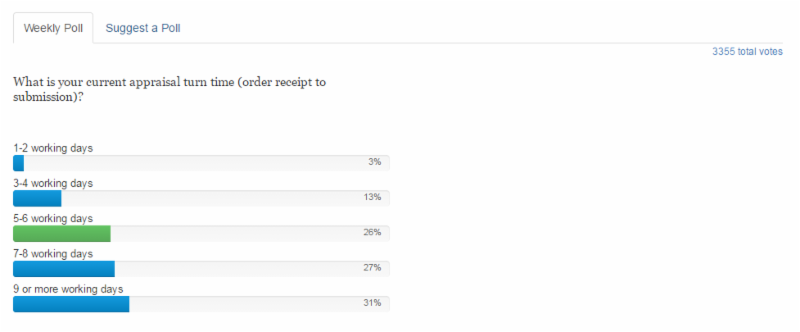
What is your current appraisal turn time (order receipt to submission)?

My comment: I wonder how many are over 2 weeks? 8 weeks?
WHAT DO YOU THINK? POST YOUR COMMENTS AT www.appraisaltodayblog.com !!
—————————
Viginia Coalition of Appraiser Professionals (VaCap) Open Letter to AMCs
A few weeks ago, Virginia Coalition of Appraiser Professionals (VaCAP) sent out an open letter to the AMCs. This letter was republished by many coalitions, and appraiser groups across the country; liked and shared on Facebook and broadcast on several industry blogs. VaCAP received an overwhelmingly positive response from the letter. We even heard from several Realtors applauding our efforts! Activity is still ongoing with comments! Click here to read the letter and comments!
We heard you loud and clear…
The letter can now be signed by individual appraiser here on AppraisersBlogs. We will gather signatures and submit the signed letter to the FDIC, CFPB, Comptroller of the Currency and our Federal Reserve Board.
Note: To protect the appraiser identity from retaliation, only the initial of your last name and state will show on line. The copies sent to the FDIC, CFPB, Comptroller of the Currency and our Federal Reserve Board will have your full name.
Excerpt of a few points on the list:
- – The use of an AMC has decreased the income of the appraiser, thereby harming local economies.
- – The use of an AMC has increased the turn time for the delivery of the appraisal.
- – AMCs operate on a fast and cheap model which has deteriorated the quality of appraisals
- – AMCs have caused undue stress on the appraiser by demanding constant updates
- – AMCs hire unqualified employees that lack comprehension of the appraisal process.
My comment: I usually don’t put in links to negative blog posts, but this seems to hit all the AMC issues, plus has something you can do. AMCs have been around since the 1960s but were never like this before. It is definitely a Big Mess and bad for the consumer (higher appraisal fees, delays in getting loans, etc.) Of course, they are doing what their lender clients want, but their methods are not good. There are some AMCs that are okay. Some appraisers have found a few they work for. Note: There is an ad in the middle of the post.
http://appraisersblogs.com/appraisers-sign-vacap-amc-letter/
——————————
In the October 2016 issue of Appraisal Today
Fees are going way up!! How to get higher appraisal fees during this boom time!! By Ann O’Rourke, MAI, SRA, PDQ and Doug Smith, SRA, AI-RRS . Lots and lots of practical tips.
Excerpt from the article:
How many appraisers are raising their fees?
I have been telling appraisers to raise their fees since early 2015. Below are two results of
appraisalport weekly polls.
Results from an April 2015 AppraisalPort weekly poll
Question: How long has it been since the last time you actually raised your fees?
- 1 year 17%
- 2-3 years 18%
- 4-6 years 18%
- 7+ years 26%
- I can’t remember – I normally just accept the fee my client offers. 21%
Back in April 2015 not many appraisers were raising their fees.
In the past year, have your standard fees for a typical non-complex assignment changed?
Results from Appraisalport September 2016 poll.
- Decreased 3
- Stayed about the same 42
- Increased by less than $50 27%
- Increased by less than $100 18%
- Increased by more than $100 11%
More appraisers are raising their fees in 9/16, but 45% have not still raised their fees! A few years ago I raised my non-lender fees to close to what borrowers pay. Why do appraisers keep working for low fees when they are so busy that they can’t take any more work? Or, they are not super busy, but want to get higher fees? Fear of never getting any more work. This is common to almost every business person, including myself. But it is not good when it keeps you from making more money, as it always does.
To read the full article with lots more data and practical tips for getting higher fees, plus 2+ years of previous issues, subscribe to the paid Appraisal Today.
$8.25 per month, $24.75 per quarter, $89 per year (Best Buy)
or $99 per year or $169 for two years
Subscribers get, FREE: past 18+ months of past newsletters
plus 4 Special Reports, plus 2 Appraiser Marketing Books!!
To purchase the paid Appraisal Today newsletter go to
www.appraisaltoday.com/products or call 800-839-0227.
————————————————–
17 Things Appraisers Should Do Before Hiring an AMC Client
October 4th, 2016 9:54 AM
Here are two of them:
7. Google the AMC’s name and see what comes up. This might seem obvious, but some AMCs have been in the news for lawsuits related to unfavorable treatment of appraisers. You do not want to waste your time vetting an AMC that has a bad reputation. Even if no lawsuits come up, a quick Google search could result in a feel for the company and let you know if this is a company you want to work for. Remember that homeowners might think you work for this AMC when you show up to do the appraisal. Is this a company that you are okay with if homeowners get confused and think you work for them?
17. Check the AMC’s data protection policy and ask what steps have been taken to keep your private information safe. Also ask if the AMC has ever had any data breaches and if so, determine what systems have been put into place to ensure that data breaches do not happen again. Does the AMC have a policy that requires them to alert appraisers if they believe a data breach was possible?
Click here for the full Most Excellent List!!
www.aqualityappraisal.com.blog
——————————————–
AMC Notes from Appraiserville by Jonathan Miller
Excerpts:
There was a CNBC article this week by Diana Olick that caused an uproar in the appraisal industry: ‘Massive’ shortage of appraisers causing home sales delays. Besides the incorrect inference of the title, the article was centered around Brian Coester, CEO of the Maryland-based CoesterVMS, currently one of the most controversial personalities in the appraisal management industry…
So I spoke with Diana Olick about the article this morning. I’ve known her for a long time and read all her stuff. She clearly did not realize what CoesterVMS represents to the appraisal industry but learned this from the outpouring of negative comments on the article by outraged appraisers. She understands now. How great is it that appraisers are getting out there and speaking their mind!
I told her that Coester is a notorious AMC in the middle of a big lawsuit that the entire appraisal industry is following. The shortage of appraisers is a myth being perpetuated by AMCS like Coester since their model only works if they pay appraisers a third to half the market rate for appraisal services.
My comment: I definitely think the current AMC model is broken, from the consumer, lender, appraisal and appraiser sides. I don’t really understand how it got so bad. I started writing in my paid newsletter about AMCs in the early 1990s. AMCs started in the were never like this before. Mostly they just paid lower fees. None had really low fees, scope creep, harassing and demeaning appraisers, etc.
To read more, Scroll down the page to Appraiserville
http://www.millersamuel.com/note/september-30-2016
—————————-
Miller was on a recent Voice of Appraisal radio interview with Phil Crawford.
Miller’s interview starts at -25:09 or 17:20 (download) 43:31 minutes total
http://www.voiceofappraisal.com/podcasts Episode 123
My comment: In last week’s email newsletter I said that the 2016 peak is almost up to the 2013 peak. In 2013 no one was complaining about high fees and turn times. In their discussion Miller said it was different because of CU/Scope Creep. He also said that business had been very slow between 2008 and 2012 and appraisers were glad for work. Appraiser attitudes about working for AMCs is much, much worse now. Good comments…Very few appraiser complaints about direct lenders and non-lender work.
————————————
Revised FHA handbook
Thanks to Dave Towne for this info!
HUD/FHA recently updated and revised the 4000.1 Handbook…..actually on June 30, 2016………..but notice about this was sent out Friday, Sept. 30.
http://portal.hud.gov/hudportal/HUD?src=/program_offices/housing/sfh/handbook_4000-1
When the page opens, scroll down the page and you’ll see two entries on the left regarding the Handbook. If you open the PDF link, and let it load…it will actually show you the changes made to the appraisal section (and others).
Note….the handbook is 1000+ pages, but only about 40 or so apply to appraisals.
Note that the revised handbook has ‘moved’ the Appraiser and Property Requirements section to II D, from its former position in B.
Buried in the revision is new info on how to account for specific named ‘appliances’ in a home you are appraising. See II D 3e.
It’s going to take someone with more time (than I have now) and expertise to determine what exactly HUD changed in the reporting requirements about “appliances that remain and contribute to value.” One needs to read the former 4000.1 Handbook and compare that to this revised edition to fully understand the implications of what HUD wants reported.
You will want to compare the attic observation requirement also. Revision 4000.1 has this in II D 3k.
Crawl space observation is in II D 3m.
————————————————-
HOW TO USE THE NUMBERS BELOW. Appraisals are ordered after the loan application. These numbers tell you the future for the next few weeks. For more information on how they are compiled, go to https://www.mba.org
Note: I publish a graph of this data every month in my printed newsletter, Appraisal Today. For more information or get a FREE sample issue go to www.appraisaltoday.com/productsor send an email to info@appraisaltoday.com . Or call 800-839-0227, MTW 8AM to noon, Pacific time.
WASHINGTON, D.C. (October 5, 2016)
Mortgage applications increased 2.9 percent from one week earlier
according to data from the Mortgage Bankers Association’s (MBA) Weekly Mortgage Applications Survey for the week ending September 30, 2016.
The Market Composite Index, a measure of mortgage loan application volume, increased 2.9 percent on a seasonally adjusted basis from one week earlier. On an unadjusted basis, the Index increased 3 percent compared with the previous week. The Refinance Index increased 5 percent from the previous week. The seasonally adjusted Purchase Index decreased 0.1 percent from one week earlier. The unadjusted Purchase Index decreased 0.2 percent compared with the previous week and was 14 percent lower than the same week one year ago.
The refinance share of mortgage activity increased to 63.8 percent of total applications from 62.7 percent the previous week. The adjustable-rate mortgage (ARM) share of activity increased to 4.5 percent of total applications.
The FHA share of total applications decreased to 10.0 percent from 10.2 percent the week prior. The VA share of total applications decreased to 11.4 percent from 11.9 percent the week prior. The USDA share of total applications increased to 0.7 percent from 0.6 percent the week prior.
The average contract interest rate for 30-year fixed-rate mortgages with conforming loan balances ($417,000 or less) decreased to 3.62 percent, the lowest level since July 2016, from 3.66 percent, with points decreasing to 0.32 from 0.33 (including the origination fee) for 80 percent loan-to-value ratio (LTV) loans. The effective rate decreased from last week.
The average contract interest rate for 30-year fixed-rate mortgages with jumbo loan balances (greater than $417,000) decreased to 3.60 percent from 3.64 percent, with points decreasing to 0.25 from 0.28 (including the origination fee) for 80 percent LTV loans. The effective rate decreased from last week.
The average contract interest rate for 30-year fixed-rate mortgages backed by the FHA decreased to 3.50 percent from 3.52 percent, with points decreasing to 0.16 from 0.21 (including the origination fee) for 80 percent LTV loans. The effective rate decreased from last week.
The average contract interest rate for 15-year fixed-rate mortgages decreased to 2.93 percent from 2.95 percent, with points decreasing to 0.32 from 0.38 (including the origination fee) for 80 percent LTV loans. The effective rate decreased from last week.
The average contract interest rate for 5/1 ARMs remained unchanged at 2.92 percent, with points increasing to 0.44 from 0.40 (including the origination fee) for 80 percent LTV loans. The effective rate increased from last week.
The survey covers over 75 percent of all U.S. retail residential mortgage applications, and has been conducted weekly since 1990. Respondents include mortgage bankers, commercial banks and thrifts. Base period and value for all indexes is March 16, 1990=100.
The Revolutionary Concept of Standard Sizes Only Dates to the 1920s
Nearly everything in your home is a certain size, thanks to German architect Ernst Neufert.
Excerpt: Almost every kitchen counter in the United States is 36 inches tall. And 25 inches deep. Eighteen inches above the counters are the cabinets, which are 16 inches deep.
Where do these sizes and dimensions come from? Have they always been so exact?
Building standards, as these numbers and rules are often known, are everywhere, helping shape everything from your kitchen cabinets and the sidewalk in front of your house to the layout of your favorite restaurant. Despite their prevalence, building standards really only came into being in the last century. A major turning point in their wild proliferation arrived in the 1920s, when the German government made the then-radical decision to standardize the size of office paper.
My comment: Fascinating!! Lots more info and images at the link below.
———————————————-
Do you have questions about using Collateral Underwriter® (CU™)? Register to attend the upcomingAsk the Expert webinar on September 27, 2 p.m. to 3 p.m. ET. Additional webinars and eLearning courses are available on the CU web page.
Have you heard about CU’s easier-to-use design and layout coming later this year? Check out the preview. You can also view the new CU infographic for an overview of CU’s powerful features. CU gives you the feedback you need, when you need it, with a CU risk score, alerts, and messages provided real-time in the Uniform Collateral Data Portal® (UCDP®). For all the latest news and resources, visit the CU web page.
———————————-
Scheer Motion to Dismiss Coester vs Scheer Lawsuit
Excerpt: More CVMS Fraud and Coester’s Fraudulent Activities Revealed
Robert Scheer, former Coester Senior VP, has filed a motion to dismiss Coester vs. Scheer lawsuit. There are also whispers in the appraisal community that Brian Coester’s motion to dismiss the lawsuit against him was denied. Looks like Scheer vs. Coester lawsuit is going to trial. Scheer continues to reveal more dirt against Coester while appraisers continue to flood social media with comments, and sometimes with humorous reactions…
This article includes the motion to dismiss.
http://appraisersblogs.com/cvms-fraud-coester–scheer
Previous post on this topic: Coester Allegedly Engaged in Fraud Sued by Former Senior VP
http://appraisersblogs.com/Coester-VMS-lawsuit-fraud-forgery
———————————–
Dollhouse Real-Estate: Inside the Elite Market for Miniature Homes
Priced as high as hundreds of thousands of dollars, these elaborate dollhouses count sex therapist Ruth Westheimer and a member of Qatar’s royal family as collectors
Excerpt: This Victorian-style home features four bedrooms, one bathroom and ornate period details like a clawfoot bathtub, crystal chandeliers and mahogany fireplaces. It is currently on the market, fully furnished, for $149,000. Since the home is roughly 18 square feet, the price comes to about $8,278 per square foot.
My comment: Thanks to Jonathan Miller for this Fun Link!!
Doll houses will never be the same for me ;>
=============================================
Coming in the October 2016 issue of Appraisal Today
How to get higher appraisal fees !!!
Topics include:
- Why AMC fees started going up last year.
- Comparison of AMCs, direct lenders and non-lender fees. Why they are very different.
- How to find out what AMCs are say they are paying and what appraisers are really getting.
- Lots of fee negotiating tips
Not just a lot of ranting. Practical advice on how to successfully make more money during this Boom that will not last forever.
To read the full article, plus 2+ years of previous issues, subscribe to the paid Appraisal Today.
$8.25 per month, $24.75 per quarter, $89 per year (Best Buy)
or $99 per year or $169 for two years
Subscribers get, FREE: past 18+ months of past newsletters plus 4 Special Reports, plus 2 Appraiser Marketing Books!!
To purchase the paid Appraisal Today newsletter go to
www.appraisaltoday.com/productsor call 800-839-0227.
If you are a paid subscriber and did not get the September 2016 issue, emailed September 1, 2016, please send an email to info@appraisaltoday.com and we will send it to you!! Or, hit the reply button. Be sure to put in a comment requesting it ;>
——————————————–
APPRAISERS IN THE NEWS. THE ARTICLES BELOW ARE ABOUT FEES, TURN TIMES, APPRAISER SHORTAGE, ETC. THEY WERE WRITTEN FOR LENDERS, REAL ESTATE AGENTS, HOME OWNERS, AND THE GENERAL PUBLIC. All allow comments, which can be very interesting!!
5 things to consider about higher appraisal fees and longer turn-times By Ryan Lundquist. Written for real estate agents and home owners
Excerpt: 4) Not Getting All the Money: A loan officer I spoke with was frustrated that his Borrowers were paying $550 for conventional appraisals and $750 for jumbo appraisals – and still experiencing longer turn-times. When he told me the Appraisal Management Company (AMC) he uses though, that’s where the problem comes in. This AMC regularly pays appraisers $350, which means they’re pocketing 40% of the fee the Borrower thinks is going to the appraiser. A few days ago on Facebook there was an appraiser who had an offer from an AMC to appraise a property for $850, but the AMC was charging the Borrower $1,385. Let’s remember appraisers are supposed to be paid “customary and reasonable” fees under Dodd-Frank, but a reasonable fee is what the appraiser gets – NOT what the Borrower pays.
My comments: Well written – for real estate agents and home owners, but has good explanations for everyone. (Ryan’s blog is primarily marketing for his appraisal business.) This article also discusses the decline in the number of appraisers in California, with data, but is relevant for many other states.
———————————-
Appraiser Shortage? By Greg Stephens, SRA, MetroWest AMC
Reprinted from a June 2016 mortgage magazine. Written for lenders.
Excerpt: A topic very relevant to mortgage professionals has been receiving increasing attention lately-the question whether there is or is not a shortage of appraisers? Regulators, as well as market participants, have been weighing in, and depending upon who you talk to, the answers vary. The problem so far is that most of the discussion has been anecdotal.
What also needs to be included in stakeholder discussions on the topic is the status of future appraisers in the pipeline to replace the aging population of practicing appraisers.
To answer the question-not only whether there is a current shortage, but also if there is the potential for a shortage either in the near future (three to five years) or perhaps even longer, I conducted some in-depth research to glean as much factual information as possible.
My comments: This article has some good data on declines in number of trainees, problems with ASC data,lenders not allowing trainees to sign on their own, etc. Written for mortgage lender publication. Of course, it does not discuss low fees, scope creep, and treating appraisers “poorly” as a reason for the shortage of appraisers willing to work for many, or all, AMCs.
http://www.nationalmortgageprofessional.com/news/60306/appraisal-industry-update
————————————————————–
Need an appraisal right away? It may cost more than you’d expect. By Ken Harney. Written for the general public. Syndicated in national newspapers.
Excerpt: The problem is part work overload, part resentment over fees. In many markets, diminishing numbers of experienced appraisers are available – and willing – to handle requests for their work on tight timetables and at fees sometimes lower than they earned a decade or more ago.
The net result: The system is getting gummed up. …. A recent survey of agents by the National Association of Realtors found that appraisal problems were connected with 27 percent of delayed closings, up from 16 percent earlier this year.
In some cases, panicked lenders and management companies are offering appraisers fat bonuses and “rush fees” to meet deadlines. The extra charges can range from $200 to $1,000 or more, turning $500 appraisals into $1,200 or $1,500 expenses, which typically get paid by home buyers.
My comment: Harney has been a nationally syndicated real estate columnist for a long time.
————————————————-
HOW TO USE THE NUMBERS BELOW. Appraisals are ordered after the loan application. These numbers tell you the future for the next few weeks. For more information on how they are compiled, go to https://www.mba.org
Note: I publish a graph of this data every month in my printed newsletter, Appraisal Today. For more information or get a FREE sample issue go to www.appraisaltoday.com/productsor send an email to info@appraisaltoday.com . Or call 800-839-0227, MTW 8AM to noon, Pacific time.
WASHINGTON, D.C. (September 21, 2016)
Mortgage applications decreased 7.3 percent from one week earlier,
according to data from the Mortgage Bankers Association’s (MBA) Weekly Mortgage Applications Survey for the week ending September 16, 2016. The prior week’s results included an adjustment for the Labor Day holiday
The Market Composite Index, a measure of mortgage loan application volume, decreased 7.3 percent on a seasonally adjusted basis from one week earlier. On an unadjusted basis, the Index increased 15 percent compared with the previous week. The Refinance Index decreased 8 percent from the previous week to the lowest level since June 2016. The seasonally adjusted Purchase Index decreased 7 percent from one week earlier. The unadjusted Purchase Index increased 15 percent compared with the previous week and was 3 percent higher than the same week one year ago.
The refinance share of mortgage activity increased to 63.1 percent of total applications from 62.9 percent the previous week. The adjustable-rate mortgage (ARM) share of activity decreased to 4.4 percent of total applications.
The FHA share of total applications increased to 10.2 percent from 9.6 percent the week prior. The VA share of total applications decreased to 11.6 percent from 12.0 percent the week prior. The USDA share of total applications remained unchanged from 0.7 percent the week prior.
The average contract interest rate for 30-year fixed-rate mortgages with conforming loan balances ($417,000 or less) increased to its highest level since June 2016, 3.70 percent, from 3.67 percent, with points increasing to 0.38 from 0.36 (including the origination fee) for 80 percent loan-to-value ratio (LTV) loans. The effective rate increased from last week.
The average contract interest rate for 30-year fixed-rate mortgages with jumbo loan balances (greater than $417,000) increased to 3.69 percent from 3.64 percent, with points decreasing to 0.29 from 0.36 (including the origination fee) for 80 percent LTV loans. The effective rate increased from last week.
The average contract interest rate for 30-year fixed-rate mortgages backed by the FHA increased to 3.56 percent from 3.50 percent, with points decreasing to 0.23 from 0.27 (including the origination fee) for 80 percent LTV loans. The effective rate increased from last week
The average contract interest rate for 15-year fixed-rate mortgages increased to 2.99 percent from 2.97 percent, with points increasing to 0.35 from 0.34 (including the origination fee) for 80 percent LTV loans. The effective rate increased from last week.
The average contract interest rate for 5/1 ARMs increased to 2.96 percent from 2.87 percent, with points
decreasing to 0.26 from 0.37 (including the origination fee) for 80 percent LTV loans. The effective rate increased from last week.
The survey covers over 75 percent of all U.S. retail residential mortgage applications, and has been conducted weekly since 1990. Respondents include mortgage bankers, commercial banks and thrifts. Base period and value for all indexes is March 16, 1990=100.