Appraisal News and Business Tips

Blog

About this blog

This blog has all my free weekly email newsletters since 2012. Plus other topics. Please note that the original email newsletter subject line has been significantly shortened. To see the original email newsletters, click here to go to the newsletter archives. The newsletter has been sent out weekly since June, 1994. To subscribe to the free email newsletters and receive them on the date they are first issued, go to www.appraisaltoday.com and sign up in the big Yellow Box!!

NOTE: All newsletters before 4/6/24 do not have the popular Liability Administrator ad in the top of the newsletter post.
Starting with the 4/6/24 newsletter it is added below the top topic.
The 30 most recent newsletters (with the LIA ad) are available in the newsletter archives at https://appraisaltoday.com/archives/
The most recent 30 appraiser newsletters start with Newz: the other emails on the list are ads.

Looking for a topic? Use Search box on the right side. There are hundreds of posts on this blog, starting in 2012. 

Every week I send out my FREE email newsletter with info on strange and weird homes and buildings, what Fannie, FHA, AMCs, UAPAP, etc. Hot topics important to appraisers. See info on the right column for topics.

I have also been publishing a paid Appraisal Today monthly newsletter since June, 1992 with in-depth articles on topics important to appraisers. This newsletter has detailed articles on appraisal topics such as Adjustments and Collateral Underwriter plus business topics such as fees, marketing tips, and productivity to get more appraisals done. Click below for more info!!

What’s the difference between the Appraisal Today free weekly email newsletters in this blog and the paid monthly newsletter?(Opens in a new browser tab)

FREE email newsletter FAQs(Opens in a new browser tab)

Posted in: Uncategorized

Fannie Appraiser Update Q1 2026

Newz: Fannie Appraiser Update Q1, Suspended AMC, Bias

March 27, 2026

What’s in This Newsletter (In Order, Scroll Down)

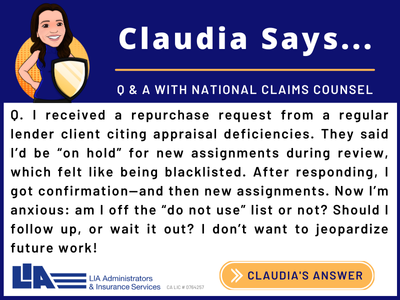
  • LIA AD: Should I consider this an actual claim?
  • Fannie Appraiser Update Q1
  • 126-Year-Old Gentlemen’s Estate That Epitomizes Gilded Age Opulence Lists in the Berkshires for $8 Million
  • Suspended: The AMC That Turned “Review” Into a Value Demand
  • Retirement: To Stay, To Go, or Can’t Decide? That is the Question!
  • AQB Releases Job Analysis Report
  • A Baseless Bias Claim Turns Into a State Appraisal Crusade
  • MBA: Mortgage applications decreased 10.5 percent from one week earlier

———————————————————-

————————————————————————–

Fannie Appraiser Update Q1

Email Message 3/19/26

Welcome to the first Appraiser Update of 2026. This edition delivers timely information to help you stay competitive and ready for what’s next, including:

Preparing for the fast-approaching Uniform Appraisal Dataset (UAD) 3.6 and Forms Redesign mandate on Nov. 2, 2026;

Understanding Appraisal Quality Monitoring letters to appraisers related to time adjustments; and

Embracing expanded eligibility for manufactured housing and accessory dwelling units – available only for UAD 3.6 submissions.

Topics list

  • UAD 3.6 articles
  • Appraisal Software Selection
  • Treatment of Location and View
  • Market Conditions Analysis Letters
  • MH Policy Changes
  • ADU Policy Changes

To read the update, Click Here

My comment: Worth reading, of course. Always a very popular link!

———————————————————-

126-Year-Old Gentlemen’s Estate That Epitomizes Gilded Age Opulence Lists in the Berkshires for $8 Million

Excerpts: 8 bedrooms, 6.5 baths, 9,364 sq.ft., 11.45 Acre lot, Built in 1900

A historical Gilded Age “cottage” that was conceived as a gentleman’s escape during the height of Manhattan’s most opulent era has hit the market in Massachusetts for $7.97 million—more than 120 years after it was built.

Located in Lenox, the heart of the Berkshires, the eight-bedroom residence is far grander than “cottage” might suggest; the word was used as a common misnomer for the extravagant country estates built in the area during the Gilded Age.

Unlike the petite properties that many associate with the word today, the sprawling home at 399 Under Mountain Road was built in 1900 as a gentleman’s equestrian estate and, despite having undergone a recent—and very extensive—renovation, it still bears many of the most elegant hallmarks of its heyday. Inside, the restoration highlights the home’s original details. Lead-glass windows frame views of rolling lawns and mature trees, while rich walnut paneling, intricate moldings, and classic pocket doors add a level of warmth rarely found in modern construction.

Ten fireplaces are scattered throughout the manor, many with ornately carved mantels.

“Every detail has been curated to embody warmth and sophistication, creating an inviting ambiance that is both refined and welcoming,” the description continues.

The extent of the property is also reflected in the home’s price tag. Having last changed hands in 2022 for $4.84 million, the dwelling is now back on the market just over four years later with a significant 65% increase on that price.

To read the listing, Click Here

My comments: Very interesting history and 50 photos.

————————————————————–

Suspended: The AMC That Turned “Review” Into a Value Demand

Financial Asset Services and its chief appraiser did not just cross the line of appraiser independence, they marched past it so boldly that the Virginia Board suspended them both. In a rare twist involving a reverse mortgage, the push for a lower value became so aggressive that the Board ultimately issued a second suspended license to drive the point home.

The Virginia Coalition of Appraiser Professionals recently highlighted a case that should make every appraiser pause. Financial Asset Services (FAS) was hired to manage a reverse mortgage appraisal, a product where the pressure often runs in the opposite direction. Instead of pushing for a higher value, the lender benefits from a lower one. The case files make that dynamic unmistakable.

The assignment went to a certified residential appraiser who delivered a well supported value of $385,000. FAS requested multiple revisions, none of which changed the value. Then came the lender supplied comparable sale from June 2023, well outside the twelve month window stated in the engagement letter. The appraiser agreed to analyze it, and ultimately included it in a later revision, but still found no basis to alter the value.

That is when the communication shifted. On March 21, 2025, FAS relayed that FHA and the lender considered the appraisal “high risk for overvaluation” and wanted the appraiser to revisit his reconciliation. The message insisted that the dated comparable was the best indicator of value and encouraged him to reconsider his conclusion.

To read more, Click Here

My comment: I wonder how often this occurs with AMCs that were supposed to stop this from happening?

———————————————————–

Are you getting too many ad-only emails?

4 ways to get only the FREE email newsletters and NOT the ad-only emails.

1. Twitter: https://twitter.com/appraisaltoday Posted by noon Friday

2. Read on blog www.appraisaltoday.com/blog Posted by noon Friday. You can subscribe to the blog in the upper right of each blog page. NOTE: the popular ads with liability tips are below the first topic on my blog posts.

3. Email Archives: https://appraisaltoday.com/archives

(posted by noon Friday) The link is above and to the left of the big yellow email signup form. Newsletters start with “Newz.” Contains all recent emails sent.

4. Link to the 10 most recent newsletters (no ads) at www.appraisaltoday.com. Scroll down past the big yellow signup block. The newsletters have abbreviated titles, taken from their blog posts.

To read more about the 4 ways, plus information on why I take ads, etc.

Click here

————————————————

Retirement: To Stay, To Go, or Can’t Decide? That is the Question!

In the January 2024 issue of Appraisal Today

Many appraisers are retiring due to stress (not much business, AMC

hassles, etc.) and increasing age. In the past, prior to licensing, most appraisers were staff appraisers for lenders. Many retired with a pension and continued to do appraisals for additional income. Now most of my retired friends with pensions are teachers or government employees.

Don’t let your E&O insurance coverage lapse. You have to renew every year

before your policy runs out. If there is a lapse in coverage you could lose your

PRIOR ACTS, which means you lose your coverage history and you won’t be

covered for the appraisals you have done in the past.

If you are retiring or quitting appraising, speak to the broker about TAIL

COVERAGE. Just because you are no longer preparing new appraisal reports

doesn’t mean you can’t be sued. You still have assets that need to be protected, so you should keep your E&O insurance in place.

Appraisers and “retirement”

In this article, I focus on appraisers approaching retirement and discuss what it means for fee appraisers.

But it is helpful for younger appraisers so they can see their future and plan.

There is lots of financial and personal advice for planning retirement available to read for younger appraisers.

To read the full article, plus 3+ years of previous issues, subscribe to the paid Appraisal Today at www.appraisaltoday.com/order.

Not sure if you want to subscribe?

Sign up for monthly auto renewal for $8.25!

Cancel at any time for any reason! You will receive a prorated refund.

$8.25 per month, $24.75 per quarter, and $89 per year (Best Buy)

or $99 per year or $169 for two years

Subscribers get FREE: past 18+ months of past newsletters

—————————————————-

What’s the difference between the Appraisal Today free Weekly email newsletter and the paid Monthly newsletter? Click here for more info.

Subscribe to Monthly Newsletter

————————————————

If you are a paid subscriber and did not receive the

March, 2026 issue emailed on

Monday March 2, 2026 please email info@appraisaltoday.com, and we will send it to you. You can also hit the reply button. Be sure to include a comment requesting it. Or, call 510-865-8041

———————————————————–

AQB Releases Job Analysis Report 3-19-26

Excerpts: AQB National Uniform Licensing and Certification Examinations Certified General, Certified Residential, and Licensed Residential Appraisers

“The AQB took a huge step to provide better transparency and clarity around our ongoing work,” said AQB Chair Jerry Yurek. “This is a key step in our modern decision-making processes as the Criteria reassessment project continues. The Job Analysis Report is a useful resource for stakeholders and the public alike to understand some of the critical data informing the AQB’s effectiveness.

This document is a comprehensive job analysis and exam development report for the AQB National Uniform Licensing Certification Examinations for appraisers.

Job Analysis and Examination Development Overview

This report details the comprehensive process used by PSI Services LLC to update the licensing examinations for real estate appraisers, ensuring content validity and alignment with current industry practices.”

To read the report, Click Click Here

My comments: Long report (89 pages), but worth reading and/or skimming the contents list on Page 1.

—————————————————————

A Baseless Bias Claim Turns Into a State Appraisal Crusade

Excerpts: This is the story of how a false bias allegation became the basis for an aggressive, unjustified prosecution by the state appraisal board.

My name is Steve Orlowski, and I am a retired Illinois Certified Residential Real Estate Appraiser. In November 2020, I conducted a property appraisal. The owner deemed my value low by more than $100,000. He only complained to the State of Illinois Department of Real Estate and filed a racism complaint with HUD; he didn’t submit a reconsideration of value.

Following an informal hearing, the State of Illinois Appraisal Board required me to acknowledge my wrongdoing, complete 35 hours of coursework, submit to public discipline, and pay a fine. I hired an attorney and declined. My attorney asked me to find an expert witness. I contacted two MAI-designated appraisers. Both MAI-designated appraisers confirmed that my appraisal seemed well-developed, but they declined to represent me due to their fear of retaliation from the appraisal board.

Looking through recent real estate listings, I discovered that the property that has been causing me so much distress recently sold for $185,000. I appraised the property in November 2020 for $164,000. It seems my estimate was accurate given the slight rise in area values over the previous five years.

The shocking part of this story is how completely unaccountable the state appraisal board is. They prosecuted me without valid cause. I understand the federal government is the only entity that can discipline a state appraisal board.

To read more, Click Here

My comment: Will this bias fiasco ever end?

——————————————————-

HOW TO USE THE NUMBERS BELOW. Appraisals are ordered after the loan application. These numbers tell you the future for the next few weeks. For more information on how they are compiled, Click Here.

Note: I publish a graph of this data every month in my paid monthly newsletter, Appraisal Today. For more information or get a FREE sample go to www.appraisaltoday.com/order Or call 510-865-8041, MTW, 7 AM to noon, Pacific time.

My comments: Rates are going up and down. We are all waiting for rates to drop lower in 2026.

——————————————————————-

Mortgage applications decreased 10.5 percent from one week earlier

WASHINGTON, D.C. (March 25, 2026) — Mortgage applications decreased 10.5 percent from one week earlier, according to data from the Mortgage Bankers Association’s (MBA) Weekly Mortgage Applications Survey for the week ending March 20, 2026.

The Market Composite Index, a measure of mortgage loan application volume, decreased 10.5 percent on a seasonally adjusted basis from one week earlier. On an unadjusted basis, the Index decreased 10 percent compared with the previous week. The Refinance Index decreased 15 percent from the previous week and was 52 percent higher than the same week one year ago. The seasonally adjusted Purchase Index decreased 5 percent from one week earlier. The unadjusted Purchase Index decreased 5 percent compared with the previous week and was 5 percent higher than the same week one year ago.

“The threat of higher-for-longer oil prices continued to keep Treasury yields elevated, and mortgage rates finished last week higher. The 30-year fixed rate rose to 6.43 percent, more than 30 basis points higher than at the end of February and at its highest level since October 2025,” said Joel Kan, MBA’s Vice President and Deputy Chief Economist. “Given this period of increasing mortgage rates and diminishing refinance incentives, refinance applications decreased 15 percent as applications across all loan types declined. Purchase applications were also down last week, as higher mortgage rates, coupled with affordability constraints and economic uncertainty, pushed some potential homebuyers to the sidelines.”

The refinance share of mortgage activity decreased to 49.6 percent of total applications from 52.3 percent the previous week. The adjustable-rate mortgage (ARM) share of activity increased to 8.1 percent of total applications.

The FHA share of total applications increased to 19.7 percent from 19.4 percent the week prior. The VA share of total applications decreased to 15.9 percent from 16.7 percent the week prior. The USDA share of total applications increased to 0.5 percent from 0.4 percent the week prior.

The average contract interest rate for 30-year fixed-rate mortgages with conforming loan balances ($832,750 or less) increased to 6.43 percent from 6.30 percent, with points increasing to 0.65 from 0.63 (including the origination fee) for 80 percent loan-to-value ratio (LTV) loans. The effective rate increased from last week.

The average contract interest rate for 30-year fixed-rate mortgages with jumbo loan balances (greater than $832,750) increased to 6.45 percent from 6.39 percent, with points increasing to 0.56 from 0.34 (including the origination fee) for 80 percent LTV loans. The effective rate increased from last week.

The average contract interest rate for 30-year fixed-rate mortgages backed by the FHA increased to 6.15 percent from 6.08 percent, with points increasing to 0.75 from 0.70 (including the origination fee) for 80 percent LTV loans.  The effective rate increased from last week.

The average contract interest rate for 15-year fixed-rate mortgages increased to 5.83 percent from 5.66 percent, with points increasing to 0.80 from 0.73 (including the origination fee) for 80 percent LTV loans. The effective rate increased from last week.

The average contract interest rate for 5/1 ARMs increased to 5.75 percent from 5.65 percent, with points increasing to 0.68 from 0.67 (including the origination fee) for 80 percent LTV loans. The effective rate increased from last week.

If you would like to purchase a subscription of MBA’s Weekly Applications Survey, please visit www.mba.org/WeeklyApps, contact mbaresearch@mba.org or click here.

The survey covers U.S. closed-end residential mortgage applications originated through retail and consumer direct channels. The survey has been conducted weekly since 1990. Respondents include mortgage bankers, commercial banks, thrifts, and credit unions. Base period and value for all indexes is March 16, 1990=100.

—————————————————————–

Ann O’Rourke, MAI, SRA, MBA

Appraiser and Publisher Appraisal Today

1826 Clement Ave. Suite 203 Alameda, CA 94501

Phone: 510-865-8041

Email:  ann@appraisaltoday.com

Online: www.appraisaltoday.com

Posted in: AMCs, appraisal business, bias, Fannie

Scatter Charts for Appraisers

Newz: Scatter Charts, Do Not Use List, UAD 3.6 Key Changes and Resources

March 30, 2026

What’s in This Newsletter (In Order, Scroll Down)

  • LIA AD: Am I Still on the ‘Do Not Use’ List
  • The Power of Scatter Charts: Bringing Objectivity to Appraisals
  • by Scott Cullen
  • 1780 Tiny Home That Was Built by a British Sea Captain Hits the Market in Georgetown for $1,198,000
  • MY AD: Highest and Best Use of the Cost Approach
  • The housing market so far in 2026 By Ryan Lundquist, March 11, 2026
  • Trump’s Executive Order on Access to Home (including appraisers)
  • MBA Origination Stats: Mortgage applications decreased 10.9 percent from one week earlier


Click here to subscribe to our FREE weekly appraiser email newsletter and get the latest appraisal news

————————————————

The Power of Scatter Charts: Bringing Objectivity to Appraisals

by Scott Cullen

Excerpts:

“Objectivity is isolating the effect of individual variables on value.”

Once upon a time, in a suburban neighborhood not so far away, an appraiser came across a pure pair, two homes that seemed almost identical. They shared the same neighborhood, lot size and condition. The only difference was size. One house had 2,500 square feet of above grade finished area and the other had 2,300. The first sold for $460,000, the second for $446,000. The difference in price was $14,000. The difference in area was 200 square feet—producing an adjustment of $70 per square foot.

Traditionally, an appraiser might document this relationship as a simple table, noting the difference in sale price and living area. Unfortunately, pure pairs are so rare that they often seem like a fairytale—something every appraiser dreams of finding but seldom does. In the real world, properties rarely align so neatly. Markets shift, concessions appear, and location nuances creep in. Yet there is hope. By learning to use scatter charts, embracing adjusted pairs, and understanding sensitivity analysis, appraisers can move closer to true objectivity in their valuation work.

From Paired Sales to Sensitivity Analysis

The Appraisal of Real Estate, 15th Edition defines paired data and grouped data as forms of sensitivity analysis—a method used to isolate the effect of individual variables on value. Sensitivity analysis is the overarching principle that allows us to quantify how much one variable contributes to price, while holding others constant (Appraisal Institute, 2020, p.371). Scatter charts are among the most powerful tools available to visualize and calculate these relationships.

Why Visualization Matters

Scatter charts do more than calculate—they communicate. They combine mathematical precision with the clarity of visualization. For appraisers, this means turning abstract numbers into evidence that both clients and reviewers can see.

A well-constructed scatter chart illustrates the logic behind the adjustment and lends weight to the appraiser’s conclusions. It reinforces transparency: others can replicate the math, verify the trendline, and confirm that the adjustments are derived from observable market behavior.

As the saying goes, “A picture is worth a thousand words.” In appraisal, it’s also worth credibility. Scatter charts bring statistical discipline to the craft of valuation, grounding professional judgement in data.

To read more, Click Here

My comments: Read more to see scatter chart samples and how they are used.

Read more!!

Posted in: AMCs, real estate market

UAD 3.6 and Appraisal Workflow

Newz: Practical AI Uses for Appraisers, Appraisal Forms Humor 

March 13, 2026

What’s in This Newsletter (In Order, Scroll Down)

  • LIA AD: Client Insists on Cost to Cure
  • UAD 3.6 Is Coming: A Practical Moment to Rethink Your Workflow
  • Appraisal By Kevin Hetch
  • One of Palm Springs’ ‘Storied’ Rock Houses Hits the Market for $1.5 Million: ‘A Rare Treasure’
  • Getting 94 offers & a tighter housing market By Ryan Lundquist
  • MY AD: Do I really have to report that state board issue to my E&O insurance? By Peter Christsen, Esq.
  • Beyond the Hype: How I’m Using AI to Actually Save 10 Hours a Week By Dustin Harris
  • Appraisal Forms – the next Generation – Humor
  • MBA : Mortgage applications increased 3.2 percent from one week earlier

——————————————————————–


—————————————————————————

UAD 3.6 Is Coming: A Practical Moment to Rethink Your Workflow Appraisal

By Kevin Hecht

Excerpts: For many appraisers, the transition to UAD 3.6 feels different from past form updates. This is not simply a revised version of the URAR with a few new fields or definitions. It represents a structural shift in how appraisal data is organized, communicated, and delivered.

While change on this scale can feel disruptive, it also creates an opportunity to improve efficiency, modernize workflows, and position your business for the future.

This transition is not just about learning a new report format. It is about adapting to a new data-centric environment. And one of the most important places to start is with your appraisal software.

This Is a Moment of Opportunity

Transitions like this can feel uncertain, but they also offer a chance to improve how you work.

By taking time now to understand UAD 3.6, evaluate your software options, and refine your workflow, you can position your business to operate more efficiently and confidently in the new reporting environment.

The goal is not simply to adapt. It is to build a workflow that supports you well into the future.

UAD 3.6 is coming. And with the right preparation, it can be a step forward for both the profession and your practice.

Topics

  • This Is More Than a Form Update
  • Start by Looking at Your Process, Not Just Your Software
  • Not All Software Will Handle This Transition the Same Way
  • Efficiency Gains Are Possible, But They May Require Change
  • Focus on What Supports Your Business Long Term
  • The Appraiser’s Role Remains the Same
  • This Is a Moment of Opportunity

To read more, Click Here

My comments: I had never thought about the “big picture”: how the software affects your business. Worth reading.

I have been writing about the appraisal software for a year and just wrote another article on Appraisal software vendor Timelines for my April newsletter. Only 1 or 2 are ready to go. The others need more work done. Appraisers cannot learn to use the software until it is fully completed.

Why is this going so slow? The GSEs did not check with the software vendors to see how much time they needed to complete their software. The actual time needed has been longer than expected. Also, GSE requirements to make all the software the same for the reporting section had to be exactly the same for all the vendors. Also, PDF and XML reports must be correctly done. Getting this all validated by the GSEs is taking time.

Read more!!

Posted in: AI, humor, real estate market, statistics, UAD 3.6, Uncategorized

UAD 3.6 Humor for Appraisers

Newz: UAD 3.6 Humor, UAD 3.6 Reality. Appraisal Volume, Waivers, PDCs

March 6, 2026

What’s in This Newsletter (In Order, Scroll Down)

LIA AD: Judicial Appraiser Panels: Balancing Opportunity and Liability
UAD 3.6 – She’s Gonna Blow CARTOON!
Lake Como-Inspired Hillsborough, CA Megamansion With Koi Pond and Private Spa Lists for an $88 Million
What are home prices doing? It depends. By Ryan Lundquist
MY AD: UAD 3.6: Yes, No or Maybe
What the latest war means for mortgage rates
UAD 3.6, the New URAR, and the Reality Nobody Wants to Say Out Loud
2026 Market Update: Appraisal Volume, Waivers, and PDCs
Mortgage applications increased 11.0 percent from one week earlier’
———————————————-

————————————————————————————

UAD 3.6 – She’s Gonna Blow CARTOON!

Acme Appraisal Company Replies to Their First UAD 3.6 Appraisal Order

To See the Cartoon, Click Here

My comment: Very Funny ;> And Appropriate!

——————————————

Lake Como-Inspired Hillsborough, CA Megamansion With Koi Pond and Private Spa Lists for an $88 Million

Excerpts: 6 bedrooms, 7.5+ bath, 12,404 sq.ft., 12.33 acre lot, built in 2013

It was inspired by the masterful megamansions found on the shores of Italy’s Lake Como.

The sprawling property in Hillsborough, CA, is focused almost entirely around serenity and relaxation, boasting an Asian garden, koi pond, rose garden, reflection pond, and an English spiral mound.

Known as Villa de Verano, the expansive estate begins with a tree-lined driveway that leads to a grand motor court, primary residence, guest home, amphitheater, event lawn, and pool.

Over-the-top highlights found throughout the 12,404-square-foot main residence include a fitness center, home theater, game room, spa, and saltwater aquarium.

A sports pavilion boasts a two-story lounge with viewing platform that overlooks a sunken tennis court, pickleball court, volleyball court, badminton court, bocce ball court, horseshoe court, shuffleboard court, and putting green. There is also an executive length golf course found on the property.

To read the listing, Click Here

My comment: Hillsborough is a city with many expensive homes located in the San Francisco Bay Area

Read more!!

Posted in: real estate market, UAD 3.6, waivers

Paired Sales for Appraisers

Newz: Paired Sales Analysis, AI and Appraisers?

February 27, 2026

What’s in This Newsletter (In Order, Scroll Down)

  • LIA AD: When Confidentiality Agreements Conflict with USPAP
  • Paired Sales Analysis: Tips and Tools for Appraisers
  • Converted Church With Bell Tower and Pulpit Lists for $225K
  • Determining Assignment Conditions in a Vacuum By Jo Ann Aposto
  • MY AD: An Appraiser Gets Audited by the IRS! My Story Don’t Make My Mistakes! By Ann O’Rourke
  • Artificial Intelligence: Friend or Foe of Appraisers?
  • Fed moves to pull mortgages back into banking fold
  • MBA: Mortgage applications increased 0.4 percent from one week earlier

———————————————————————————

Click here to subscribe to our FREE weekly appraiser email newsletter and get the latest appraisal news


Paired Sales Analysis: Tips and Tools for Appraisers

By Kevin Hecht

Excerpts: Though not without challenges, paired sales analysis is a valuable technique to have in your appraisal toolkit. Mastering this method will help you develop more accurate, credible, and defensible appraisals.

This guide presents a step-by-step approach to performing paired sales analysis, practical tips and tools to improve your accuracy, plus strategies to overcome common challenges like sparse comparable data.

Paired Sales Analysis Example

For example, suppose two very similar homes in the same neighborhood sell within three months of each other. One house has a separate two-car garage, while the other does not. If the garage-equipped home sold for $15,000 more, you can reasonably infer that the garage adds $15,000 in value.

Uses

Primarily used in the sales comparison approach, paired sales analysis is particularly useful for estimating the value of unique property attributes such as:

  • Location advantages (corner lots, cul-de-sac positions, or waterfront access)
  • Scenic views or privacy features
  • Property upgrades (pools, finished basements, luxury kitchens)
  • Additional structures (workshops, guest houses, storage buildings)
  • Land size variations or irregular lot configurations

TOPICS

  • What is paired sales analysis
  • Step-by-Step Methodology of a Paired Sales Analysis…
  • Paired Sales Analysis Tips and Best Practices
  • Additional Tips Shared by Appraisers
  • Overcoming Challenges: What to Do When Data Is Sparse

To read more, Click Here

My comments: Comprehensive and definitely worth reading. I have regularly used paired sales, when I could find good comps. I often go back in time, as market conditions adjustments are easy to do. I got a few new ideas I had not thought of before in this article.

Read more!!

Posted in: adjustments, AI, appraisal business

How to Appraise Basements

Newz: Appraising Basements, AMCs,

Who is doing UAD 3.6 appraisals?

February 20, 2026

What’s in This Newsletter (In Order, Scroll Down)

  • LIA AD: Limiting Liability to Third Parties
  • Basement Appraisals: Understanding Contributory Value (Updated for UAD 3.6)
  • Fascinating ‘Basement Home’ That Rises Just Inches Above the Ground Hits the Market for Less Than $160K
  • The AMCs: Coming Soon to a Lawsuit Near You
  • MY AD: The Cost Approach for Appraisers is not popular, by Tim Andersen, MAI
  • 26% of Appraisers Feel Ready: What UAD 3.6 Demand
  • Mortgage applications increased 2.8 percent from one week earlier
  • Have you received a UAD 3.6 order yet? Survey.
  • MBA: Mortgage applications increased 2.8 percent from one week earlier

Basement Issues and Values

Click here to subscribe to our FREE weekly appraiser email newsletter and get the latest appraisal news


Basement Appraisals: Understanding Contributory Value (Updated for UAD 3.6)

Excerpts: While homeowners may ask, “Does a finished basement add value to my appraisal?” you know the answer is a bit more complicated. A basement may impact a residential property’s value, and as an appraiser, you’ll need to evaluate its significance.

While determining the contributory value of basements isn’t overly complex, it does pose challenges. To help you out, we’ll outline essential steps and provide tips for evaluating a basement’s contributory value.

Summary

Determining how a basement contributes to a residential property’s value requires an appraiser to identify the basement type, its level of finishing, and any common concerns, like signs of mold or structural issues. Following best practices is key. This includes separating the basement from the above-grade finished area, understanding the intended use of the space, and completing comprehensive market research. By doing so, you can evaluate the basement’s contributory value more accurately

Topics include:

Types of basements (partial list)

Cellars

Partial Basements

Walk-Up Basements

How Is the Basement Finished? Determining Levels

Know the Intended Use and Client Requirements

To read more, Click Here

My comments: The best analysis and advice on basements I have seen. Watch the 7 minute video on Understanding Q/C ratings (UAD 3.6) Where I work the ground does not freeze. In my Island city there is no cemetery as the ground water from San Francico Bay is very high. Basements need pumps to remove salt water. Basement walls are not used to support the home. Sometimes there are above ground basements, basements dug out of the ground, and many other types of basements. In steep hillside areas what is a “basement” can be controversial.

In Alameda, my city, native American burials, primarily from the Ohlone people, are heavily concentrated in former shellmounds (ancient cemeteries) throughout Alameda. Almost were removed many years ago, similar to other Bay area cities close to the Bay.

Read more!!

Posted in: AMCs, appraisal how to, UAD 3.6

ANSI and UAD 3.6 for Appraisers

Newz: ANSI and UAD 3.6, Trainee Inside the Fast and Cheap Model

February 13, 2026

What’s in This Newsletter (In Order, Scroll Down)

  • LIA AD: Buyer Wants Lower Price to Negotiate
  • ANSI Z765 and the New UAD 3.6: What Appraisers Need to Know
  • New York Lumber Baron’s Private Island Retreat Hits the Market for $2.7 Million—With a Historic 8-Bedroom Mansion
  • We Will Always Need Appraisers: Josh Walitt on Valuation, Technology, and Adaptability By Isaac Peck, Publisher WorkingRE
  • MY AD: What is new in the New URAR. List of data requests for each page of UAD 3.6 SFR report.
  • The Trainee Inside the Fast and Cheap Model
  • The Ethics of Credibility in Real Estate Appraisal By Timothy Andersen, MAI
  • MBA: Mortgage applications decreased 0.3 percent from one week earlier

———————————————–

Click here to subscribe to our FREE weekly appraiser email newsletter and get the latest appraisal news

—————————————-


——————————————————-

ANSI Z765 and the New UAD 3.6: What Appraisers Need to Know

Excerpts:

Why ANSI Z765 Matters More Under UAD 3.6

Fannie Mae and Freddie Mac have both adopted ANSI Z765 as the standard for measuring one-unit detached and attached dwellings. For years, ANSI shaped how appraisers calculated gross living area, but measurement practices still varied from one professional to another. Under the new UAD 3.6 framework, those differences matter more because:

The URAR now breaks out finished area by level, making ANSI designations part of the form structure.

Lenders run automated checks that compare the sketch, GLA figures, and room-level data for consistency.

Any mismatch can trigger a revision request, a CU warning, or a QC hold.

In short, ANSI is no longer just a best practice. It’s now deeply connected to how the form captures data and how lenders review appraisals.

Core ANSI Rules that Every Appraiser Must Apply

ANSI Z765 is the national standard for measuring single-family homes. Appraisers must follow the standard in full when required by the assignment. Key elements include:

Above-Grade vs. Below-Grade

A basement is any area partially or fully below grade, regardless of finish. Even if it includes high-quality living space, it must be reported as below-grade finished area, not GLA.

Ceiling Height Requirements….

To read more, Click Here

My comments: Good review of ANSI standards and how they change with UAD 3.6

Read more!!

Posted in: ANSI, new appraisers, New URAR, trainees, UAD 3.6, USPAP

UAD 3.6 Appraisal Fees

New URAR and UAD 3.6 Appraisal Fees, AMC Tech Fees

February 6, 2026

What’s in This Newsletter (In Order, Scroll Down)

  • LIA AD: Using trainees – the safe way
  • Will the New URAR and UAD 3.6 Impact Appraisal Fees?
  • It looks like an SF apartment complex. It’s actually a $32M estate.
  • From Dealerships to AMCs: Tech Fees as the New Normal by Desiree Mehbod
  • MY AD: New in the February 2026 issue of Appraisal Today. Book Review: Mein Comp: The Last Appraiser
  • “Because Houses Are Human” AI and Appraisers By David Hyman
  • Architecture Is About to Grow a Nervous System
  • Buildings that are alive
  • MBA: Mortgage applications decreased 8.5 percent from one week earlier

Click here to subscribe to our FREE weekly appraiser email newsletter and get the latest appraisal news


———————————————————-

Will the New URAR and UAD 3.6 Impact Appraisal Fees?

Excerpts: With the new URAR and UAD 3.6 rolling out this year, you may be wondering what effect this will have on your fees. While there’s still a lot of uncertainty and speculation around this question, we’re sharing the opinions of professional real estate appraisers who answered our survey, “How do you anticipate the new URAR/UAD 3.6 changes will impact your appraisal fees?”

FEE INCREASES

Over 40% of respondents said they expect their appraisal fees to increase. Still, many respondents (28%) said they anticipate that fees will remain static, and 31% said they are not sure yet. Read their comments below to learn why or why not some appraisers believe their fees will increase with the new URAR and UAD 3.6.

APPRAISER RESPONSES

I Expect Fees to Increase” (41%)

“I have had ample time to practice the new 3.6 through my software and the inspection time will be increasing substantially…. Inspections are going to take some time especially if the dwelling is more than 1,000sf, which most in my market area are well above that. The report cannot be submitted until all sections are 100% complete, so there will be more time contacting agents, homeowners, town facilities, etc. Hoping the learning curve will be quicker than it appears at this point in time.”

I Expect Fees to Stay About the Same” (28%)

FEES REMAIN THE SAME

“I think it will be more labor intensive in the field but easier once you get back to the office.”

“I expect fees to stay the same. There may be less form filling; however, the analysis will remain the same. It’s not about the form or the analytics tools we use; it’s the analysis itself.”

The Bottom Line

While many appraisers anticipate that UAD 3.6 and the new URAR will initially require more time, tighter workflows, and new technology investments, the longer-term outlook is more balanced and, in many ways, promising.

Transitions of this scale often come with short-term growing pains, but clearer data standards, more structured reporting, and modernized tools are designed to create greater consistency and efficiency once the learning curve levels out. As several respondents pointed out, it will take real-world experience to understand where timelines and workloads ultimately settle.

At the same time, the new form offers appraisers a stronger platform to demonstrate the depth of their analysis, judgment, and market expertise.

To read more, Click Here

My comments: THIS IS THE HOTTEST TOPIC IN RESIDENTIAL LENDER APPRAISING. Appraiser opinions are useful but we all want to know what AMCs are planning for fees. I anticipate higher fees by AMCs, borrowers and direct lenders. I have been writing about what is happening since early this year, including details of all the “questions” and uncertainties on the SFR report.

Another significant fee factor is that many appraisers are retiring or quitting because they don’t want to learn the UAD 3.6 for appraisers. Those who stay will have lots of appraisal work as the 11-2-26 mandatory deadline approaches.

UAD 3.6 is not mandatory until November 2, 2026. The Legacy forms will be used during the transition. Will it be done by 11-2-26? Now, software vendors and lenders are way behind. 11-2-27 new mandate date???

On the plus side, 41% of appraisers said fees would go up and are positive about the new reports.

Read more!!

Posted in: AI, AMCs, Appraisal fees

AI and Appraisers

Newz: UAD 3.6 Started for Lenders, AI and Appraisers

January 30, 2026

—————————————————————————–

What AI Means For Appraisers

Click here to subscribe to our FREE weekly appraiser email newsletter and get the latest appraisal news

——————————————————————–

 

What’s in This Newsletter (In Order, Scroll Down)

  • LIA AD: Safety issues not fixed
  • 7.5 Things AI Is Already Doing Better Than Most Appraisers (And Why That’s Okay) By Mark Buhler
  • EXCLUSIVE: Tech Mogul Lists His Custom-Built Coral Gables Megamansion for Sky-High Price of $22 Million
  • Critical Thinking and the Intellectual Deficit in Real Estate Appraisal Qualifying Education by Timothy Andersen
  • MY AD: Appraisers’ Guide to the New URAR by Dave Towne
  • GSEs: Available Now in Broad Production: UAD 3.6 and Forms Redesign
  • URAR: Expect The Unexpected. How UAD 3.6 affects lenders
  • MBA: Mortgage applications decreased 8.5 percent from one week earlier

————————————–

7.5 Things AI Is Already Doing Better Than Most Appraisers (And Why That’s Okay)

By Mark Buhler

A while ago I wrote about “7.5 Things Appraisers Can Do That Artificial Intelligence Cannot”—the human parts of the job AVMs and algorithms still can’t touch: judging condition and quality, interpreting oddball features, smelling the house, defending adjustments, testifying in court, and exercising professional judgment under pressure.

None of that has changed.

What has changed is the toolset. AI is already doing parts of the workflow faster, cheaper, and more consistently than most humans—not the appraisal itself, but much of the heavy lifting underneath it:

Data gathering and sorting

Pattern detection

First-draft writing

Basic consistency and error checks

You will not beat AI at those tasks. The good news is you do not need to.

7.5 Tools you need:

1. Sifting Massive Datasets for Patterns

2. 2. Generating a First-Pass Comp Set

3. Producing Market Metrics and Adjustment Support on Demand

In my first article, I argued that AI cannot judge condition, interpret quirks, smell the house, testify in court, or exercise professional judgment. That remains true.

What has changed is the gap between appraisers who leverage AI and those who pretend it does not exist. The market is looking for valuation professionals who can…

To read more, Click Here

My comments: Definitely worth reading, including all 7 of the Tools.

——————————————————

 

EXCLUSIVE: Tech Mogul Lists His Custom-Built Coral Gables Megamansion for Sky-High Price of $22 Million

Excerpts: 7 bedrooms, 7.5 baths, 7007 sq.ft., 0.47 acre lot, built in 2018

It was the unobstructed views out over the water that first drew the tech expert to the property, as well as the privacy offered by its location in a secure gated community, and the fact that the Bahamian island chain of Bimini is just a 1.5-hour boat ride from the home’s dock.

From the outside, the home could be mistaken for a resort thanks to its lavish pool, built-in barbecue, firepit lounge, outdoor kitchen, expansive waterfront terraces, and a basketball or volleyball court by the water—all of which make for a rare backdrop of relaxation and play.

Elsewhere on the grounds, there are two private docks that accommodate a superyacht of more than 100 feet, a 30,000-pound boat lift, and access to Biscayne Bay.

To read more, Click Here

To see the listing with an aerial view, virtual tour and 60 photos, Click Here

————————————————————-

Critical Thinking and the Intellectual Deficit in Real Estate Appraisal Qualifying Education

by Timothy Andersen, MAI The Appraiser’s Advocate

Excerpts: It is the premise of this essay that critical thinking, analytical rigor, integrative synthesis, and dialectical method are indispensable to the cultivation of competent real estate appraisers and the concomitant production of credible appraisals and non-misleading appraisal reports.

Yet, curiously, these conceptual pillars are either wholly absent or conspicuously marginalized within the current corpus of real estate appraisal qualifying education (QE). That QE in its present form is devoid of any formal engagement with these concepts suggests a foundational deficiency that imperils the credibility of both practice and pedagogy.

Appraisal is, at its core, a dialectical enterprise. The seller posits a value—often broker-influenced and aspirational. The buyer counters with skepticism and a desire for a discount. The broker inserts pecuniary incentives into the mix, motivated by the commission structure. The appraiser is thrust into this cauldron of competing value claims, charged with the burden of arbitrating truth. The appraiser must navigate opposing viewpoints, adjudicate conflicting data, and deliver a resolution rooted in evidence and reason.

In this sense, each appraisal is a dialectical negotiation, an intellectual endeavor wherein the appraiser becomes not merely a market technician but a philosophical mediator. Such work demands a skill set that far exceeds the filling of forms or the clicking of dropdown menus. It requires a mind trained in critical discernment, analytical rigor, synthetic coherence, and dialectical resolution, not merely in filling out a reporting form.

Yet, current appraisal QE and CE, and some of their providers, entrenched in their pedagogical inertia, fail to cultivate these competencies. They privilege mechanics over meaning, technique over thought. The consequence of such tactics is clear: we produce technicians, not scholars; form-fillers, not thinkers.

To read more, Click Here

My comments: This article explains what is missing in classes required for licensing. What you learn when first starting appraising is very, very important so you don’t have to try to learn it later.

Unfortunately after licensing started many new appraisers had not very good education. The appraisal professional associations, such as the Appraisal Institute (and predecessor associations) would not offer trainee classes. They only offered classes for getting designations. I had to refer them to the local “how to fill out a form” classes which were not very good.

The plan for appraisers to train appraisers did not work out well for many new appraisers. Appraisers lacked experience in teaching and did not want to take the time to train appraisers. Prior to licensing, most appraisers were staff appraisers at lenders who provided training. I was trained at an assessor’s office.

——————————————————————–

Are you getting too many ad-only emails?

4 ways to get only the FREE email newsletters and NOT the ad-only emails.

1. Twitter: https://twitter.com/appraisaltoday Posted by noon Friday

2. Read on blog www.appraisaltoday.com/blog Posted by noon Friday. You can subscribe to the blog in the upper right of each blog page. NOTE: the popular ads with liability tips are below the first topic on my blog posts.

3. Email Archives: https://appraisaltoday.com/archives

(posted by noon Friday) The link is above and to the left of the big yellow email signup form. Newsletters start with “Newz.” Contains all recent emails sent.

4. Link to the 10 most recent newsletters (no ads) at www.appraisaltoday.com. Scroll down past the big yellow signup block. The newsletters have abbreviated titles, taken from their blog posts.

To read more about the 4 ways, plus information on why I take ads, etc.

Click here

——————————————————–

Train the Trainer Class for GSEs New URAR and UAD 3.6

Appraisers’ Guide to the New URAR

In the May 2025 issue of Appraisal Today

By Dave Towne

Excerpts: Quality and Condition Ratings Updated and Appendix F-1

We learned that the Definitions for Q and C have been updated for more

clarity.

These will be in a new Appendix F-1, (available on the GSE web sites) which

appraisers should review BEFORE beginning to do UAD 3.6 URAR Reports!

I have to keep F-1 running in the background on my computer, and will do

that when teaching. F-1 is about 350 pages and shows most all entries that are required on the new reports.

Secondly, the Report will allow for better reporting of Q & C ratings for

various components. And additional property amenities can be selected from a list or drop-down.

In most cases, the Report will involve both office desktop and field tablet

inputting of data… which at this point appears to be more comprehensive than is currently required. Will the lenders recognize this fact, and correspondingly tell their lending client that the “appraisal Report” will cost more than what it might have in the past?

More importantly, will appraisers quit accepting low-ball fee assignments?

These are unknown at this point.

One more point, based on my review of the class material: this new process

is demanding a much more intensive and precise gathering of property detail than appraisers currently do.

It will take more time to do in the field than appraisers currently spend, and if

the appraiser transfers the field data back to their office desktop for completion, that will entail more time.

The ability to do complete inspections with a piece of paper on a clipboard is

going to end. A tablet or large smart phone is strongly recommended.

To read the full article and more newer articles on UAD 3.6, plus 3+ years of previous issues, subscribe to the paid Appraisal Today at www.appraisaltoday.com

Not sure if you want to subscribe?

Sign up for monthly auto renewal for $8.25!

Cancel at any time for any reason! You will receive a prorated refund.

$8.25 per month, $24.75 per quarter, and $89 per year (Best Buy)

or $99 per year or $169 for two years

Subscribers get FREE: past 18+ months of past newsletters

What’s the difference between the Appraisal Today free Weekly email newsletter and the paid Monthly newsletter? Click here for more info.Subscribe to Monthly Newsletter

——————————————

If you are a paid subscriber and did not receive the

January, 2026 issue emailed on Friday January 2, 2026 please email info@appraisaltoday.com, and we will send it to you. You can also hit the reply button. Be sure to include a comment requesting it. Or, call 510-865-8041
Available Now in Broad Production: UAD 3.6 and Forms Redesign

UAD 3.6 and Forms Redesign Broad Production Period is here.

The Uniform Appraisal Dataset (UAD) 3.6 and Forms Redesign Broad Production period starts today, January 26, 2026, with a mandate of November 2, 2026. All lenders are now permitted to submit UAD 3.6 appraisal reports to the Uniform Collateral Data Portal® (UCDP®). EMAIL DATED 1-26-26

The Uniform Appraisal Dataset (UAD) 3.6 and Forms Redesign Broad Production Period begins today, January 26, 2026. All lenders are now permitted to submit UAD 3.6 appraisal reports to the Uniform Collateral Data Portal® (UCDP®).

Submission of UAD 3.6 appraisal reports is not yet mandatory; however, lenders that have updated their systems and processes to support UAD 3.6 appraisal reports – including working with an appraisal software provider whose software has been verified for UAD 3.6 – are encouraged to begin integrating appraisal reports that use UAD 3.6 into their workflow. Gradually integrating UAD 3.6 appraisal reports will help lenders prepare for a full transition by the November 2, 2026 mandate, when all appraisal reports on loans sold to Freddie Mac or Fannie Mae must use UAD 3.6

WHAT THIS MEANS FOR APPRAISERS NOW: Appraisers will still be providing UAD 2.6 – the current forms. You will have time to learn UAD 3.6 appraisals. The demand for the UAD 2.6 will decline over time as lenders get set up for UAD 3.6.

To read the official original copy of what Freddie says, Click Here

Comments from Dave Towne on 1-27-26

Editor’s comment: I have been reading Dave’s emails for a long time. They are reliable.

What this means is the process to order appraisals, appraisal completion using software coded for the New URAR/UAD 3.6 data base, submittal back to the appraiser client, and eventual upload to the GSE’s can now happen. However, during this phase, the legacy appraisal forms and back end processing can also be used.

But the current reality is only 2.5 appraisal software vendors and few mortgage lenders are actually able to do this new process in what was expected to be full processing by now.

Two of the software vendors apparently have their software fully coded and approved to work with UAD 3.6. The third vendor has the ‘front end’ of their software working, but some of the other internal functions are not yet included which can somewhat impede the appraisers interaction. Two of the well-known vendors, and another newer vendor do not yet have their software fully approved by the GSE’s – which is required before the lender can allow the appraiser to use those. This is a real conundrum at present.

The process of updating the appraisal inspection and reporting beyond our current legacy actions sounds simple, “on paper”, as they say. The same applies to the lender back-end systems. In actual implementation it’s a daunting process to write software to do what the GSE’s expect. And from what I’ve been told, the software vendors apparently were not fully consulted early on.

There currently are SIX appraisal software vendors independently charged with designing their software to work with the UAD 3.6/MISMO system and functionality.

The timeline from the GSE’s shows the full cut-over date to the New URAR/UAD 3.6 to be Monday, Nov. 2, 2026. Per the GSE plan, this means:

Submit 3.6 Only – November 2, 2026 – Lenders must use UAD 3.6 for all new submissions on or after this date. Revisions allowed for previously submitted

Will this date ‘hold’ throughout the mortgage lending arena? I won’t speculate because I dropped my crystal ball two days ago when I got out of my vehicle and it shattered on the pavement! It depends on all vendor software operating correctly, and all lender back end processing systems up and running properly.

dtowne@fidalgo.net

www.towneappraisals.com

Mount Vernon, WA

———————————————————————

URAR: Expect The Unexpected

How UAD 3.6 affects lenders

Editor’s notes: Published by National Mortgage Professional. A good look at what lenders and appraisers need to know plus comments by an appraiser, Dan Figurski.

Broad production opens January 26, 2026, when all lenders may submit the new format alongside the legacy UAD 2.6. UAD 3.6 becomes mandatory for all new GSE appraisal submissions on November 2, 2026, and UAD 2.6 will fully retire in May 2027.

WHAT THIS MEANS FOR APPRAISERS NOW: Appraisers will still be providing UAD 2.6 – the current forms. No one knows when UAD 3.6 software will be ready for appraisers to use from all vendors and when lenders will be set up for it. Change required final date to 11-2-27 or later??

Key changes include the elimination of individual form numbers, expanded and standardized field sets, updated condition and quality definitions, and enhanced data structures that improve automation, quality control, and interoperability with loan origination systems. Lenders must ensure technology readiness, update systems to support UAD 3.6, and adjust quality control processes accordingly. FHA’s adoption is expected to begin in spring 2026, extending the new format beyond GSE‑conforming business.

Appraiser comments (interview):

NMP: Are there any unexpected changes that may surprise originators?

Figurski: One change in the redesigned URAR that might catch originators by surprise is how clearly property issues will be highlighted in the new reports.

In the past, if there was a concern with a property — say a safety hazard, a structural problem, or evidence of water damage — you’d have to really dig through the report to find it. On the new reports, those issues will be front and center at the beginning of the report. Originators will know very quickly whether there are problems that could influence the transaction or collateral risk.

NMP: What are the repercussions for those who are unprepared for implementation?

Figurski: The redesigned URAR will create a lot of efficiencies for lenders, originators, and servicers, but it’s a complete overhaul of how appraisal information has been delivered in the past. The structure looks different, the way information is presented is different, and there are more details and data fields than before. Companies that aren’t updating their workflows, training their teams, or working closely with their partners to prepare for these changes will struggle to keep pace.

On the other hand, those that are putting in effort now will be in a strong position to benefit.

NMP: What other positive features have you learned about?

Figurski: Something I thought was interesting was that the new report allows appraisers to confirm whether a property has broadband internet access. Considering how heavily our society relies on the internet — whether for streaming movies, working from home, running home security systems, or even supporting smart appliances — a strong internet connection is almost as important as having electricity or running water. By formally including it in the appraisal, the redesigned URAR acknowledges how central connectivity has become to both property value and livability.

To read more, Click Here

My comments: Definitely worth reading to see what will change for lenders. Also, appraiser comments on why the internet broadband data is provided.

—————————————————————–

HOW TO USE THE NUMBERS BELOW. Appraisals are ordered after the loan application. These numbers tell you the future for the next few weeks. For more information on how they are compiled, Click Here.

Note: I publish a graph of this data every month in my paid monthly newsletter, Appraisal Today. For more information or get a FREE sample go to www.appraisaltoday.com/order Or call 510-865-8041, MTW, 7 AM to noon, Pacific time.

My comments: Rates are going up and down. We are all waiting for rates to drop lower in 2026.

Mortgage applications decreased 8.5 percent from one week earlier

WASHINGTON, D.C. (January 28, 2026) — Mortgage applications decreased 8.5 percent from one week earlier, according to data from the Mortgage Bankers Association’s (MBA) Weekly Mortgage Applications Survey for the week ending January 23, 2026. This week’s results include an adjustment for the Martin Luther King Jr. Day federal holiday.

The Market Composite Index, a measure of mortgage loan application volume, decreased 8.5 percent on a seasonally adjusted basis from one week earlier. On an unadjusted basis, the Index decreased 16 percent compared with the previous week. The Refinance Index decreased 16 percent from the previous week and was 156 percent higher than the same week one year ago. The seasonally adjusted Purchase Index decreased 0.4 percent from one week earlier. The unadjusted Purchase Index decreased 4 percent compared with the previous week and was 18 percent higher than the same week one year ago.

“Mortgage rates increased for the first time in a month, and as expected, refinance applications fell by 16 percent. The 30-year fixed rate was the highest in three weeks at 6.24 percent,” said MBA’s Joel Kan, Vice President and Deputy Chief Economist. “FHA refinance activity bucked the overall trend and increased, as FHA rates remained almost 20 basis points lower than conforming rates. With rates holding in the 6 percent range, the refinance market is likely to remain sensitive to week-to-week rate movements.”

Added Kan, “Purchase applications were 18 percent higher than last year’s pace, and the average loan size stayed at its highest level since September 2025, signaling that prospective homebuyers remain active at the start of 2026.”

The refinance share of mortgage activity decreased to 56.2 percent of total applications from 61.9 percent the previous week. The adjustable-rate mortgage (ARM) share of activity increased to 7.6 percent of total applications.

The FHA share of total applications increased to 18.6 percent from 15.9 percent the week prior. The VA share of total applications decreased to 14.7 percent from 16.2 percent the week prior. The USDA share of total applications increased to 0.5 percent from 0.4 percent the week prior.

The average contract interest rate for 30-year fixed-rate mortgages with conforming loan balances ($832,750 or less) increased to 6.24 percent from 6.16 percent, with points increasing to 0.55 from 0.54 (including the origination fee) for 80 percent loan-to-value ratio (LTV) loans. The effective rate increased from last week.

The average contract interest rate for 30-year fixed-rate mortgages with jumbo loan balances (greater than $832,750) decreased to 6.34 percent from 6.39 percent, with points increasing to 0.40 from 0.38 (including the origination fee) for 80 percent LTV loans. The effective rate decreased from last week.

The average contract interest rate for 30-year fixed-rate mortgages backed by the FHA increased to 6.06 percent from 6.04 percent, with points increasing to 0.75 from 0.73 (including the origination fee) for 80 percent LTV loans. The effective rate increased from last week.

The average contract interest rate for 15-year fixed-rate mortgages increased to 5.64 percent from 5.55 percent, with points decreasing to 0.61 from 0.65 (including the origination fee) for 80 percent LTV loans. The effective rate increased from last week.

The average contract interest rate for 5/1 ARMs increased to 5.56 percent from 5.42 percent, with points increasing to 0.80 from 0.62 (including the origination fee) for 80 percent LTV loans. The effective rate increased from last week.

The survey covers U.S. closed-end residential mortgage applications originated through retail and consumer direct channels. The survey has been conducted weekly since 1990. Respondents include mortgage bankers, commercial banks, thrifts, and credit unions. Base period and value for all indexes is March 16, 1990=100.


Ann O’Rourke, MAI, SRA, MBA

Appraiser and Publisher Appraisal Today

1826 Clement Ave. Suite 203 Alameda, CA 94501

Phone: 510-865-8041

Email: ann@appraisaltoday.com

Online: www.appraisaltoday.com

Posted in: AI, appraisal, Appraisal Qualifications Board, UAD 3.6

Appraising with Limited Comps

Newz: Limited Comps, Freddie Mac: Property Data Collection, Avoiding ourt

January 23, 2026

What’s in This Newsletter (In Order, Scroll Down)

  • LIA AD: Avoiding Court
  • Arriving at a Credible Appraisal When Comparable Sales Are Limited By Kevin Hecht
  • MAPPED: The Most Expensive Home Sales of 2025—From Palantir CEO’s Record-Breaking Ranch to Florida’s Priciest Mansion
  • MY AD: The AMC Conundrum in the Appraisal Business by Dave Towne
  • From Data to Value: How Mass Appraisal Delivers Fair Market Assessments
  • Freddie Mac. Insight Articles: Property Data Collection: An Overview
  • Housing Market Predictions for 2026
  • MBA: Mortgage applications increased 14.1 percent from one week earlier

———————————————————————–

Click here to subscribe to our FREE weekly appraiser email newsletter and get the latest appraisal news


Arriving at a Credible Appraisal When Comparable Sales Are Limited
By Kevin Hecht

Excerpts: Limited sales activity is common in rural markets, custom-home neighborhoods, and low-turnover areas. When comps are few, the appraiser’s task is not to find perfect matches, but to show that the selected sales are the best available indicators of value and that all departures from ideal data are well supported.

In this article, we’ll answer questions like: How far back do appraisers look for comps? How far out geographically? What other tips and tricks do appraisers use to arrive at a credible appraisal, even when comps are limited? Additionally, we’ll share some insights from appraisers who answered our survey question, “What do you do when appraisal comps are few?”

When recent, proximate, and similar sales are unavailable, appraisers typically rely on some combination of the “Three D’s” to broaden their search for comparable property sales:

Dated – Search for older sales within the subject neighborhood.Distant – Search for similar sales farther away in competing neighborhoods.

Dissimilar – Search for dissimilar sales within the subject neighborhood by widening the parameters for improvements (GLA, age, features, etc.).

How Far Back Do Appraisers Look for Comps?

Time adjustments draw scrutiny. Most agency assignments expect appraisers to use the most recent closed sales available, typically within the prior 12 months when possible.1 When older sales are used, market conditions adjustments often become central to the analysis.

Time adjustments should be supported with clear data, applied consistently, and reconciled logically. Underwriters pay close attention to whether these adjustments reflect documented market behavior rather than assumptions, particularly in shifting markets.

We surveyed our appraisal community to find out, “What do you do when appraisal comps are few?” The following comments show how individual appraisers often put their own spin on the “Three D’s” when expanding the search for comparable sales:

“Time and distance. My preference is to go back farther in time within the same neighborhood and/or market area and make market condition adjustments. If that still doesn’t provide enough comps, I expand the market area, looking for more recent sales with similar characteristics to the subject property.”

“First consider a broader time frame. Market conditions adjustments are very supportable.”

“Expand search to other competitive neighborhoods. Next, go back in time.”

To read more, Click Here

My comments: I usually go back in time sometimes several years or longer if needed. Of course, I don’t do GSE appraisals with their restrictions…


Read more!!

Posted in: AMCs, appraisal how to, forecast