Appraisal News and Business Tips

Blog

Arms Length Sales for Appraisers

Newz: Arm’s Length, AMC Panel Requirements, Fed’s Influence on Mortgages

January 16, 2026

What’s in This Newsletter (In Order, Scroll Down)

  • LIA AD: AMC Panel Requirements
  • What Does Arm’s Length Mean in Real Estate?
  • $329K California Cabin Has a Tree Growing Through Its Center: ‘Commune With Nature in a Whole New Way’
  • How does the Federal Reserve affect mortgages?
  • MY AD: What is new in the New URAR/UAD 3.6 SF-1 Scenario
  • Critical Thinking Skills Needed by Appraisers By Vernon Martin
  • Waste, Fraud & Abuse Flourished Under Former Secretary Fudge
  • MBA: Mortgage applications increased 28.5 percent from one week earlier

Non-Arms Length Sales for Appraisers

Click here to subscribe to our FREE weekly appraiser email newsletter and get the latest appraisal news


————————————————————–

What Does Arm’s Length Mean in Real Estate?

Excerpts: As a real estate appraiser, understanding whether a transaction is an arm’s length sale or a non-arm’s length sale is crucial. Therefore, when evaluating the current terms of a sale or analyzing past sales of the subject property or comparables, it’s essential to consider the nature of the sale to ensure a credible appraisal.

A non-arm’s length sale is a transaction between parties who have a personal or professional connection, such as family, marriage, or work relationships. Due to their relationship, the parties might not act in their own best interests, which can result in a final sale price that does not reflect the property’s true market value.

Non-arm’s length transactions extend beyond the relationship between the buyer and seller; additional conditions must be considered to determine whether a transaction qualifies as an arm’s length transaction.

Example of a non-arm’s length transaction: An employer sells a property to an employee and agrees to pay 80% of the down payment for a mortgage loan, all the closing costs, the transfer tax, and any and all repairs up to $50,000 in the first 5 years of home ownership.

Example of a non-arm’s length transaction: An elderly couple sells their property to their next-door neighbor without fully understanding its market value, relying solely on the neighbor’s offer.

Example of a non-arm’s length transaction: An elderly couple sells their property to their next-door neighbor without fully understanding its market value, relying solely on the neighbor’s offer.

To read more and watch a 5 minute video, Click Here

My comments: Worth reading for all appraisers. I have never read a more comprehensive and understandable explanation of this very important topic.

When I have a sale that does not “look right” I always find out why it is high or low or has some other issue on “arms length”. If I can’t find out, I don’t use the sale.

Read more!!

Posted in: Uncategorized

5 Excel Resources and How-To Guides for Appraisers

Newz: Forecasts, Appraisal Forgery,
Excel Appraiser Resources

January 9, 2026

What’s in This Newsletter (In Order, Scroll Down)

  • LIA ad: A Case of Forgery
  • 5 Excel Resources and How-To Guides for Appraisers
  • Appraisal By Jim Amorin, MAI
  • Rare Sculptural Masterpiece by Architect Charles Haertling Hits the Market in Boulder for Under $4 Million
  • USPAP and the State Board By Timothy Andersen, The Appraiser’s Advocate
  • 2026 Housing Market Forecast: The Great Recalibration Appraisal By Kevin Hecht
  • When Protecting Tenants Starts With Targeting Property Rights By Desiree Mehbod
  • MBA: Mortgage applications decreased 9.7 percent from two weeks earlier

———————————————-

Click here to subscribe to our FREE weekly appraiser email newsletter and get the latest appraisal news

———————————-

—————————————————-
5 Excel Resources and How-To Guides for Appraisers

By Jim Amorin, MAI

Excerpts: Are you getting the most out of Excel in your real estate appraisal work? If you’ve ever found yourself drowning in data or spending too much time on tedious tasks, it’s time to transform how you complete your appraisal tasks.

We’ll dive into five essential functions that can streamline your appraisal process and boost your efficiency as well as provide real-world examples to help you master these Excel tools and revolutionize your workflow.

VLOOKUP: Your Go-To for Vertical Data Retrieval

Imagine this: You’re working on an appraisal, and you need to verify the sale price of a property quickly. Instead of sifting through pages of data, VLOOKUP does the heavy lifting for you to pull information in a snap.

HLOOKUP: The Horizontal Companion

Now, let’s talk about HLOOKUP. If VLOOKUP is your vertical search tool, HLOOKUP is the horizontal counterpart. It’s perfect for those times when your data is organized across columns rather than rows.

XLOOKUP: The All-Rounder

XLOOKUP was introduced in 2019 as the successor to the VLOOKUP and HLOOKUP functions. XLOOKUP empowers real estate appraisers to navigate vast datasets seamlessly and enhance the precision of their valuations.

IF Statements: Decision-Making Made Simple

In Excel, the IF statement acts like a swift decision-maker, constantly asking, “Is this true or false?” Based on the response to this straightforward yet powerful question, Excel takes a divergent path, calculating different outcomes for the true condition compared to the false one.

To read more, Click Here

My comments: Understandable. I had never heard of this software. Detailed answers on how to use the tools by an expert: Jim Amorin, MAI

Read more!!

Posted in: appraisal business, appraisal charts and graphs, forecast, state appraiser regulators, USPAP

Crazy Appraiser Stories

Newz: Crazy Appraiser Stories,
How to Do Regression, Resolutions

CHANGE YOUR TEMPLATES!!

January 2, 2026

What’s in This Newsletter (In Order, Scroll Down)

  • LIA AD: Borrower Wants Answers Appraiser Can’t Give
  • Off the Rails: Crazy Appraiser Stories
  • Inside Pacific Palisades’ Most Expensive Home—a $39.5 Million Hilltop Marvel
  • How to Build a Regression Model in Excel: A Guide for Real Estate Appraisers by Jim Amorin
  • Why Resolve anything? By George Dell, MAI
  • MBA, Fannie Mae see 2027 (and 2026) housing markets very differently
  • MBA STATS – None This Week

Crazy Appraiser Stories!!

Click here to subscribe to our FREE weekly appraiser email newsletter and get the latest appraisal news

——————————————————

Off the Rails: Crazy Appraiser Stories

You’ve all got stories of crazy inspections: eccentric collections, mysterious apparitions, and unorthodox decor. Here are a few we found to be the most Buzzworthy.

Excerpts: Reflections

My assignment: a log home in the middle of the city. I go into the owner’s suite, and right in the middle of the room is this built-in whirlpool tub up on a pedestal with velvet steps leading up to it. The whole ceiling is just mirrors. I think, How am I going to deal with this? The owner is so proud of this custom owner’s suite they’ve built.

It isn’t something that the normal market would want, so it has a certain…market impact, let’s say. I handled it by cost to cure.

—Jared Preisler

Let That Sink In

When I was an appraiser trainee, I was tagging along with my supervisor on a packed day of about eight appointments. It was mid-January in upstate New York. Trust me when I tell you it was COLD. First appointment, 9am: we finished walking through the inside of the home and headed outside. I began walking around the back yard (tall winter boots on, of course) when I suddenly realized I was about three feet lower than I had been moments ago. I looked down to see brown, icy water pooling around my feet. I struggled to comprehend what was happening as my boots became completely submerged. Seconds later, the homeowner cracked the door open just wide enough to shout, “Watch out for the koi pond! It’s probably covered in snow!”

I spent the rest of the day wearing socks I borrowed from a homeowner and plastic bags stuffed into my boots, while a swampy smell permeated my boss’s car. Lesson learned.

—KWAppraisalGroup

To read more, Click Here


Read more!!

Posted in: appraisal, appraisal charts and graphs, humor, non lender appraisals, real estate market

Appraisal Condition Ratings Under UAD 3.6 and the New URAR

Newz: Appraisal Condition Ratings,

Disaster Risks and Appraisals

December 26, 2025

What’s in This Newsletter (In Order, Scroll Down)

  • LIA AD: Navigating Value Revisions in Appraisals
  • Understanding Appraisal Condition Ratings Under UAD 3.6 and the New URAR By Kevin Hecht
  • Off-Grid ‘Bug-Out’ Bunker With a Maze of Secret Rooms That Have Never Been Lived In Lists for Just $715K
  • Insurance problems aren’t going away in 2026 By Ryan Lundquist
  • My AD: Review of Appraiser’s Guide to the New URAR Class
  • Where to get the list of Fannie Mae’s list of verified (approved) appraisal UAD 3.6 software providers
  • Disaster Risk and the Housing Market: Telling the Future
  • Mortgage applications decreased 5.0 percent from one week earlier

——————————————————————————–

——————————————————————————

2024 Updated UAD and URAR – What does It Mean for You?(Opens in a new browser tab)

Click here to subscribe to our FREE weekly appraiser email newsletter and get the latest appraisal news

———————————————————————————

Understanding Appraisal Condition Ratings Under UAD 3.6 and the New URAR

By Kevin Hecht

Excerpts: One of the biggest changes from the legacy forms is that condition is no longer captured with a single rating for the entire property. UAD 3.6 breaks condition into several components.

Appraisers now provide an exterior condition rating, an interior condition rating, room-level condition details for each kitchen and bathroom, and finally an overall condition rating in the Reconciliation section. The “overall” rating must reflect the information documented earlier in the report rather than serving as an isolated judgment.

How Updating Is Reported in UAD 3.6

The previous “not updated,” “updated,” and “remodeled” categories are no longer part of UAD reporting. Instead, the URAR captures updating within the required Kitchen and Bathroom Details.

For each kitchen and bathroom, the appraiser reports the update status, the time frame in which updates occurred, the room’s condition status, and brief comments describing the work. This approach provides better clarity and consistency without relying on broad categories.

More topics:

  • Understanding Each Property Condition Rating (C1–C6)
  • The Role of Defects, Damages, and Deficiencies
  • Where Condition Appears in the New URAR
  • Condition Ratings and GSE Eligibility

Video 7 minutes 20 seconds by Kevin Hecht – short and covers topics briefly.

To read more, Click Here

My comments: Listen to the short video. The article is well written, explaining the difference between the current forms and new UAD 3.6 QC ratings. This makes the changes easier to understand.

Read more!!

Posted in: adjustments, UAD 3.6

Q4 2025 Fannie Mae Appraiser Update – AMC Risk, UAD 3.6

Newz: 12 Days of Appraiser Christmas,
Q4 2025 Fannie Mae Appraiser Update –AMC Risk, UAD 3.6

December 19, 2025

What’s in This Newsletter (In Order, Scroll Down)

  • LIA AD: A Family Feud and Intended Use
  • Q4 2025 Fannie Mae Appraiser Update – AMC risk, UAD 3.6
  • 12 Days of Appraiser Christmas
  • Santa’s House is Back on Zillow with a Bold New Holiday Look
  • Highest and Best—and the Highest Value By Richard Hagar
  • AQB Proposed Changes in New Appraiser Requirements
  • MBA: Mortgage applications decreased 3.8 percent from one week earlier
  • ————————————————————

Click here to subscribe to our FREE weekly appraiser email newsletter and get the latest appraisal news


——————————————————

Q4 2025 Fannie Mae Appraiser Update

As the year wraps up, we’re focused on what matters most to your success: clarity, consistency, and confidence in every appraisal. This edition gives you practical insights to stay ahead:

  • Several deep-dive articles on Uniform Appraisal Dataset (UAD) 3.6, focused on condition/quality ratings, the inspection component of Scope of Work, disaster mitigation, energy efficiency, and training and resources;
  • Why time adjustments matter—and how to apply them effectively; and
  • Our approach to managing Appraiser Management Company (AMC) risk for stronger compliance and reliability. Excerpts: In Jul. 2025, Fannie Mae began sending letters to AMCs detailing appraisal quality issues identified through Fannie Mae loan quality reviews completed in 2024. Each letter contains a comprehensive list of the issues identified for appraisals associated with that AMC.

To read more, Click Here

My comments: Worth reading. First time I have ever seen comments on AMCs. Good to see that GSEs are looking at AMCs.

————————————————————–

12 Days of Appraiser Christmas

NOTE on video: Click on image and it opens in Youtube.

Very funny!! 3.5 minute video

Sample appraisal requests:

On the fourth day of Christmas my best client sent to me falling

Shacks, three field reviews, two double wides, and a drive by single family.

On the tenth day of Christmas, my best client sent to me 10 tax appeals and eight Mega Mansions.

Singer in this video is comedian David Cassel as the Ukulele Bandito http://www.theukulelebandito.com / (he is not a Portland appraiser, but he is funny)

Many thanks to Gary F. Kristensen, SRA, ASA, AGA at A Quality Appraisals in Portland, Oregon.

My comment: I love this FUN video ;>

Read more!!

Posted in: ADUs, AMCs, appraisal, AQB, Fannie, UAD 3.6

Few comps in 2026 for Appraisers

Newz: Few comps in 2026, NAR Revises Nonmember Broker/Appraiser Access Policy

December 12, 2025

What’s in This Newsletter (In Order, Scroll Down)

  • LIA AD: Can’t Certify the Work
  • The problem with comps in 2026 (and the good news)
  • Gravity-Defying Colorado Mansion Designed by a Rocket Scientist Hits the Market for $2.7 Million
  • Creating a Histogram in Excel: A Guide for Appraisers
  • My ad: The AMC Conundrum in the Appraisal Business, By Dave Towne
  • NAR Revises Nonmember Broker/Appraiser Access Policy Language
  • MBA Mortgage applications increased 4.8 percent from one week earlier

Appraisers and Local Market Analysis

Click here to subscribe to our FREE weekly appraiser email newsletter and get the latest appraisal news

——————————————————


——————————————————-

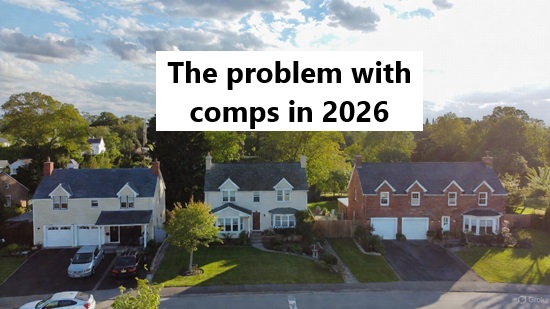
The problem with comps in 2026 (and the good news)

By Ryan Lundquist

Excerpts: We have a problem with comps in real estate. There just aren’t that many, and it’s made it much more challenging to figure out value. Yet, this could get a little better in 2026.

WE’VE HAD A COMP PROBLEM FOR THREE YEARS:

We’ve been missing about 30% of the normal number of sales. This is true both locally and nationally. This chart from Calculated Risk shows the gravity of the situation as we’ve been flirting with historically low volume for three years now. And what this means is we’ve had 30% less comps to choose from. Yikes!! This is exactly why it’s been challenging to value properties.

THE BAD NEWS

We’re still poised to have historically low volume until there is a sharper change with affordability. The housing market simply feels stuck, and there isn’t a mechanism to quickly increase the number of buyers. In other words, it’s not going to be a market with robust volume for a long time since it’s going to take years to get buyers and sellers back. Yet, if the projection is correct about next year, it’s going to be something positive to get even a little more volume back. This isn’t standing ovation news, but maybe a golf clap is in order. And for my real estate friends, this is a solid reminder to stay focused.

SOMEONE WAS MAD AT ME FOR USING OLD COMPS

I had someone angry with me recently that I used much older sales as comps in a private appraisal. I tried to explain my rationale, but the person wasn’t willing to listen. Here’s the deal though. If there aren’t any recent comps, then we have two choices. Use older sales and adjust for how the market has changed, or go out further into other markets for more recent sales (doable, but not always ideal). In real estate textbooks, this issue doesn’t come up since there are always three model match sales over the past 90 days, but the real world is different. The truth is valuations today look a bit messy since we don’t have the luxury of ample recent sales. We simply have to do the best with what we have. Remember, when the market changes, how we do things sometimes has to change also.

To read more, Click Here

My comments: Some interesting appraiser comments. This is a hot topic for appraisers now. Definitely a problem in most areas. What is your market like?

Read more!!

Posted in: AMCs, appraisal, appraisal charts and graphs, MLS

Appraising with Inventory Shortages and Surpluses

Newz: UAD Quality Ratings,

Appraising with Inventory Shortages and Surpluses

December 5, 2025

What’s in This Newsletter (In Order, Scroll Down)

  • LIA AD: When a Property Owner Wants to Do the Appraiser’s Job
  • Understanding UAD Quality Ratings (Updated for UAD 3.6 and the New URAR)
  • Gothic-Inspired ‘Fairytale Castle’ in Miami’s Exclusive Coconut Grove Michigan Hits the Market for $24 Million
  • Navigating the Challenges of Inventory Shortages and Surpluses in Real Estate: Insights from a Chief Appraiser at a National AMC By Jim Jenkins, Chief Appraiser
  • What Is a Scatter Chart Analysis in Appraisal?
  • 53% of U.S. homes lost value in the past year, the most since 2012 – Zillow
  • MBA:  Mortgage applications decreased 1.4 percent from one week earlier

————————————-

Click here to subscribe to our FREE weekly appraiser email newsletter and get the latest appraisal news

————————————————

—————————————-

Understanding UAD Quality Ratings (Updated for UAD 3.6 and the New URAR)

Excerpts: Quality ratings are one of the most familiar parts of UAD, but the way appraisers report them has changed under UAD 3.6 and the new dynamic Uniform Residential Appraisal Report (URAR). While the Q1–Q6 scale remains in place, the way you apply, support, and reconcile quality is more structured and data-driven than in the legacy forms.

What “Quality” Means in UAD 3.6

In UAD 3.6, quality represents the materials, craftsmanship, and construction standards of a dwelling. The familiar Q1 through Q6 framework still applies, but the workflow is different:

Quality is no longer a single, form-level checkbox.

You now provide quality ratings in multiple places:

  • Exterior Quality Rating (Dwelling Exterior section)
  • Interior Quality Rating (Unit Interior section)
  • Kitchen and Bathroom Detail tables
  • Overall Quality (reconciled in Section 15)
  • The “overall” rating is informed by the component-level data you report in these earlier sections.

Other topics include:

  • What Does UAD Stand For?
  • What Are the Quality of Construction Ratings?
  • Breaking Down the UAD Quality Ratings (Q1–Q6)
  • How Quality Is Applied in the New URAR
  • Tips for Applying Quality Ratings Credibly

Final Thoughts

Quality ratings remain an important part of UAD, but the approach is more precise now. UAD 3.6 pushes appraisers to rely on observable details rather than broad descriptions or market norms. When you follow the definitions, support your ratings with the structured data, and reconcile logically, the quality rating becomes a clear and defensible part of your analysis.

To read more, Click Here

My comments: Comprehensive and well written. Worth reading.

Read more!!

Posted in: appraisal, appraisal business, appraisal charts and graphs, real estate market

ADU vs. Two-Family Property for Appraisers

Newz: ADU vs. Two-Family Property,
Everyone Must Be Ready for UAD 3.6

November 21, 2025

What’s in This Newsletter (In Order, Scroll Down)

  • LIA: Protecting My Appraisal Report
  • How to Identify a Single-Family with ADU vs. Two-Family Property
  • $1 Million Midcentury Modern Ranch House on Lake Michigan Holds a Wild Surprise in the Basement
  • Top Appraisers Advise on How to Generate New Business
  • When One Bulb Fails… Why Everyone Must Be Ready for UAD 3.6 By Tony Pistilli
  • A Real Estate Agent’s Guide to Understanding the New UAD 3.6 Appraisal Report By Tom Horn
  • MBA: Mortgage applications decreased 5.2 percent from one week earlier

———————————————————————-

SFR or 2 units with an ADU?

Click here to subscribe to our FREE weekly appraiser email newsletter and get the latest appraisal news


————————————————————–

How to Identify a Single-Family with ADU vs. Two-Family Property

Excerpts: Across the country, accessory dwelling units (ADUs) are becoming more common. Cities and counties are updating zoning laws to encourage them, whether to increase housing supply, create affordable rental options, or allow families to live closer together. Appraisers need to understand how ADUs fit into their local markets, how they’re used and perceived, and how to properly distinguish them from true two-family properties.

The presence of an additional living unit can complicate the appraisal process by making it difficult for you, the appraiser, to know how to classify the subject property. How do you know whether you’re dealing with an accessory dwelling unit (ADU) or a second unit? In this article, you’ll learn about ADU meaning and types as well as how to identify a single-family with ADU vs. two-family property.

Topics include:

  • What Is an ADU?
  • Do ADUs Add Value to a Property?
  • Types of ADUs
  • What Is a Two-Family Property?
  • Is It a Single-Family with an ADU or Two-Family Property?

To read more and watch an ADU video, Click Here

My comments: Good explanations of ADU issues. Well done short video. UAD 3.6 requires including details on ADUs.

Read more!!

Posted in: ADUs, appraisal business, UAD 3.6

Fannie Mae’s Selling Guide Updates

Newz: Fannie Mae’s Selling Guide Updates, Appraisers and Certainty in Mortgage Lending

November 14, 2025

What’s in This Newsletter (In Order, Scroll Down)

  • LIA: Conflicting Assignments and Professional Ethics
  • Beyond Terminology: What Fannie Mae’s Selling Guide Updates Mean for Appraisers
  • Genius’ Midcentury Modern Home Designed by Jimi Hendrix’s Studio Architect Lists in Woodstock for $3.5 Million
  • App-solutely Clueless: When Sales Tries to School Appraisers
  • Trump Defends 50-Year Mortgage Plan as ‘Not a Big Deal’ After Furious Backlash
  • The Strategic Advantage of Certainty in Mortgage Lending What it means for appraisals
  • MBA: Mortgage applications increased 0.6 percent from one week earlier

—————————————————————

Changes to Fannie Selling Guide dated April 15, 2014

Click here to subscribe to our FREE weekly appraiser email newsletter and get the latest appraisal news

————————————————————

—————————————————————

Beyond Terminology: What Fannie Mae’s Selling Guide Updates Mean for Appraisers

by Scott DiBiasio, Director of Government Affairs, Appraisal Institute

Excerpts: Fannie Mae recently issued important updates to its Selling Guide that may look like technical revisions but have significant implications for appraisers, consumers, and the valuation profession. The most visible changes involve the retirement of the term “appraisal waiver” in favor of “value acceptance” and adjustments to the Reconsideration of Value (ROV) process. Together, these changes reflect the GSEs’ modernization priorities—but also highlight the ongoing tension between efficiency and transparency.

From “Appraisal Waiver” to “Value Acceptance”

Fannie Mae has decided to eliminate the term “appraisal waiver” from the Selling Guide, replacing it entirely with “value acceptance.” Even the parenthetical “(appraisal waiver)” has been removed. The stated goal is to unify industry language and create consistency across the valuation spectrum.

That may sound harmless, but let’s be clear: the average consumer is not going to recognize that “value acceptance” means their lender has waived an appraisal altogether. That lack of clarity undermines transparency at a critical stage of the lending process.

The Appraisal Institute (AI) will absolutely continue to call these products what they are: appraisal waivers. Language matters. Consumers and appraisers alike deserve accuracy, not euphemisms, when it comes to understanding whether an independent appraisal has been performed.

Why This Matters for Appraisers

Taken together, the Selling Guide updates and the expansion of waiver-based models point to several key takeaways:

1. Language shapes perception. If consumers don’t recognize that value acceptance is an appraisal waiver, transparency suffers. That’s why AI will continue to call these products by their true name.

2. Efficiency is not clarity. Simplifying disclosures may ease compliance for lenders, but it risks reducing borrower awareness of their rights.

3. Modernization is accelerating. With waivers, UPDs, and hybrid appraisals expanding, appraisers must adapt their skills to remain at the center of the valuation process.

4. Incursion is real. Regulators, property data collectors, and third-party vendors are positioning themselves between appraisers and their clients. The profession cannot afford to cede ground.

To read more, Click Here

My comments: I had never read about what is discussed in this article. I don’t always read the Fannie Selling Guide Updates. Now I know why it is important.

When I wrote my article on Appraisal Regulatory Chaos in the monthly Appraisal Today newsletter, Scott let me include excerpts from what he has written about it plus sent me new information. This article has a few “promotional” comments about AI and classes, but well worth reading.

Read more!!

Posted in: appraisal business, bias, Fannie, UAD 3.6

Appraisers – Disclose When You Did Not Do the Inspection 

Newz: 24 Hour Appraisal, Disclose When Some One Else Did the Inspection

November 7, 2025

What’s in This Newsletter (In Order, Scroll Down)

  • LIA AD: When a Property Owner Wants to Do the Appraiser’s Job
  • The Hazards of Signing a URAR When Another Person Conducts the Inspection
  • Honolulu Diamond Head Estate for $34,000,000
  • The 24-Hour Appraisal Funded by Appraisers
  • How Policy, Data, and Technology Are Reshaping Lending and Valuation: MBA 2025 Recap
  • MBA: Mortgage applications decreased 1.9 percent from one week earlier

———————————————————————–

Click here to subscribe to our FREE weekly appraiser email newsletter and get the latest appraisal news

———————————————–


———————————————-

The Hazards of Signing a URAR When Another Person Conducts the Inspection

By Dan Bradley

Excerpts: When using the Uniform Residential Appraisal Report (URAR) to report the results of an appraisal, the appraiser’s signature on the report is not merely a formality, it is a certification. By affixing his or her signature, the appraiser is certifying to (among other things) having personally made an interior and exterior inspection of the subject property.

Clients, AMCs, and state regulatory agencies are reporting that appraisers are increasingly delegating their inspection responsibilities to others yet are signing the URAR certifying they made a personal inspection.

What are the risks if an appraiser signs a URAR report certifying an interior and exterior inspection that was actually conducted by someone else?

Conclusion

Signing a URAR appraisal report that states the appraiser personally inspected the property, when in fact another party performed the inspection, is a serious liability risk. USPAP permits an appraiser to value a property that they did not make an interior and exterior inspection.

However, USPAP does not allow an appraiser to communicate a misleading report. A report that falsely indicates that an individual made an inspection of a property when in fact they did not is misleading, and could result in disciplinary action, civil liability, or other negative consequences.

To read more, Click Here

My comments: Good reminder, especially with the use by the GSEs of alternative valuation methods. Of course, you know nothing about the qualifications of the person doing the inspection. The article did not specifically address UAD 3.6, but I assume it would have the same certification section and requirements.

Read more!!

Posted in: AMCs, appraisal, Appraisal fees, UAD 3.6