Fannie Appraiser Update Q1 2026

Newz: Fannie Appraiser Update Q1, Suspended AMC, Bias

March 27, 2026

What’s in This Newsletter (In Order, Scroll Down)

  • LIA AD: Should I consider this an actual claim?
  • Fannie Appraiser Update Q1
  • 126-Year-Old Gentlemen’s Estate That Epitomizes Gilded Age Opulence Lists in the Berkshires for $8 Million
  • Suspended: The AMC That Turned “Review” Into a Value Demand
  • Retirement: To Stay, To Go, or Can’t Decide? That is the Question!
  • AQB Releases Job Analysis Report
  • A Baseless Bias Claim Turns Into a State Appraisal Crusade
  • MBA: Mortgage applications decreased 10.5 percent from one week earlier

———————————————————-

————————————————————————–

Fannie Appraiser Update Q1

Email Message 3/19/26

Welcome to the first Appraiser Update of 2026. This edition delivers timely information to help you stay competitive and ready for what’s next, including:

Preparing for the fast-approaching Uniform Appraisal Dataset (UAD) 3.6 and Forms Redesign mandate on Nov. 2, 2026;

Understanding Appraisal Quality Monitoring letters to appraisers related to time adjustments; and

Embracing expanded eligibility for manufactured housing and accessory dwelling units – available only for UAD 3.6 submissions.

Topics list

  • UAD 3.6 articles
  • Appraisal Software Selection
  • Treatment of Location and View
  • Market Conditions Analysis Letters
  • MH Policy Changes
  • ADU Policy Changes

To read the update, Click Here

My comment: Worth reading, of course. Always a very popular link!

Read more!!

Scatter Charts for Appraisers

Newz: Scatter Charts, Do Not Use List, UAD 3.6 Key Changes and Resources

March 30, 2026

What’s in This Newsletter (In Order, Scroll Down)

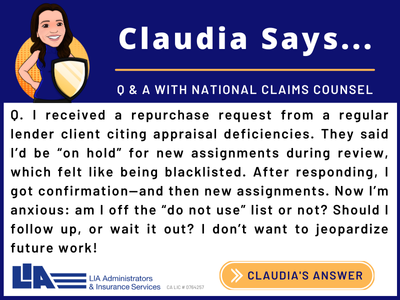
  • LIA AD: Am I Still on the ‘Do Not Use’ List
  • The Power of Scatter Charts: Bringing Objectivity to Appraisals
  • by Scott Cullen
  • 1780 Tiny Home That Was Built by a British Sea Captain Hits the Market in Georgetown for $1,198,000
  • MY AD: Highest and Best Use of the Cost Approach
  • The housing market so far in 2026 By Ryan Lundquist, March 11, 2026
  • Trump’s Executive Order on Access to Home (including appraisers)
  • MBA Origination Stats: Mortgage applications decreased 10.9 percent from one week earlier


Click here to subscribe to our FREE weekly appraiser email newsletter and get the latest appraisal news

————————————————

The Power of Scatter Charts: Bringing Objectivity to Appraisals

by Scott Cullen

Excerpts:

“Objectivity is isolating the effect of individual variables on value.”

Once upon a time, in a suburban neighborhood not so far away, an appraiser came across a pure pair, two homes that seemed almost identical. They shared the same neighborhood, lot size and condition. The only difference was size. One house had 2,500 square feet of above grade finished area and the other had 2,300. The first sold for $460,000, the second for $446,000. The difference in price was $14,000. The difference in area was 200 square feet—producing an adjustment of $70 per square foot.

Traditionally, an appraiser might document this relationship as a simple table, noting the difference in sale price and living area. Unfortunately, pure pairs are so rare that they often seem like a fairytale—something every appraiser dreams of finding but seldom does. In the real world, properties rarely align so neatly. Markets shift, concessions appear, and location nuances creep in. Yet there is hope. By learning to use scatter charts, embracing adjusted pairs, and understanding sensitivity analysis, appraisers can move closer to true objectivity in their valuation work.

From Paired Sales to Sensitivity Analysis

The Appraisal of Real Estate, 15th Edition defines paired data and grouped data as forms of sensitivity analysis—a method used to isolate the effect of individual variables on value. Sensitivity analysis is the overarching principle that allows us to quantify how much one variable contributes to price, while holding others constant (Appraisal Institute, 2020, p.371). Scatter charts are among the most powerful tools available to visualize and calculate these relationships.

Why Visualization Matters

Scatter charts do more than calculate—they communicate. They combine mathematical precision with the clarity of visualization. For appraisers, this means turning abstract numbers into evidence that both clients and reviewers can see.

A well-constructed scatter chart illustrates the logic behind the adjustment and lends weight to the appraiser’s conclusions. It reinforces transparency: others can replicate the math, verify the trendline, and confirm that the adjustments are derived from observable market behavior.

As the saying goes, “A picture is worth a thousand words.” In appraisal, it’s also worth credibility. Scatter charts bring statistical discipline to the craft of valuation, grounding professional judgement in data.

To read more, Click Here

My comments: Read more to see scatter chart samples and how they are used.

Read more!!

How to Appraise Basements

Newz: Appraising Basements, AMCs,

Who is doing UAD 3.6 appraisals?

February 20, 2026

What’s in This Newsletter (In Order, Scroll Down)

  • LIA AD: Limiting Liability to Third Parties
  • Basement Appraisals: Understanding Contributory Value (Updated for UAD 3.6)
  • Fascinating ‘Basement Home’ That Rises Just Inches Above the Ground Hits the Market for Less Than $160K
  • The AMCs: Coming Soon to a Lawsuit Near You
  • MY AD: The Cost Approach for Appraisers is not popular, by Tim Andersen, MAI
  • 26% of Appraisers Feel Ready: What UAD 3.6 Demand
  • Mortgage applications increased 2.8 percent from one week earlier
  • Have you received a UAD 3.6 order yet? Survey.
  • MBA: Mortgage applications increased 2.8 percent from one week earlier

Basement Issues and Values

Click here to subscribe to our FREE weekly appraiser email newsletter and get the latest appraisal news


Basement Appraisals: Understanding Contributory Value (Updated for UAD 3.6)

Excerpts: While homeowners may ask, “Does a finished basement add value to my appraisal?” you know the answer is a bit more complicated. A basement may impact a residential property’s value, and as an appraiser, you’ll need to evaluate its significance.

While determining the contributory value of basements isn’t overly complex, it does pose challenges. To help you out, we’ll outline essential steps and provide tips for evaluating a basement’s contributory value.

Summary

Determining how a basement contributes to a residential property’s value requires an appraiser to identify the basement type, its level of finishing, and any common concerns, like signs of mold or structural issues. Following best practices is key. This includes separating the basement from the above-grade finished area, understanding the intended use of the space, and completing comprehensive market research. By doing so, you can evaluate the basement’s contributory value more accurately

Topics include:

Types of basements (partial list)

Cellars

Partial Basements

Walk-Up Basements

How Is the Basement Finished? Determining Levels

Know the Intended Use and Client Requirements

To read more, Click Here

My comments: The best analysis and advice on basements I have seen. Watch the 7 minute video on Understanding Q/C ratings (UAD 3.6) Where I work the ground does not freeze. In my Island city there is no cemetery as the ground water from San Francico Bay is very high. Basements need pumps to remove salt water. Basement walls are not used to support the home. Sometimes there are above ground basements, basements dug out of the ground, and many other types of basements. In steep hillside areas what is a “basement” can be controversial.

In Alameda, my city, native American burials, primarily from the Ohlone people, are heavily concentrated in former shellmounds (ancient cemeteries) throughout Alameda. Almost were removed many years ago, similar to other Bay area cities close to the Bay.

Read more!!

UAD 3.6 Appraisal Fees

New URAR and UAD 3.6 Appraisal Fees, AMC Tech Fees

February 6, 2026

What’s in This Newsletter (In Order, Scroll Down)

  • LIA AD: Using trainees – the safe way
  • Will the New URAR and UAD 3.6 Impact Appraisal Fees?
  • It looks like an SF apartment complex. It’s actually a $32M estate.
  • From Dealerships to AMCs: Tech Fees as the New Normal by Desiree Mehbod
  • MY AD: New in the February 2026 issue of Appraisal Today. Book Review: Mein Comp: The Last Appraiser
  • “Because Houses Are Human” AI and Appraisers By David Hyman
  • Architecture Is About to Grow a Nervous System
  • Buildings that are alive
  • MBA: Mortgage applications decreased 8.5 percent from one week earlier

Click here to subscribe to our FREE weekly appraiser email newsletter and get the latest appraisal news


———————————————————-

Will the New URAR and UAD 3.6 Impact Appraisal Fees?

Excerpts: With the new URAR and UAD 3.6 rolling out this year, you may be wondering what effect this will have on your fees. While there’s still a lot of uncertainty and speculation around this question, we’re sharing the opinions of professional real estate appraisers who answered our survey, “How do you anticipate the new URAR/UAD 3.6 changes will impact your appraisal fees?”

FEE INCREASES

Over 40% of respondents said they expect their appraisal fees to increase. Still, many respondents (28%) said they anticipate that fees will remain static, and 31% said they are not sure yet. Read their comments below to learn why or why not some appraisers believe their fees will increase with the new URAR and UAD 3.6.

APPRAISER RESPONSES

I Expect Fees to Increase” (41%)

“I have had ample time to practice the new 3.6 through my software and the inspection time will be increasing substantially…. Inspections are going to take some time especially if the dwelling is more than 1,000sf, which most in my market area are well above that. The report cannot be submitted until all sections are 100% complete, so there will be more time contacting agents, homeowners, town facilities, etc. Hoping the learning curve will be quicker than it appears at this point in time.”

I Expect Fees to Stay About the Same” (28%)

FEES REMAIN THE SAME

“I think it will be more labor intensive in the field but easier once you get back to the office.”

“I expect fees to stay the same. There may be less form filling; however, the analysis will remain the same. It’s not about the form or the analytics tools we use; it’s the analysis itself.”

The Bottom Line

While many appraisers anticipate that UAD 3.6 and the new URAR will initially require more time, tighter workflows, and new technology investments, the longer-term outlook is more balanced and, in many ways, promising.

Transitions of this scale often come with short-term growing pains, but clearer data standards, more structured reporting, and modernized tools are designed to create greater consistency and efficiency once the learning curve levels out. As several respondents pointed out, it will take real-world experience to understand where timelines and workloads ultimately settle.

At the same time, the new form offers appraisers a stronger platform to demonstrate the depth of their analysis, judgment, and market expertise.

To read more, Click Here

My comments: THIS IS THE HOTTEST TOPIC IN RESIDENTIAL LENDER APPRAISING. Appraiser opinions are useful but we all want to know what AMCs are planning for fees. I anticipate higher fees by AMCs, borrowers and direct lenders. I have been writing about what is happening since early this year, including details of all the “questions” and uncertainties on the SFR report.

Another significant fee factor is that many appraisers are retiring or quitting because they don’t want to learn the UAD 3.6 for appraisers. Those who stay will have lots of appraisal work as the 11-2-26 mandatory deadline approaches.

UAD 3.6 is not mandatory until November 2, 2026. The Legacy forms will be used during the transition. Will it be done by 11-2-26? Now, software vendors and lenders are way behind. 11-2-27 new mandate date???

On the plus side, 41% of appraisers said fees would go up and are positive about the new reports.

Read more!!

Appraising with Limited Comps

Newz: Limited Comps, Freddie Mac: Property Data Collection, Avoiding ourt

January 23, 2026

What’s in This Newsletter (In Order, Scroll Down)

  • LIA AD: Avoiding Court
  • Arriving at a Credible Appraisal When Comparable Sales Are Limited By Kevin Hecht
  • MAPPED: The Most Expensive Home Sales of 2025—From Palantir CEO’s Record-Breaking Ranch to Florida’s Priciest Mansion
  • MY AD: The AMC Conundrum in the Appraisal Business by Dave Towne
  • From Data to Value: How Mass Appraisal Delivers Fair Market Assessments
  • Freddie Mac. Insight Articles: Property Data Collection: An Overview
  • Housing Market Predictions for 2026
  • MBA: Mortgage applications increased 14.1 percent from one week earlier

———————————————————————–

Click here to subscribe to our FREE weekly appraiser email newsletter and get the latest appraisal news


Arriving at a Credible Appraisal When Comparable Sales Are Limited
By Kevin Hecht

Excerpts: Limited sales activity is common in rural markets, custom-home neighborhoods, and low-turnover areas. When comps are few, the appraiser’s task is not to find perfect matches, but to show that the selected sales are the best available indicators of value and that all departures from ideal data are well supported.

In this article, we’ll answer questions like: How far back do appraisers look for comps? How far out geographically? What other tips and tricks do appraisers use to arrive at a credible appraisal, even when comps are limited? Additionally, we’ll share some insights from appraisers who answered our survey question, “What do you do when appraisal comps are few?”

When recent, proximate, and similar sales are unavailable, appraisers typically rely on some combination of the “Three D’s” to broaden their search for comparable property sales:

Dated – Search for older sales within the subject neighborhood.Distant – Search for similar sales farther away in competing neighborhoods.

Dissimilar – Search for dissimilar sales within the subject neighborhood by widening the parameters for improvements (GLA, age, features, etc.).

How Far Back Do Appraisers Look for Comps?

Time adjustments draw scrutiny. Most agency assignments expect appraisers to use the most recent closed sales available, typically within the prior 12 months when possible.1 When older sales are used, market conditions adjustments often become central to the analysis.

Time adjustments should be supported with clear data, applied consistently, and reconciled logically. Underwriters pay close attention to whether these adjustments reflect documented market behavior rather than assumptions, particularly in shifting markets.

We surveyed our appraisal community to find out, “What do you do when appraisal comps are few?” The following comments show how individual appraisers often put their own spin on the “Three D’s” when expanding the search for comparable sales:

“Time and distance. My preference is to go back farther in time within the same neighborhood and/or market area and make market condition adjustments. If that still doesn’t provide enough comps, I expand the market area, looking for more recent sales with similar characteristics to the subject property.”

“First consider a broader time frame. Market conditions adjustments are very supportable.”

“Expand search to other competitive neighborhoods. Next, go back in time.”

To read more, Click Here

My comments: I usually go back in time sometimes several years or longer if needed. Of course, I don’t do GSE appraisals with their restrictions…


Read more!!

Q4 2025 Fannie Mae Appraiser Update – AMC Risk, UAD 3.6

Newz: 12 Days of Appraiser Christmas,
Q4 2025 Fannie Mae Appraiser Update –AMC Risk, UAD 3.6

December 19, 2025

What’s in This Newsletter (In Order, Scroll Down)

  • LIA AD: A Family Feud and Intended Use
  • Q4 2025 Fannie Mae Appraiser Update – AMC risk, UAD 3.6
  • 12 Days of Appraiser Christmas
  • Santa’s House is Back on Zillow with a Bold New Holiday Look
  • Highest and Best—and the Highest Value By Richard Hagar
  • AQB Proposed Changes in New Appraiser Requirements
  • MBA: Mortgage applications decreased 3.8 percent from one week earlier
  • ————————————————————

Click here to subscribe to our FREE weekly appraiser email newsletter and get the latest appraisal news


——————————————————

Q4 2025 Fannie Mae Appraiser Update

As the year wraps up, we’re focused on what matters most to your success: clarity, consistency, and confidence in every appraisal. This edition gives you practical insights to stay ahead:

  • Several deep-dive articles on Uniform Appraisal Dataset (UAD) 3.6, focused on condition/quality ratings, the inspection component of Scope of Work, disaster mitigation, energy efficiency, and training and resources;
  • Why time adjustments matter—and how to apply them effectively; and
  • Our approach to managing Appraiser Management Company (AMC) risk for stronger compliance and reliability. Excerpts: In Jul. 2025, Fannie Mae began sending letters to AMCs detailing appraisal quality issues identified through Fannie Mae loan quality reviews completed in 2024. Each letter contains a comprehensive list of the issues identified for appraisals associated with that AMC.

To read more, Click Here

My comments: Worth reading. First time I have ever seen comments on AMCs. Good to see that GSEs are looking at AMCs.

————————————————————–

12 Days of Appraiser Christmas

NOTE on video: Click on image and it opens in Youtube.

Very funny!! 3.5 minute video

Sample appraisal requests:

On the fourth day of Christmas my best client sent to me falling

Shacks, three field reviews, two double wides, and a drive by single family.

On the tenth day of Christmas, my best client sent to me 10 tax appeals and eight Mega Mansions.

Singer in this video is comedian David Cassel as the Ukulele Bandito http://www.theukulelebandito.com / (he is not a Portland appraiser, but he is funny)

Many thanks to Gary F. Kristensen, SRA, ASA, AGA at A Quality Appraisals in Portland, Oregon.

My comment: I love this FUN video ;>

Read more!!

Few comps in 2026 for Appraisers

Newz: Few comps in 2026, NAR Revises Nonmember Broker/Appraiser Access Policy

December 12, 2025

What’s in This Newsletter (In Order, Scroll Down)

  • LIA AD: Can’t Certify the Work
  • The problem with comps in 2026 (and the good news)
  • Gravity-Defying Colorado Mansion Designed by a Rocket Scientist Hits the Market for $2.7 Million
  • Creating a Histogram in Excel: A Guide for Appraisers
  • My ad: The AMC Conundrum in the Appraisal Business, By Dave Towne
  • NAR Revises Nonmember Broker/Appraiser Access Policy Language
  • MBA Mortgage applications increased 4.8 percent from one week earlier

Appraisers and Local Market Analysis

Click here to subscribe to our FREE weekly appraiser email newsletter and get the latest appraisal news

——————————————————


——————————————————-

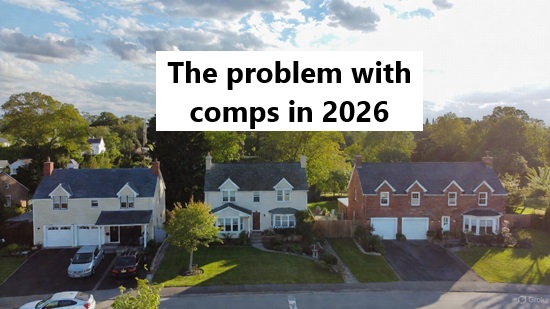
The problem with comps in 2026 (and the good news)

By Ryan Lundquist

Excerpts: We have a problem with comps in real estate. There just aren’t that many, and it’s made it much more challenging to figure out value. Yet, this could get a little better in 2026.

WE’VE HAD A COMP PROBLEM FOR THREE YEARS:

We’ve been missing about 30% of the normal number of sales. This is true both locally and nationally. This chart from Calculated Risk shows the gravity of the situation as we’ve been flirting with historically low volume for three years now. And what this means is we’ve had 30% less comps to choose from. Yikes!! This is exactly why it’s been challenging to value properties.

THE BAD NEWS

We’re still poised to have historically low volume until there is a sharper change with affordability. The housing market simply feels stuck, and there isn’t a mechanism to quickly increase the number of buyers. In other words, it’s not going to be a market with robust volume for a long time since it’s going to take years to get buyers and sellers back. Yet, if the projection is correct about next year, it’s going to be something positive to get even a little more volume back. This isn’t standing ovation news, but maybe a golf clap is in order. And for my real estate friends, this is a solid reminder to stay focused.

SOMEONE WAS MAD AT ME FOR USING OLD COMPS

I had someone angry with me recently that I used much older sales as comps in a private appraisal. I tried to explain my rationale, but the person wasn’t willing to listen. Here’s the deal though. If there aren’t any recent comps, then we have two choices. Use older sales and adjust for how the market has changed, or go out further into other markets for more recent sales (doable, but not always ideal). In real estate textbooks, this issue doesn’t come up since there are always three model match sales over the past 90 days, but the real world is different. The truth is valuations today look a bit messy since we don’t have the luxury of ample recent sales. We simply have to do the best with what we have. Remember, when the market changes, how we do things sometimes has to change also.

To read more, Click Here

My comments: Some interesting appraiser comments. This is a hot topic for appraisers now. Definitely a problem in most areas. What is your market like?

Read more!!

Condo Prices, up/down/?? for Appraisals

Newz: NAR Calls Out Unregulated Middlemen (AMCs), Modular Construction?

October 10, 2025

What’s in This Newsletter (In Order, Scroll Down)

  • LIA AD: Dealing with Unhappy Buyers as an Appraiser
  • Condo prices are obviously dropping, By Ryan Lundquist
  • Foreclosure Fixer-Uppers Ready for Their Next Chapter: 5 Abandoned Homes Offering a Bargain Deal to Buyers
  • The Modular Construction Revolution That Hasn’t Happened (Yet)

By Ivan Rupnik

  • NAR Calls Out Unregulated Middlemen: A Wake-Up Call for FHFA
  • When Appraisers Rally: Korea Sends the U.S. a Wake-Up Call
  • MBA Mortgage applications decreased 4.7 percent from one week earlier,

——————————————————–

Click here to subscribe to our FREE weekly appraiser email newsletter and get the latest appraisal news

———————————————


Condo prices are obviously dropping

By Ryan Lundquist

Excerpts: So many price graphs right now look pretty flat, but this condo scatter graph shows definitive declines, right? This is stunning to see, but it’s also not a shocker since the condo market has been hit harder over the past couple of years. Keep in mind I’m showing the entire county, and not every single subdivision will have the exact trend.

WHAT’S HAPPENING WITH CONDOS?

Buyers have been turned off lately with condos, and so much of it has to do with HOA fees rising and affecting purchasing power (see paragraph below). There can also be issues with obtaining financing. Moreover, SB326 is a new balcony law in California in 2025, and that’s also something we want to keep watching. Yet, the declines began before 2025, so don’t blame SB326 alone.

LOSING PURCHASING POWER IS A BIG PROBLEM – SEE GRAPHIC BELOW

Check out the huge difference in purchasing power between the following two properties. The monthly payment is the same for a $350K condo with a $600 monthly HOA fee and a $450K detached home without an HOA fee. While there is some advantage in having the HOA cover exterior maintenance or even having a gym on site, buyers are looking at the math, and the higher fee has been a roadblock for condos.

SUPPLY HAS GROWN FASTER WITH CONDOS

Condo supply has been growing at a faster pace all year than the detached market in Sacramento County. This is a good reminder that not all parts of the market are experiencing the same trend (key point). No wonder why prices have gone down at a quicker rate for condos, right?

To read more, Click Here

My comments: What’s happening in your market??

Over my 40 years appraising in my local market, condo markets are almost always different than the market for detached homes.

Many condos in my city are conversions of apartments built prior to 1970. Today, there are new condos are being built here and all over the Bay Area due to very high land prices. Across the street from my office are many 3-5 story new condos with a few attached townhomes. They are sorta boring and look the same. A marina is being converted to residential mostly. I had my business there for over 30 years and had to move as my office building was destroyed in the first year of Covid.

Read more!!

Humor What is an appraiser?

What is an Appraiser? Humor, Upzoning,
New UAD Quality Ratings

August 15, 2025

What’s in This Newsletter (In Order, Scroll Down

  • LIA AD: A Family feued and Intended Use
  • Upzoning: What It Is and What Appraisers Need to Know
  • Off-Grid ‘Stilt Home’ That Hovers Above a St. Augustine Beach Hits the Market for $1.35 Million
  • What Is An Appraiser? Humor
  • The New UAD Quality Equation: Interior + Exterior = Overall Rating
  • The Harbor Model: Where Appraisers Take the Helm
  • Mortgage applications increased 3.1 percent from one week earlier,

——————————————————————————-

Click here to subscribe to our FREE weekly appraiser email newsletter and get the latest appraisal news

—————————————————————————


Upzoning: What It Is and What Appraisers Need to Know

Excerpts: Upzoning is a powerful but often misunderstood tool in urban planning and real estate. In this post, we’ll break down what upzoning is, why it’s becoming more prevalent, and what appraisers need to know about its potential impact on property values.

What Is Upzoning?

Upzoning is the process of modifying zoning laws to allow for higher-density development in areas that previously had stricter land-use regulations. This might include permitting multi-family housing where only single-family homes were allowed, increasing building height limits, or reducing minimum lot sizes. The goal is often to promote more efficient land use and address housing shortages.

What to Be Aware of as an Appraiser

It’s important for real estate appraisers to stay informed about changes in local zoning laws, as these can significantly affect property valuations. Upzoning, in particular, can alter what is legally permissible on a parcel of land, shifting development potential and land use expectations.

When upzoning occurs, the highest and best use of a property may change—from a single-family home to a multi-family development, for example—requiring appraisers to reassess the property’s value accordingly.

How to Address Upzoning in Your Appraisal Report

If you find that a property has been upzoned, how do you tackle that in your actual appraisal report? “I think the place to start is building permitting,” says Dobbs. “A lot of cities have pretty decent permitting websites. You can go in there and look at what types of permits are being pulled in the area.”

More topics:

  • How to Address Upzoning in Your Appraisal Report
  • Opportunities for Real Estate Appraisers
  • How to Prepare for Future Upzoning

To read more, Click Here

My comments: Excellent, understandable article about this important topic. There are rental housing shortages in many areas in U.S. Today there is pressure to allow upzoning to make more rental housing available.

Residential appraisers did not receive much education on this topic. You don’t want to get into trouble with the state board by using the incorrect highest and best use on a property or not recognizing and reporting on upzoning.

I do commercial appraisals. HBU issues occur regularly in my city, so I keep up on zoning changes.

Don’t forget local regulations. In my city, regulations (not in zoning regs) restricts the number of rental units on a property (downzoning) after many Victorians were demolished and ugly modern apartment buildings constructed in the early 1960s. Appraisers only looking at zoning for HBU would make a very big mistake.

—————————————————————————————-

Off-Grid ‘Stilt Home’ That Hovers Above a St. Augustine Beach Hits the Market for $1.35 Million

Excerpts 4 bedroom 3 baths,3,374 square feet, 0.41acre lot, built in 1980

Beachfront homes that offer instant access to white sand and a crystal-clear ocean are a rare find—but even rarer is a dwelling that sits directly atop that beachfront, mere feet away from the water.

Yet one such property has just washed ashore in St. Augustine, FL, listed for $1.35 million, 19 years after it last changed hands for less than a sixth of that price.

This unique dwelling is situated on large wooden stilts that have been hammered into the sand, providing the perfect perch overlooking the water, ensuring 24/7 beach access—a rare amenity that comes with its fair share of complications.

Unsurprisingly, given its location, the home is classified as being at “extreme” risk of flooding, according to the Realtor.com® Flood Factor rating, which notes that the dwelling has a “100% risk of flooding” over the next 30 years.

Additionally, the “stilt house” has an extreme wind factor rating, as well as an extreme risk of hotter-than-average temperatures.

To read more Click Here

To read the listing with 59 photos and a video tour, Click Here

————————————————————————-

What Is An Appraiser? Humor

An appraiser is one who compiles and analyzes voluminous data of problematical accuracy from sources of dubious veracity and derives therefrom a numerical quantification of unquestionable necessity,

analogous to a nebulous and euphemistic concept representational of value commensurate with ambient configurations of the open market

and promulgates thereby a precise written declamation which delineates his observation, deliberations and conclusions all done while he feigns absolute ignorance of the avaricious machinations of Buyers, Sellers, Brokers and Lenders, compensated only by that penurious stipend known as the professional fee.

This joke is from Bill Sparks. Bill doesn’t know where this joke originated, but Thanks for sending it to us!

My comments: We all need a little appraiser humor!

Read more!!

Highest and Best Use For Appraisers

Newz: Hidden AMC fees, Appraisal Subcommitee Cutbacks, Highest and Best Use

July 11, 2025

What’s in This Newsletter (In Order, Scroll Down)

    • LIA AD: Borrower Wants Answers Appraiser Can’t Give
    • What is Highest and Best Use in Appraisal? Appraisal
    • By Kevin Hecht
    • Purple Rain! Vibrant Violet Villa That Would Make Prince Proud for $3,499,000
    • Could a Class Action Lawsuit Finally Unbundle Hidden AMC Fees? by Isaac Peck, Publisher WorkingRe
    • The AMC Industry Won’t Be Toppled by Code
    • Appraisal Oversight (ASC) Subcommittee Faces Cuts Amid Leadership Turmoil
    • Mortgage applications increased 9.4 percent from one week earlier

Click here to subscribe to our FREE weekly appraiser email newsletter and get the latest appraisal news

————————————————-

——————————–

What is Highest and Best Use in Appraisal?

By Kevin Hecht

Excerpts: When determining property value, one of the most critical concepts in real estate appraisal is highest and best use (HBU). Professional standards require appraisers to develop an opinion of HBU when necessary for credible assignment results. HBU refers to how a property should be used to generate maximum value under specific constraints, not necessarily how it’s currently being used.

Definition of Highest and Best Use

In professional appraisal practice, Highest and Best Use is defined as “the reasonably probable and legal use of vacant land or an improved property that is physically possible, appropriately supported, financially feasible, and that results in the highest value” (Appraisal Institute, The Dictionary of Real Estate Appraisal, 2022). This definition emphasizes that HBU must be reasonably probable, not merely possible or speculative.

Appraisers must analyze the property as vacant land, and as improved, considering what is legally permissible, physically possible, financially feasible, and maximally productive in the current market.

Why Highest and Best Use in Appraisal Matters

Highest and Best Use gives stakeholders insight into a property’s worth at its full potential. It guides market value determinations that reflect the property’s full potential and informs development and investment decisions based on feasibility and profitability. Additionally, HBU supports lending and underwriting decisions, especially for construction loans or redevelopment projects, guiding land use planning and zoning analysis in transitioning neighborhoods.

To read more, Click Here

My comments: Well written and understandable. I was trained at an assessor’s office to first determine highest and best use for each property I appraised. For homes, issues I have had were a small house on a large lot where nearby lots were being converted to apartments. More common for homes is a possible lot split. HBU is a regular factor for appraising commercial properties in my city. The main part of the city was almost fully developed by the early 1940s. Often the HBU was not the current use.

Read more!!