9-15-16 Newz// Rush fees, Flying saucer homes, $1.1 billion home

A Map of the Last Remaining Flying Saucer Homes

All the 1960s Futuro Houses left in the world.

Just For Fun!! Take a break from writing up those darn appraisal reports ;>

Excerpt: The Futuro House, in all its space age retro splendor, is like a physical manifestation of 1960s optimism. Shaped like the Hollywood idea of a flying saucer, the Futuro is a plastic, prefabricated, portable vacation home built to easily adapt to any climate or terrain, from mountain slopes to the seaside. After enjoying a heyday in the late ’60s and early ’70s, the remaining Futuros are now scattered across all parts of the globe, from the Australian beaches to the mountains of Russia, like secluded relics of midcentury technoutopianism.

Very interesting!!

http://www.atlasobscura.com/articles/a-map-of-the-last-remaining-flying-saucer-homes

My comment: I love atlasobscura.com. The strange homes and buildings I include in these emails are just the tip of the iceberg!!!!

——————

What is your typical rush fee?

www.appraisalport.com poll.


My comment: Rush fees are another way to make more money during this boom time, to save for the downturn when AMC fees will drop.

The most critical appraisals are those for purchases, which can require rush fees to get appraisers to drop their regular refi business and do them.

I am hearing about widely varying AMC fee increases from around the country, depending on the local market supply of appraisers willing to work for AMCs I guess. Savvy AMC appraisers reply to low bids with an increased fee. After a few weeks, sometimes their fee is accepted. Local appraisers I know only work for a very few select AMCs, if any. But, when business slows way down, they take more AMC work. I also hear from appraisers in the same market with widely varying fees that they will accept.

What do I do? Rush fees stress me out too much as I am very backed up. I just put new appraisal requests in my queue, which is typically around 60 days. Sometimes I will do one faster if it is a special circumstance and/or a referral from a local real estate agent, but I don’t require a rush fee. When I used to do appraisals for purchases, I always gave them priority but never charged a rush fee. I am definitely in the minority!!

What do you think? Post your comments at https://wp.me/p7jsxG-Cl !!!

——————————————

The Most Expensive House In The World Could Sell For $1.1 Billion

Just For Fun!! Take a break from writing up those darn appraisal reports ;>

Excerpt: What can justify a $1.1 billion price tag for a house?

Before searching for the features behind the number, let’s clarify that in this case, “the house” is rather a large, opulent mansion on the French Côte d’Azur, set in a “small” privileged refuge between Nice and Monaco frequently described as the ‘billionaires’ playground.’

First, there’s the house itself, with the understated name Villa Les Cèdres-The Cedars-at the center of Saint-Jean-Cap-Ferrat, known in French as a “presqu’île,” or “almost island.”

The description of the magnificent property in the French press includes 10 bedrooms, a ballroom, concierge, a chapel, 50-meter swimming pool dug into the rocks, a winter garden and stables for 30 horses.

My comment: I could take a few months (or more) to do an appraisal for a trip to France to appraise this property… Or maybe just an open house tour ;>

Very interesting!!

http://www.forbes.com/sites/ceciliarodriguez/2016/08/20/at-1-1-billion-the-most-expensive-house-in-the-world-in-france-goes-to-market

————————————

Beware of unknown desperate AMCs sending email solicitations

An appraiser I know, who only works for one AMC, received an email request from an AMC he had never heard of. He replied politely that he was not interested. He was added to their approved list and bombarded with requests for appraisals every day. It was a lot of hassle to get his name removed.

I seldom get any AMC appraisal requests by email or phone, or request to join their panel. I must be on a Do Not Call or Email List ;> I have been replying to emails saying I have never worked for an AMC. They are really getting desperate!! Now, I am thinking about not even replying.

==========================================

In the June 2016 issue of Appraisal Today

FHA attic inspection requirement 

Excerpt: Inspection Tips – Insulation and attic access by Doug Smith, SRA, AI-RRS

When blown in insulation is added, the installer will often add an extension or dam to the scuttle that makes it difficult to fully observe the full attic.

Formerly, attics had walkways which when blown in insulation is applied, these walkways were covered with insulation. If the scuttle is in a closet and closet shelves make it difficult to fully access the attic, the difficulty with attic must be reported and a photograph taken to demonstrate the difficulty with attic access.

However, if the access is blocked by personal possessions, it may be practical to enlist the help of the homeowner to make the attic or scuttle accessible. In the instant case of the underwriter stating that a full inspection is required, the underwriter is incorrect.

The appraiser must document why a full inspection was not performed when there is not an accessible attic. Suggested language might include: “A full attic inspection was not

performed as the subject property does not have a readily accessible attic and only has scuttle access.” Along with a photo of what can be seen from the scuttle, the appraiser might add that the appraiser completed a head and shoulders inspection of the attic.

Remember to check the block on page one of the form that the attic is accessed by a scuttle. If the property has a full attic, note if a full inspection was performed and comment how access was gained either by stairway or drop stair.

To read the full article, plus 2+ years of previous issues, subscribe to the paid Appraisal Today.

 $8.25 per month, $24.75 per quarter, $89 per year (Best Buy)

or $99 per year or $169 for two years

 Subscribers get, FREE: past 18+ months of past newsletters

plus 4 Special Reports, plus 2 Appraiser Marketing Books!!


To purchase the paid Appraisal Today newsletter go to

www.appraisaltoday.com/products or call 800-839-0227.

If you are a paid subscriber and did not get the September 2016 issue, emailed September 1, 2016, please send an email to info@appraisaltoday.com   and we will send it to you!! Or, hit the reply button. Be sure to put in a comment requesting it ;>

=====================================================

Selling a $5 Million, Seven-Story Basket Is No Picnic

Its size, location, and fundamental basket-ness make it tough to sell, even at a steep discount

Thanks (again) to Jonathan Miller at http://www.millersamuel.com/housing-notes/

Excerpts: “You might see it three or four miles off before you come around the bend, and then you say, ‘That is a basket. That is unquestionably a basket,'” said Tom Rochon.

It is a basket, or rather, a seven-story office building shaped like one-a massive facsimile of the signature picnic basket made by the company once headquartered there. Some 40 miles outside Columbus, Ohio, the basket building, as it’s locally known, is one of the area’s grandest attractions, inviting quirky selfie-seekers, architecture nerds, and, of course, basket enthusiasts.

When the property – slightly larger than another Ohio landmark, Cleveland’s Rock and Roll Hall of Fame-was listed 18 months ago, the asking price was $7.5 million. Now it’s on the market for $5 million, or about $28 a square foot, about half of what traditionally shaped office buildings in the area usually sell for… commercial property in the area typically ranges from $50 to $80 a square foot.

The basket was built for about $32 million and finished in 1997.

http://www.bloomberg.com/news/articles/2016-09-07/selling-a-5-million-seven-story-basket-is-no-picnic

My comment: I regularly write about weird properties in my weekly emails, including the Basket House a few years ago. Finally we find out what it is (not) worth. Definitely an Appraisal Challenge!!

———————–

Status Quo Bias: ‘Linear” Thinking in the Real Estate Industry

by Jonathan Miller

Excerpt: When we look at forecasting, planning, trending or anything that includes a look out over the future, I find the real estate industry (i.e. appraisers, real estate agents & brokers) generally thinks along linear lines.

For example:

When housing prices rise…they will rise forever.

When housing prices fall…they will fall forever.

When sales activity rises…they will rise for ever.

When inventory falls…it will fall forever.

When rental prices rise…they will rise forever.

…and so on.

Where does this status quo bias come from?

Click here for some more interesting comments..

http://www.millersamuel.com/status-quo-bias-linear-thinking-in-the-real-estate-industry/

My comment: Of course, I completely agree. It is very important if you work in a market like mine, where residential prices seem to go from stable to increasing and back overnight. I have no idea why. I go on the broker open house tour every week and see what agents are saying. For example, only 1 or 2 offers vs. 5-6 and longer days on market

————————————————-

HOW TO USE THE NUMBERS BELOW. Appraisals are ordered after the loan application. These numbers tell you the future for the next few weeks. For more information on how they are compiled, go to https://www.mba.org

Note: I publish a graph of this data every month in my printed newsletter, Appraisal Today. For more information or get a FREE sample issue go to www.appraisaltoday.com/products or send an email to info@appraisaltoday.com . Or call 800-839-0227, MTW 8AM to noon, Pacific time.

WASHINGTON, D.C. (September 14, 2016

Mortgage applications increased 4.2 percent from one week earlier,

according to data from the Mortgage Bankers Association’s (MBA) Weekly Mortgage Applications Survey for the week ending September 9, 2016. This week’s results included an adjustment for the Labor Day holiday.

The Market Composite Index, a measure of mortgage loan application volume, increased 4.2 percent on a seasonally adjusted basis from one week earlier. On an unadjusted basis, the Index decreased 17 percent compared with the previous week. The Refinance Index increased 2 percent from the previous week. The seasonally adjusted Purchase Index increased 9 percent from one week earlier. The unadjusted Purchase Index decreased 15 percent compared with the previous week and was 8 percent higher than the same week one year ago.

The refinance share of mortgage activity decreased to 62.9 percent of total applications from 64.0 percent the previous week. The adjustable-rate mortgage (ARM) share of activity increased to 4.6 percent of total applications.

The FHA share of total applications increased to 9.6 percent from 9.5 percent the week prior. The VA share of total applications increased to 12.0 percent from 11.9 percent the week prior. The USDA share of total applications increased to 0.7 percent from 0.6 percent the week prior.

The average contract interest rate for 30-year fixed-rate mortgages with conforming loan balances ($417,000 or less) decreased to 3.67 percent from 3.68 percent, with points decreasing to 0.36 from 0.37 (including the origination fee) for 80 percent loan-to-value ratio (LTV) loans. The effective rate decreased from last week.

The average contract interest rate for 30-year fixed-rate mortgages with jumbo loan balances (greater than $417,000) decreased to 3.64 percent from 3.66 percent, with points increasing to 0.36 from 0.30 (including the origination fee) for 80 percent LTV loans. The effective rate decreased from last week.

The average contract interest rate for 30-year fixed-rate mortgages backed by the FHA decreased to 3.50 percent from 3.52 percent, with points decreasing to 0.27 from 0.35 (including the origination fee) for 80 percent LTV loans. The effective rate decreased from last week.

The average contract interest rate for 15-year fixed-rate mortgages increased to 2.97 percent from 2.96 percent, with points unchanged at 0.34 (including the origination fee) for 80 percent LTV loans. The effective rate increased from last week.

The average contract interest rate for 5/1 ARMs remained unchanged at 2.87 percent, with points increasing to 0.37 from 0.30 (including the origination fee) for 80 percent LTV loans. The effective rate increased from last week.

The survey covers over 75 percent of all U.S. retail residential mortgage applications, and has been conducted weekly since 1990. Respondents include mortgage bankers, commercial banks and thrifts. Base period and value for all indexes is March 16, 1990=100.
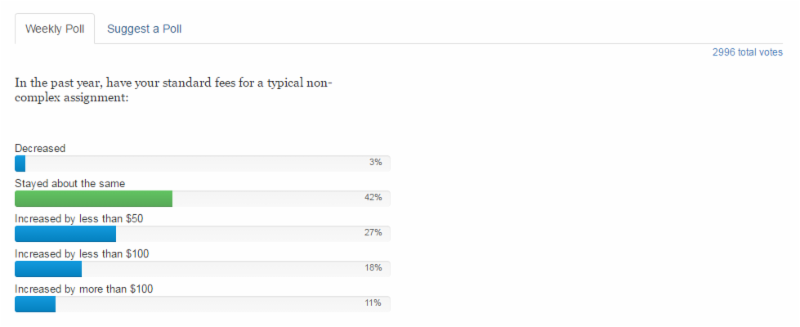
How many appraisers are increasing their fees?

Poll: In the past year, have your standard fees for a typical non-complex assignment?

www.appraisalport.com

My comment: Good news that the majority of responses were for increased fees. But, less than $50 annual increase is low. If you work for AMCs, your fees will drop when business slows down, assuming you are not getting very low fees now. If you don’t ask for higher fees now, or drop AMCs that insist on low fees, you are losing lots of money. I keep increasing my fees by $50 every 3-4 months and am still below other local appraisers’ fees. Remember, there is little or no AMC “loyalty” to appraisers. They will not remember you when business slows down and you really need work.
AT_final_rev_newslet

What are Customary & Reasonable fees when residential fees are changing?

I don’t think that residential fees have ever gone up this quickly, both for non-AMCs and some AMCs. Keeping up on residential fees in my local market is tough. Of course, the “flip side” is that fees will go down when the boom is over, especially AMC fees.

Some consider VA fees as C&R, but they are increasing also in some areas.

Although some AMCs keep looking for appraisers who will do a quick turn time for a low fee, it is becoming more and more difficult as fewer appraisers are willing to do this.

I recently attended a CE class nearby that focused on AMCs, who said that there were big issues with turn times and fees from their lender clients. The September issue of the paid Appraisal Today will have an article on what was discussed at the class, “AMCs tell All to residential appraisers”.

Why were fees relatively stable for decades? Prior to HVCC, in my market, fees would gradually go up over time, increasing $25 to $50 when demand was very strong. Most fees were in a fairly narrow price range. We made money on the easy tract homes and lost money on the “tough ones”.

Why have fees gone up so dramatically? Appraisers are reporting turning down (or not responding to) 20-30 or more requests a day from AMCs. Residential appraisers had never competed much on lender fees prior to HVCC. I do commercial appraisals, where bidding has always been done. Fee ranges of $1,500 to $3,000 for the same property have never been unusual. The time and cost of bidding is included in the fee. Most AMCs have been using bidding as there was an oversupply of appraisers. When business is slow, they offer lower fees. Now that business is strong, they pay higher fees. Of course, there are still some appraisers doing them for low fees.

Appraisal Today Paid Newsletter

In some areas, AMCs are desperate for any appraisers at any fees to accept appraisals, especially for purchases. Particularly tough are markets where an AMC has one, or a few appraisers. NAR warned real estate agents not to try for 30 day closes.

How do AMCs handle the high fees? This depends on their lender agreements. TRID is a factor as loan officers usually set the fees, which are very difficult to change. Some lenders will allow AMCs to charge more for a specific appraisal. If not, the AMC has to pay the additional cost.

What about turn time? If a loan needs to close quickly, such as a purchase loan, some lenders are offering very high fees. Be careful taking them – be sure to see how difficult the appraisal will be before accepting as turn time is very critical. Also, you will doing less work for a regular “A list” clients.

8-18-16 Newz: Ex-appraiser sentenced , Statistics humor, Flooding

Statistics humor

Three statisticians go hunting. They see a deer and the first one

shoots, hitting three feet left of the deer. The second one shoots, hitting three feet right of the deer. The third one leaps up in joy, yelling, “we got him!”

Thanks to Scott Jura for this great joke! Posted on a yahoo appraiser discussion group.

—————————–

Ex-appraiser sentenced to 6 years for mortgage fraud

Excerpt: A Pittsburgh federal jury convicted Jason Moreno, 33, on five counts of wire fraud and two counts of conspiracy in September 2013.

A former appraiser, Moreno overstated housing values and glossed over problems such as a den of black snakes in one house’s basement so that others in the scheme could obtain loans for more than the properties were worth.

U.S. District Judge Nora Barry Fischer resentenced Moreno on Monday to six years in prison and three years of probation.

http://triblive.com/news/adminpage/10811871-74/moreno-court-sentenced

Court documents from 1/16. Lots of very interesting details:

http://www2.ca3.uscourts.gov/opinarch/141568p.pdf


Read more!!

8-11-16 Newz//How to fix the appraiser shortage now, Photo blurring, Gold medal for town planning in 1936 Olympics

America’s First Medal at the Nazi Olympics Was For…Town Planning

Excerpt: Yes, from 1928 until 1948, town planning was an actual Olympic sport.

Town planning fell under an “architectural design” category at the Olympic art competition. The field that year was dominated by German entries. Yet the first U.S. medal of the Olympics went to Lay, a New York architect, for his ambitious blueprint to modernize Marine Park in Brooklyn.

http://www.atlasobscura.com/articles/americas-first-medal-at-the-nazi-olympics-was-fortown-planning

My comment: I love these Obscure Olympic Facts ;>

—————————————

Photo blurring gone waay overboard!!

Excerpt: At issue was the ubiquitous “client requirement” involving digital masking of people from images. While lenders and AMCs wave the Fair Housing penalty flag in order to assure compliance; there is NO such law. Never has been.

Lenders need to re-examine the reason for all of these pointless and invasive interior shots. They add nothing meaningful to the file. Nobody is laying out mortgages for Beanie Baby collections and bad drapes. So why are appraisers wasting megapixels on decorating images?

AMCs are on notice to cease demanding and insisting that appraisers do digital staging. That is clearly in violation of Illinois law.

Click here to read the full article plus the comments, of course…

http://appraisersblogs.com/digital-staging-amc-fair-housing-myth

My comment: Blurring interior pictures on walls, personal objects, etc. seems very excessive. Don’t know about rooms with strange devices and chains hanging from walls and ceilings, etc ;> Maybe appraisers will only be able to appraise vacant homes with nothing in them without getting requests for blurring. This applies only to AMCs doing business in Illinois, but maybe the AMCs will quit doing it in other states.

Read more!!

How to fix the appraiser shortage now!!

CLARIFICATION:
Until I wrote this post, I had been saying that AMC low fees and hassles were the main cause of the current appraiser shortage. Many appraisers won’t work for AMCs. Others left the profession because they would not work for AMCs.

I was wrong. The major factor is that trainees cannot sign on their own until certified. There is no other way to manage the huge ups and downs in volume of lender appraising. Prior to HVCC, this had been done for decades.

If this cannot be fixed, lenders will try to get their regulators to require fewer appraisals by using AVMs, BPOs, etc. They have always wanted this.  Their reason now: too few appraisers causing purchases to be delayed. 

========================================================

The residential lender appraisal system is broken.

The problem is NOT primarily low fees, licensing requirements, college degree, aging appraiser population, reluctance to hire “competitors”, etc.

The Problem: for the first time, there is no way to bring in trainees during boom times to sign on their own.

Since the 1970s, when Freddie and Fannie started and refis accelerated, lender volume had huge ups and downs, depending on interest rates. Lenders hired armies of trainees and laid them off when business slowed down. During the last big boom prior to the mortgage meltdown, fee appraisers hired the trainees and let them go. Now, very few appraisers are hiring trainees, except friends and relatives.

Lots of complaints now about the appraiser shortage. The Appraisal Foundation is considering lowering licensing requirements for certified appraisers. But, this will take years to change.

If lenders accept licensed appraisers, who do not need a college degree but need 150 hours of college classes, this will really help. A minimum of 12 months and 2000 hours of experience is required. The certified appraiser requirements will not have to be reduced. Certified res is 2.5 years of experience.

The AQB experience requirements are the minimum. I am in California, which has the AQB requirement: “Personally inspect the property with the Trainee until the supervisor determines the Trainee is competent to make unsupervised inspections, in accordance with the Competency Rule of USPAP for the type of property being appraised.” Some states have gone way beyond this, requiring the supervisor to inspect the subject with the trainee for the two years of experience. e supervision.

Lenders who want to switch from conventional and FHA will not be able to use licensed or trainees, of course. But, this is much, much better than weeks of delays getting appraisals, especially for purchases.

AQB requirements

Residential (AL) 150 hours, covering specific modules including the 15-hour National USPAP Course (or its equivalent as determined by the AQB); and 30 semester units of college-level education, OR an Associate’s degree or higher (in any field). 2,000 hours and encompassing no less than 12 months of acceptable appraisal experience. Any non-complex 1-4 family property with a transaction value up to $1 million; and non-residential property with a transaction value up to $250,000


Certified Residential (AR) 200 hours, covering specific modules, including the 15-hour National USPAP Course; and a Bachelor’s degree or higher. 2,500 hours and encompassing no less than 2.5 years (30 months) of acceptable appraisal experience. Any 1-4 family property without regard to transaction value or complexity; and non-residential property with a transaction value up to $250,000.


Of course, for existing appraisers, this is a boom time with no new competitors entering the business. Fees are increasing dramatically and have increased this much in the past.

What percentage of your work do you receive from AMCs?

My comment: Looks like there are some appraisers who don’t work for AMCs. I had expected higher percentages that worked mostly for AMCs.  Now that business is strong, some appraisers don’t work for AMCs, or take less work from them. When business is slow, they do more work for AMCs.

7-28-16 Newz Origin of tiny houses – HUD warning letters – FHA transfers

The Surprising Origins of the Tiny House Phenomenon

Why ancient hermits are the key to understanding our tiny home obsession

Excerpts”

Invariably, someone will remind you that civilization emerged from tiny houses-caves, yurts, tents, wigwams, igloos, grass huts, and so forth.

These early antecedents are beside the point. Sioux, Samoans, and Inuits were not offered more spacious alternatives. But people who opt for tiny houses-meaning the kind that tug at heartstrings and star on cable-generally choose to live small. The reasons aren’t just practical, but also ethical and emotional.

the true parents of tiny-house living are hermits. From the ancient Chinese Taoists in mountain caves to the Desert Fathers of third century Christianity and onward (the word “hermit” derives from the Greek word for “desert”), hermits were the first people to actively downsize to confined, remote, and minimally furnished living spaces.

Read the full story here:

http://www.curbed.com/2016/7/13/12162832/tiny-house-history-hermits

My comment: The most interesting article I have read on tiny houses. Of course, I started sailing sailboats in the early 1970s. Living aboard a sailboat is the Ultimate Tiny House!! Narrow and long but very portable… Another good link from Jonathan Miller…

———————————-

FHA Case Transfer, issued July 26, FHA INFO #16-49

Mortgagees should note the following about case transfers relative to appraisal reports in both the EAD (electronic appraisal delivery) portal and FHAC:

Read more!!

7-21-16 Newz//Bracketing-AMC staff appraisers-Appraiserville

8 Spooky New York Places That Should Be in the New Ghostbusters Movie

There’s something strange in these neighborhoods.

Excerpt: Here is one, but you gotta see the photos and the other 7!!

The Morris-Jumel Mansion

On a hill overlooking the Harlem River, the stately Morris-Jumel mansion is not only Manhattan’s oldest home but supposedly one of its most haunted. Its macabre history started after owner Stephen Jumel died in 1832. His wife Eliza was rumored to have had a hand in the death-there was some suspicion afoot that she orchestrated the carriage accident that killed him….

Take a break from typing appraisal reports and check it out!!

http://www.atlasobscura.com/articles/8-spooky-new-york-places-that-should-be-in-the-new-ghostbusters-movie

———————————————

The Shrinking of the American Lawn

As houses have gotten bigger, yard sizes have receded. What gives?

Excerpts:

The American house is growing. These days, the average new home encompasses 2,500 square feet, about 50 percent more area than the average house in the late 1970s, according to Census data. Compared to the typical house of 40 years ago, today’s likely has another bathroom and an extra bedroom, making it about the same size as the Brady Bunch house, which famously fit two families.

This expansion has come at a cost: the American lawn.

As homes have grown larger, the lots they’re built on have actually gotten smaller-average area is down 13 percent since 1978, to 0.19 acres. That might not seem like a lot, but after adjusting for houses’ bigger footprints, it appears the median yard has shrunk by more than 26 percent, and now stands at just 0.14 acres. The actual value lies somewhere between those two numbers, since a house’s square footage could include a second (or third) floor. Either way, it’s a substantial reduction.

Read the full story at: Very interesting!!

http://www.citylab.com/navigator/2016/07/the-shrinking-of-the-american-lawn/490157/

—————————-

There Go My Brackets

From the Illinois Appraiser June 2016

Excerpt:

Is it a USPAP violation to fail to bracket or end up with a tight bracket?

Read more!!

6-9-16 Newz:: Expandable Space Station, Turn times, FHA news  

Time-lapse video of the International Space Station expandable habitat

Excerpt: On Saturday, May 14, NASA successfully completed the deployment of the first expandable habitat on the International Space Station. With help from the ground, NASA astronaut Jeff Williams began inflating the Bigelow Expandable Activity Module (BEAM) at 9:04AM ET.

He opened the valve 25 times to inject air into the module in short bursts, according to NASA. Time in between allowed the BEAM to expand and stabilize, as the NASA and Bigelow Aerospace teams monitored the module’s internal pressure. The BEAM was expanded to its full size seven hours later, at 4:10PM ET.

http://www.theverge.com/2016/5/30/11812844/this-time-lapse-video-of-the-beam-inflating-on-the-international-space-station-is-awesome

My comment: WoW!!!

——————————

United States Spy Town Auction

It’s not the first time that an entire American town has gone on the auction block, but it might be the most unusual. Sugar Grove Station, West Virginia was originally a United States Navy military base to support part of the National Security Agency’s surveillance operation. Though the array of giant parabolic dishes that continue to track location and content of international telecommunications activity is still in operation and not part of the sale, they are completely obscured from view behind thick forest on their ridgetop one mile distant. When it became unnecessary to house related analytical staff at the base, it was retired in the fall of 2015 and put up for auction to the highest bidder over $1 million.

Built between 1960 and 2014, the fenced and gated rural town has private full-service utilities to support as many as 500 people on over 120 acres. Included are 80 homes on tree-lined residential streets in like-new condition, a swimming pool, bowling alley, youth daycare center, community center with fireplace which was designed to function as a restaurant with bar, a gym, full-sized indoor basketball court, tennis and racquetball courts, a football field, large playground with kiddie pool, and twelve guest cabins for visitors. There are also several large buildings for multiple use as well as a four-section hobby building for working on cars, woodworking shop and other creative pursuits. For community safety, a police station and fire station are already in place.

https://www.toptenrealestatedeals.com/homes/weekly-ten-best-home-deals/2016/06-06-2016/1/ 

https://en.wikipedia.org/wiki/Sugar_Grove_Station

Read more!!