Newz 3-3-15 Abandoned places, Late appraisal, Cost vs value, Fees

Spam blockers are going wild!!! I have made some changes in subject line and some changes in newsletter content so more subscribers will get this newsletter. I can’t even mention some of the changes as using the words may send this email to spam!!!
=====================================================
17 abandoned places around the world
Take a break from your appraisals with these Interesting Links!!
 
Here are a few:
1.  House of the Bulgarian Communist Party – Mount Buzludzha, Bulgaria
9. Michigan Central Station – Detroit, Michigan, United States
10. Sarajevo Olympic Bobsleigh and Luge Track – Sarajevo, Bosnia and Herzegovina
Good for taking an appraisal break!!
———-

Read more!!

Newz 2-25-16-True cost of low fees, FHA appraisals, Worst street names, Appraisers with guns

20 worst street names

Excerpt:

I’m sure the folks on Cannibal Road are lovely people, I just won’t be attending any of their dinner parties. These are the streets that you don’t want to find yourself driving down – trust us, no good can come from a stroll on Buckets of Blood Street. Proceed with caution..

http://heavy.com/comedy/2012/12/the-20-worst-street-names/

Thanks (again) to Jonathan Miller for this great link!!

What are the strangest street names you have seen?

POST YOUR STRANGE STREET NAMES BELOW AND READ OTHER COMMENTS!!

My comment: Yes, there is an O’Rourke Street in a nearby city!!

—————————-

How many appraisers are doing FHA appraisals now?

From www.appraisalport.com

My comment: I suspected that most appraisers will do them even with all the additional work required. Only 13% have given up FHA appraisals.

Read more!!

Newz: 2-18-16 No amcs – Banks fined – College degree

Toronto’s Half House

Willy Wonka would love this weird half-a-home

Excerpts:

No, this isn’t a trick of Photoshop. Nor is it the world’s nastiest spite house; rather, this bonafide half-home shares more with its nail house brethren after witnessing a history of blight and zoning changes.

The lone row home at 54 1/2 Saint Patrick Street dates back to Toronto’s slums in the late 19th century. Built somewhere between 1890 and 1893, this bay-and-gable relic from a bygone era once was a one of six identical, structurally intertwined homes on what was then known as Dummer Street

This begs the question: how does half a building cleave away so cleanly only to leave the rest of it standing?

Read more at: Be sure to click on photo full screen to see it better

http://www.atlasobscura.com/places/toronto-s-half-house

 More photos and info atClick here Link was too long to post…

Read more!!

NEWZ// 2-4-16 – Adjustments-Unwanted mansions-Why homeowners don’t refi-Loan buybacks

 5 Reasons Homeowners are not Taking Advantage of Refi Opportunities

Excerpts:

Historically low mortgage rates have been circling the housing market for several years now. Low mortgage rates present opportunities for homeowners to refinance their homes, but recent data and analysis shows that they are not taking advantage of billions of dollars in savings.

Although the number of refinancers may appear to be large, it is actually down from over 7 million in April 2015. Black Knight reports that interest rates were under 3.7 percent during this time, and the 20-year rate was 3.96.

Black Knight Data & Analytics SVP Ben Graboske explained, “This population is diminishing, and as mortgage interest rates rise, it will only continue to shrink further.”

Here are the five:

Lower credit scores and income.

Hassle and upfront expense.

Not enough equity.

Inconsistent job history.

Lack of assets.  

Lots more info plus a link to the original study.

http://www.themreport.com/news/data/01-25-2016/5-reasons-homeowners-are-not-taking-advantage-of-refi-opportunities

My comment: interesting analysis plus a link to the nerdwallet full analysis. I have always wondered why so few people are not doing refis with rates still at historic lows.

——————————————

 CU Quick Guide Videos Now AvailableNew short videos (~4 min) show how to easily use the Collateral Underwriter® (CU™) web application to research common messages. Watch the Quick Guide Intro to the Comp Selection Message to see how to use CU to review appraisals with a material difference between the appraiser-provided and CU model-selected comparable sale rankings. The Quick Guide to Data Discrepancy Messages shows how to quickly view other appraiser observations when there is a discrepancy in reported data (either from what the appraiser previously reported or from what other appraisers have reported.) Want to learn how other lenders have leveraged CU? Review this new Housing Industry Forum article which details how lenders that maximize the use of CU have been able to make the underwriting process more efficient while improving appraisal quality and reducing appraisal-related loan defects.Additional CU live webinar dates are also now available:

CU User Interface Basic Training: Feb 10, 2016 from 2 – 3:30 p.m. ET

CU User Interface Advanced Training: Feb. 18, 2016 from 2 – 3:30 p.m. ET

Maximize your Appraisal Review Efficiency and Effectiveness with CU: Feb. 24, 2016 from 2 – 3 p.m. ET

For more information on CU visit the CU web page. 

My comment: see how CU works, from the lender side. 

——————————-

America’s Most Unwanted: The Neverland Ranch and Other Unsold $100 Million Mega-Mansions

Excerpt:

Michael Jackson’s $100 million Neverland-formally known as Sycamore Valley Ranch-is still stuck on the block.

Listed last May (sans the King of Pop’s amusement park), the 2,698-acre compound in Los Olivos showcases a 12,598-square-foot, French Normandy-style main house with six bedrooms and nine baths. Other structures include three separate guesthouses, a 5,500-square-foot movie theater with a stage, numerous barns, animal shelter facilities, and a maintenance shop.

Check them all out at:

http://www.forbes.com/sites/kristintablang/2016/01/26/100-million-mega-mansions-for-sale-neverland-ranch-jeff-greene-rancho-san-carlos-palazzo-di-amore-le-palais-royal

My comment: if they ever do sell… very, very long exposure times!

===============================================


Adjustments – “Support” vs. “Proof, what should you do?

New in the FEBRUARY 2016 issue of the paid Appraisal Today

Adjustments Part 1 – Are you making too many adjustments? Lots of ideas, research, etc.

– Support vs. proof for adjustments by Bob Keith. A very good explanation of Scope Creep on adjustments. He is the former Executive Director 

of the Oregon State Appraisal Board and is a consultant for appraisers with state board complaints

Identifying Residential Architectural Styles by Mark Nadeau,SRA, Book review. Read my review to decide if you want to buy the book.                        

Two good, practical residential books, with very good tips on adjustments  Book reviews. 

The Dictionary of Real Estate Appraisal, 6th Edition – Read my review to decide if you want to buy this book. 

Cancel at any time. For any reason!!

$8.25 per month, $24.75 per quarter, $89 per year (credit card only),  

or $99 per year or $169 for two years (no credit card required) 

Subscribers get, FREE: past 18+ months of newsletters plus 4 Special Reports!!

If you are a paid subscriber and did not get the January 2016 issue, emailed Jan. 4, 2016, please send an email to info@appraisaltoday.com  requesting it and we will send it to you!! Or, hit the reply button. Be sure to put in a comment requesting it ;>

==============================================================

Fannie, Freddie Unveil New Appeals Process for Loan Repurchases

Excerpt:

Fannie Mae and Freddie Mac unveiled an appeals process Tuesday that will allow an independent arbitrator to resolve disputes between lenders and the government-sponsored enterprises over loan repurchase demands.

The new independent dispute resolution process, which was approved by the Federal Housing Finance Agency and endorsed by the Mortgage Bankers Association, is an effort to provide lenders more certainty that they won’t later face costly repurchase requests if a loan goes bad.

http://www.nationalmortgagenews.com/news/secondary/fannie-freddie-unveil-new-appeals-process-for-loan-repurchases-1071121-1.html

My comment: Maybe lenders will be less paranoid about appraisals causing buybacks and cut back on Excessive Appraisal Requirements.

——————————

One-third of realty transactions are plagued by delays, some of them fatal By Ken Harney

Excerpt:

According to the study, of the 32 percent that experienced delays, 46 percent were triggered by “financing issues,” which is up from 40 percent during the first half of 2015. Appraisal-related problems caused 21 percent of the delays and home-inspection issues in 14 percent. Of the nearly 1 of every 16 (6 percent) of deals that turned into total disasters and fell through, home inspection and financing were the primary culprits. Sixteen percent went south because of the appraisal.

https://www.washingtonpost.com/realestate/one-third-of-realty-transactions-are-plagued-by-delays-some-of-them-fatal/2016/01/19/0d74d684-beb9-11e5-83d4-42e3bceea902_story.html 

My comment: maybe that’s why some AMCs are pressuring/asking for more when you “come in” under the sales price. Their clients, the lenders, don’t like deals falling through…

—————————————-

Study finds discrepancies between reported and actual home sales prices By Ken Harney

Are some realty agents hyping the pricing information on closed sales they report to their local multiple listing service, or MLS? And if so, should you care?

A first-of-its-kind study by appraisal and real estate experts suggests that maybe they are and maybe you should. Researchers compared closing documents – which are supposed to indicate the final price in sales transactions – with the prices that agents actually reported to their MLS and found that in nearly 1 of every 11 cases (8.75 percent) there were discrepancies. Overstatements of final price exceeded understatements by a ratio of nearly 3 to 1. In one case, the price reported to the MLS was 21.4 percent above the actual closing price.

https://www.washingtonpost.com/realestate/study-finds-discrepancies-between-reported-and-actual-sales-prices/2016/01/26/86d11660-c435-11e5-a4aa-f25866ba0dc6_story.html

My comment: And AMCs worry about discrepancies on public records and appraisers on GLA!! Another reason Big Data (CU) fails and needs appraiser input. 

———————————————————–

HOW TO USE THE NUMBERS BELOW. Appraisals are ordered after the loan application. These numbers tell you the future for the next few weeks. For more information on how they are compiled, go to www.mbaa.org 

Note: I publish a graph of this data every month in my printed newsletter, Appraisal Today. For more information or get a FREE sample issue go to www.appraisaltoday.com/products.htm  or send an email to info@appraisaltoday.com . Or call 800-839-0227, MTW 8AM to noon, Pacific time.

Mortgage applications decreased 2.6 percent from one week earlier 

WASHINGTON, D.C. (February 3, 2016) – Mortgage applications decreased 2.6 percent from one week earlier, according to data from the Mortgage Bankers Association’s (MBA) Weekly Mortgage Applications Survey for the week ending January 29, 2016.  The previous week’s results included an adjustment for the Martin Luther King holiday.

The Market Composite Index, a measure of mortgage loan application volume, decreased 2.6 percent on a seasonally adjusted basis from one week earlier.  On an unadjusted basis, the Index increased 11 percent compared with the previous week.  The Refinance Index increased 0.3 percent from the previous week to its highest level since October 2015.  The seasonally adjusted Purchase Index decreased 7 percent from one week earlier. The unadjusted Purchase Index increased 11 percent compared with the previous week and was 17 percent higher than the same week one year ago.

The refinance share of mortgage activity increased to 59.2 percent of total applications from 59.0 percent the previous week. The adjustable-rate mortgage (ARM) share of activity decreased to 5.9 percent of total applications.

The FHA share of total applications increased to 12.9 percent from 12.7 percent the week prior. The VA share of total applications remained unchanged from 11.1 percent the week prior. The USDA share of total applications remained unchanged from 0.7 percent the week prior.

The average contract interest rate for 30-year fixed-rate mortgages with conforming loan balances ($417,000 or less) decreased to its lowest level since October 2015, 3.97 percent, from 4.02 percent, with points increasing to 0.41 from  0.40 (including the origination fee) for 80 percent loan-to-value ratio (LTV) loans.  This is the fourth straight weekly decrease for this rate.  The effective rate decreased from last week.

The average contract interest rate for 30-year fixed-rate mortgages with jumbo loan balances (greater than $417,000) decreased to its lowest level since April 2015,  3.84 percent, from 3.89 percent, with points increasing to 0.26 from 0.25 (including the origination fee) for 80 percent LTV loans.  This is the fourth straight weekly decrease for this rate.  The effective rate decreased from last week.

The average contract interest rate for 30-year fixed-rate mortgages backed by the FHA decreased to 3.80 percent from 3.83 percent, with points decreasing to 0.35 from 0.38 (including the origination fee) for 80 percent LTV loans.  The effective rate decreased from last week.

The average contract interest rate for 15-year fixed-rate mortgages decreased to 3.22 percent from 3.28 percent, with points remaining unchanged at 0.37 (including the origination fee) for 80 percent LTV loans. The effective rate decreased from last week.

The average contract interest rate for 5/1 ARMs decreased to 3.00 percent from 3.09 percent, with points remaining unchanged at 0.34 (including the origination fee) for 80 percent LTV loans.  The effective rate decreased from last week

The survey covers over 75 percent of all U.S. retail residential mortgage applications, and has been conducted weekly since 1990.  Respondents include mortgage bankers, commercial banks and thrifts.  Base period and value for all indexes is March 16, 1990=100

 
To purchase the paid Appraisal Today newsletter  go to

www.appraisaltoday.com/products.htm  or call 800-839-0227. 


Comp Photos and MLS, Fannie, USPAP, etc.

To keep up on what is happening in appraisal businesses, mortgage lending, USPAP, etc. , Plus humor and strange homes, sign up for my FREE weekly appraisal email newsletter, sent since June 1994. Go to Home on the left side of the menu at the top of this page or go to www.appraisaltoday.com
Sign up in the Big Yellow Boxes

I regularly write about hot topics in appraising and appraisal business management issues
in my paid Appraisal Today monthly newsletter.
$99 per year or (credit card only) $8.25 per month, $24.75 per quarter, or $89 per year.
For more info, go to https://www.appraisaltoday.com/products


Appraisalport polls on comp photos from June 2015

By Steve Costello,

This month I want to discuss three recent polls dealing with comp photos. In the first poll, we asked “With the availability of MLS photos, do you still feel it is necessary to drive by and photograph every comp?” We had a total of 3819 responses and the top two answers were very close. The winner, with 40 percent of the vote, was “Sometimes, it depends on the complexity of the specific assignment.” Coming in a close second was “Yes, I always want to see any property I use in a report” with 38 percent of the vote. The final answer of “No, I would rather just use MLS photos” only scored about half the votes as the first two answers, finishing with 22 percent. This makes sense because I think most appraisers want to look at a comp before they include it in a report, especially if they aren’t already familiar with the property. I can also see where some appraisers are very familiar with the properties in their area, use many of the same comps over and over again, and don’t feel a need to drive by and photograph them every time they use them.

In the next poll, we asked “In your opinion, with MLS, Google, and other photo sources available to clients, the main reason original comp photos are required from the appraiser is:” This poll had 3986 responses and had a pretty clear winner. A full 63 percent of the appraisers chose the answer “To make sure the appraiser actually drives by the comps.” So it looks like most appraisers don’t think their clients care as much about the actual photo compared to just making sure the appraiser actually visited the comp. The answer we expected to be very popular, “To provide the client with up-to-date photos of the comps – ensuring they exist in the stated condition,” only received 22 percent of the vote. A third response of “So the clients won’t have to take the time to look up the photos from one of the sources noted above” didn’t do well, only pulling in 3 percent of the vote. Not a surprise — we didn’t really expect many appraisers to choose that answer. Finally, 13 percent of appraisers went with “Other reason” as the best choice for this question. We really don’t know if there were one or many “other reasons” or what they are.

Finally, we asked “Would you be in favor of eliminating the requirement to include an original photo of every comp as long as a recent MLS photo of the property could be included with your report?” This question was very popular with 4770 total votes. It also produced a landslide vote with 79 percent of the appraisers selecting the answer “Yes.” Only 15 percent answered “No” and would not want to use an MLS photo instead of an original if it were available. A final 6 percent were “Not sure” how they felt about this issue. So, from this poll it is clear that appraisers feel that an original photo is not a necessity to produce a quality appraisal as long as a good representative photo is available from another source like an MLS.

My comment: As we all know, a photo taken at the time of listing from the MLS is often better than one taken later and USPAP does not require comp photos. Fannie Mae certifications require that the appraiser inspect the exterior of the comp, not take a photo. What about re-using a comp photo? Why the requirement of an “original” photo? To be sure appraisers drive by the comps.

Appraisal Humor

Appraisal business tips

A very, very funny appraiser video!

What does it cost to take appraisal comp photos?(Opens in a new browser tab)

Poll – Taking comp photos?(Opens in a new browser tab)

Appraisal Today newsletter

Appraisals-how long to write/how many per week

To keep up on what is happening in appraisal businesses, mortgage lending, USPAP, etc. , Plus humor and strange homes, sign up for my FREE weekly appraisal email newsletter, sent since June 1994. Go to Home on the left side of the menu at the top of this page or go to www.appraisaltoday.com
Sign up in the Big Yellow Boxes

I regularly write about hot topics in appraising and appraisal business management issues
in my paid Appraisal Today monthly newsletter.
$99 per year or (credit card only) $8.25 per month, $24.75 per quarter, or $89 per year.
For more info, go to https://www.appraisaltoday.com/products

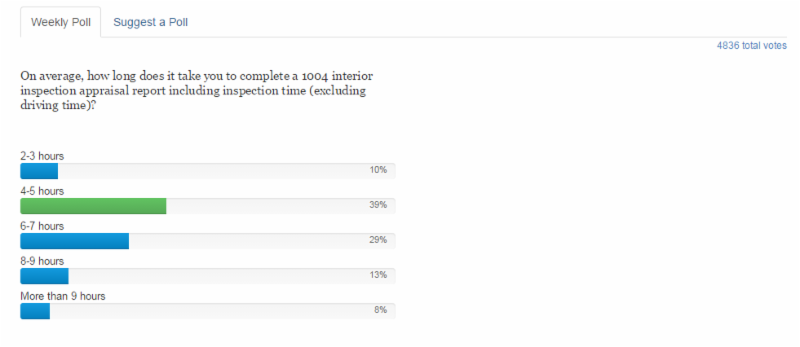
On average, how long does it take you to complete a 1004 interior inspection appraisal report including inspection time (excluding driving time)?

Another Very Interesting poll from May 2015

 My comment: I have been hearing about scope creep causing increased appraisal report writeup times but now there is some data. Significantly increased, and still increasing from pre-AMC days. My non-lender report writing time has not changed since before HVCC. Appraisalport is a lender portal, so I guess there are some appraisers that write fast and others that write slow. Or, maybe it depends on your clients. AMCs tend to combine the requirements of multiple lenders into very long lists of requirements.
—————————-

On average, how many “interior inspection” appraisals reported on a 1004 do you normally produce in a week?

My comments: Starting with a conforming tract home close to your office, the time increases, depending on driving time, use of an assistant and client requirements.

Appraisal Humor

Appraisal business tips

A very, very funny appraiser video!

Limiting Conditions and Assumptions Appraiser Humor(Opens in a new browser tab)

Appraisal Today newsletter

It’s Not a Comp, It’s a Sale – Lies, Damn Lies…and FNMA 'statistics'

Another “good one” by Dave Towne, Washington appraiser and commentator

Something’s been gnawing at my craw ever since January when FNMA’s wonderful CU was unleased to the world.  And before that, which still continues, is the AQM process they still use to judge the work of appraisers.

No one else has written about this, or even mentioned it, so I will: It has to do with the word “Comp” which is used liberally by FNMA.

What exactly is a “Comp?”

In FNMA’s world, it’s any property that they obtain, either by their vast AVM process which examines millions of property transactions, or properties that have been extracted from appraisal reports submitted by appraisers……..yes, your work.  In their fuzzy logic, it’s a “Comp” considered for your report if they say it is.  It is not!

A true “Comp” is a property viewed and/or analyzed by a real living, breathing, mirror fogging appraiser who compares that sold property against the subject property in terms of multiple features, characteristics and amenities.  It is not determined by an AVM or algorithm within the vast bowels of FNMA.  Until the property has such analysis done by an appraiser, it is merely a SALE……it is not a “Comp.”

This FNMA lie really became evident to me on 4/20/15 when FNMA released a news release about how CU has been integrated into their on-line Desktop Underwriter software mortgage lenders use, which you can read here:  http://www.fanniemae.com/portal/about-us/media/corporate-news/2015/6239.html?p=Media&s=News+Releases&from=RSS

Within that news release is this quotation from a VP at a mortgage lender:  “The collateral information that CU provides is invaluable and simply staggering,” said Breck Tyler, Executive Vice President, Trustmark Mortgage Services. “CU has aided in providing important comparable data that was previously unavailable or very difficult to get. CU messages in DU will help streamline appraisal review and make the underwriting of an appraisal a much more informed process.”

Then, FNMA released info directed to Correspondent Lenders who intend to use the CU process in UCDP, but don’t intend to sell the loan to FNMA:  https://www.fanniemae.com/content/fact_sheet/collateral-underwriter-non-seller-implementation-guide.pdf

That has this statement:  “Fannie Mae does not instruct or suggest to lenders that they ask appraisers to address all or any of the up to 20 comparables that are provided by CU for most appraisals.”

I want to repeat what I said above…in case you missed the point:  A PROPERTY IS NOT A “COMP” UNLESS YOU DETERMINE IT IS AND INCLUDE IT IN AN APPRAISAL REPORT.  Otherwise it’s just a ‘sale.’

If you’re an appraiser who liberally uses the word “Comp” in place of a ‘property sale’ I would ask that you be more careful.  If you receive info from a lender, AMC or anyone else who asks you to look at the “Comp” they have provided, correct them and use the words “sale property” until you have determined that it truly is a “Comp.”

I’m also asking members of appraisal organizations and associations to communicate your concern about this lie perpetrated by FNMA directly with them, and ask FNMA to change the word “Comp” used in their CU Reports, news releases, instructional materials, etc. to ‘Property Sales’ so that there is no misunderstanding about the significance of this issue.

If organizations and associations won’t do that on behalf of appraisers, then we might as well kiss the profession of residential real property appraising goodbye. Because if a list of ‘sales’ are considered “Comps” then an actual human appraiser won’t be needed to provide supportable property analysis and market value reports.

Dave Towne
dtowne@towneappraisals.com

www.towneappraisals.com
Mount Vernon, WA

My comment: I have been aware of the difference between a sale and a “comp” for a very long time. I try not to mix them up. It is very important when communicating with lenders and real estate agents, who should already know the difference. I am glad that Dave Towne points out this very big difference.

I have not found it to be an issue with non-lender clients, where I use “comparable sales” which is a much clearer term to use, since few are familiar with the term “comp”.

Appraisal Today newsletter

Newz Flash: Fannie Mae’s Collateral Underwriter Hacked!!!

A disgruntled man who lost his home to foreclosure did it!! The CU system is completely shut down. No details were available on when, or if, it will be fixed. The un-named man was not available for comment as he is reportedly hiding out in a remote cabin in the woods in a very rural upper Michigan or Canadian location.

He, his wife, and 4 children are now living in a Tiny House on his brother in law’s rural property in Michigan. They lost their suburban 4 bedroom home they had owned for over 20 years to foreclosure. The family has an outhouse, a hand pumped well and wood heat. A small solar power array is used for a computer and Internet connection with a few hours of electricity daily.

Who is in an uproar about this? 

– Not appraisers who don’t like a system that evaluates their appraisals but they don’t know the criteria.
– Not underwriters who are required to learn a new system and do manual reviews of appraisals before sending warnings to appraisers.
– Not loan officers whose deals are taking longer to close. Not borrowers who have to wait longer to get their loans approved.
– Not law enforcement, who don’t think he is a terrorist or a nut holed up with a lot of guns.

FYI, it is April 1 today. You know what that means ;>

Appraisal Today newsletter

CU – subject vs. comp data. I want the subject data!!

Fannie says that typically there are around 7 UAD records per property. However, most of them must be from appraisers who used it as a comp. Why should we be compared with appraisers who used the property as a comp?

I want access to CU property data from appraisers who did an appraisal on the subject property, not from appraisers who used it as a comp. I want CU to use this data to compare my appraisal data with “peers”. Comp data is not very reliable as it usually comes from MLS and public records. Fannie says that MLS and public records are not as reliable as data from the appraiser who appraised the property for the sale.
Maybe the appraiser had seen the interior of the comp recently, but this is very unlikely. Also, I go on the MLS tour/caravan almost ever week, but I don’t spend a lot of time at each open house. Well..I do spend more time if there is good food ;> MLS photos are subject to interpretation as they are done for sales purposes. I make brief notes on the flyers and file them in binders, going back to 1990.

Appraisal Today newsletter

Fannie’s new Collateral Underwriter (CU) FAQs updated

Fannie’s new Collateral Underwriter (CU) FAQs updated – not dated but available on Feb. 25
Why does Fannie keep saying appraisals there will be minimal, or no effect, on appraisal turn times? The real estate agents are worried about delaying closings.
For now, since few appraisers are receiving warnings, the underwriters appear to be slowing down the processing as they are responsible for decided which, if any, warnings to send to appraisers, after reading the 30+ page appraisal reports.
These FAQs mostly clarify what they have said before, but there is some interesting new information.
The first two pages has the new FAQs updates,
Here is some of the new info:
– Fannie Mae does not instruct or suggest to lenders that they ask the appraiser to address all or any of the 20 comparables that are provided by CU for most appraisals.
– (Underwriters) Carefully review the appraisal report before seeking additional clarification from the appraiser based on CU findings.
– Fannie Mae expects lenders to use human due diligence in combination with the CU findings, and will actively follow up with lenders who are reported to be asking appraisers to change their reports based on CU findings without any further due diligence by the lender.
– Fannie Mae encourages lenders to carefully review the appraisal report – including all commentary – before seeking clarification from the appraiser. Don’t assume the appraiser is wrong just because you see a CU message. Taking messages or alternative sales at face value and simply asking your appraiser to address them is neither effective nor efficient. CU is intended to supplement a lender’s human due diligence. After completing a thorough review, lenders should be able to have constructive dialogue with appraisers to resolve specific appraisal questions or concerns. Lenders should not, however, make demands or provide
instructions to the appraiser based solely on automated feedback.
It is also available on the main CU link at www.fanniemae.com/singlefamily/collateral-underwriter

Appraisal Today newsletter