7-21-16 Newz//Bracketing-AMC staff appraisers-Appraiserville

8 Spooky New York Places That Should Be in the New Ghostbusters Movie

There’s something strange in these neighborhoods.

Excerpt: Here is one, but you gotta see the photos and the other 7!!

The Morris-Jumel Mansion

On a hill overlooking the Harlem River, the stately Morris-Jumel mansion is not only Manhattan’s oldest home but supposedly one of its most haunted. Its macabre history started after owner Stephen Jumel died in 1832. His wife Eliza was rumored to have had a hand in the death-there was some suspicion afoot that she orchestrated the carriage accident that killed him….

Take a break from typing appraisal reports and check it out!!

http://www.atlasobscura.com/articles/8-spooky-new-york-places-that-should-be-in-the-new-ghostbusters-movie

———————————————

The Shrinking of the American Lawn

As houses have gotten bigger, yard sizes have receded. What gives?

Excerpts:

The American house is growing. These days, the average new home encompasses 2,500 square feet, about 50 percent more area than the average house in the late 1970s, according to Census data. Compared to the typical house of 40 years ago, today’s likely has another bathroom and an extra bedroom, making it about the same size as the Brady Bunch house, which famously fit two families.

This expansion has come at a cost: the American lawn.

As homes have grown larger, the lots they’re built on have actually gotten smaller-average area is down 13 percent since 1978, to 0.19 acres. That might not seem like a lot, but after adjusting for houses’ bigger footprints, it appears the median yard has shrunk by more than 26 percent, and now stands at just 0.14 acres. The actual value lies somewhere between those two numbers, since a house’s square footage could include a second (or third) floor. Either way, it’s a substantial reduction.

Read the full story at: Very interesting!!

http://www.citylab.com/navigator/2016/07/the-shrinking-of-the-american-lawn/490157/

—————————-

There Go My Brackets

From the Illinois Appraiser June 2016

Excerpt:

Is it a USPAP violation to fail to bracket or end up with a tight bracket?

Read more!! →

Bracketing and USPAP

To keep up on what is happening in appraisal businesses, mortgage lending, USPAP, etc. , Plus humor and strange homes, sign up for my FREE weekly appraisal email newsletter, sent since June 1994. Go to Home on the left side of the menu at the top of this page or go to www.appraisaltoday.com
Sign up in the Big Yellow Boxes

I regularly write about hot topics in appraising and appraisal business management issues
in my paid Appraisal Today monthly newsletter.
$99 per year or (credit card only) $8.25 per month, $24.75 per quarter, or $89 per year.
For more info, go to https://www.appraisaltoday.com/products

There Go My Brackets

From the Illinois Appraiser June 2016
Excerpt: Is it a USPAP violation to fail to bracket or end up with a tight bracket?
USPAP is silent on bracketing. For that matter, so is Illinois law. Here’s what Fannie Mae says;
“When there are no truly comparable sales for a particular property because of the uniqueness of the property or other conditions, the appraiser must select sales that represent the best indicators of value for the subject property and make adjustments to reflect the actions of typical purchasers in that market.”
Not a word about bracketing.
While comforting for an underwriter to see the collateral fall snugly into place, bracketing is still a guideline. This hasn’t stopped AMCs and lenders from complaining to the Board about missed brackets or huge ranges. There just isn’t a law against having a sloppy bracket, nor should there be.
Something else from Fannie Mae;
“It should be noted that the indicated value in the Sales Comparison Approach must be within the range of the adjusted sales price of the comparables that are reported in the appraisal report form.”
Read here for the full article:

Check out the other very interesting articles such as AMC fair housing Myths and Evaluations. Link to the original newsletter.

My comment:
I have never “bracketed” anything except the value when I used to do appraisals for Fannie Mae loans. I have no idea why lenders are requiring bracketing for everything with an adjustment. Just another Stupid Scope Creep I guess. Works ok in conforming tracts with lots of sales and minimal adjustments, but goes downhill quickly after that. Of course, the entire appraisal review-by-computer assumes that all houses are in conforming tracts. As do the Fannie forms, of course.
AT_final_rev_newslet

7-15-16 Newz//CU Crumbles-Refi mania-Urbanization since 3700 BC

The history of urbanization, 3700 BC – 2000 AD

Watch as the world’s cities appear one-by-one over 6,000 years

Fascinating!! Take a break from appraising and check this out!!

By 2030, 75 percent of the world’s population is expected to be living in cities. Today, about 54 percent of us do. In 1960, only 34 percent of the world lived in cities.

Urbanization didn’t begin in the 1960’s. But until recently, tracking its history much further back than that was a challenging task. The most comprehensive collection of urban population data available, U.N. World urbanization prospects, goes back only to 1950. But thanks to a report released last week by a Yale-led team of researchers, it’s now possible to analyze the history of cities over a much longer time frame.

http://metrocosm.com/history-of-cities/

——————————————

419.99 Mile Marker

Just For Fun

When zealous marijuana enthusiasts kept stealing the “Mile 420” highway marker, the State of Colorado got creative.

Another obscure factoid from atlasobscura.com ;>

Since the recreational use of marijuana was made legal in Colorado in 2012, the “Mile 420” post became a hot commodity. So hot, it kept disappearing – and the Colorado Department of Transportation got tired of replacing it.

Check out the photos (and try not to click on too many of the other weird stuff) at:

http://www.atlasobscura.com/places/41999-mile-marker

——————————-

Refis skyrocketing per Zillow – Brexit

Read more!! →

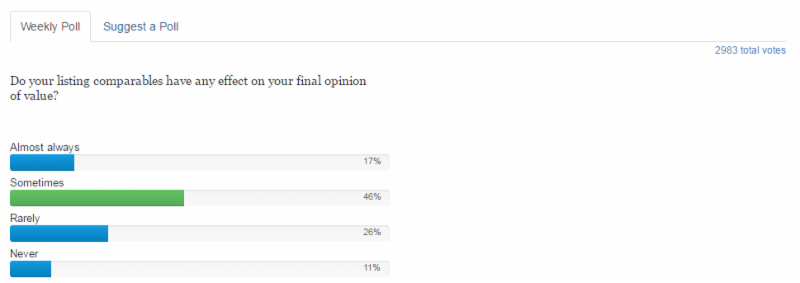
Do your listing comparables have any effect on your final opinion of value?

Another great poll from www.appraisalport.com.
My comments: I have always looked at listings, pendings, expired, etc. to tell me what is happening in the market today. Sales are the past.

Recent articles below in the May 2016 issue of the Paid Appraisal Today discuss using listings, particularly in markets that are declining or increasing. Lenders, of course, are way behind. They are just now complaining about low appraisals on purchases and want appraisers to use pending sales. Also, having no closed sales higher than the listing price is ok!!

  • Practical tips on qualifying the 1004MC and preparing a Market Conditions Summary – most examples are declining markets
  • No man’s land & the aggressive real estate market
  • How to handle rapidly increasing prices in your market

4-7-16 Newz .Verifying sales .Big data .Weird bathrooms

8 Bizarre Bathrooms from Around the World

“From pop-up toilets in city streets to a bathroom surrounded entirely by an aquarium, these public and private bathrooms are beyond bizarre-and you need to see them!”

Take a break from appraising and check these out. Definitely Weird!!

http://blog.rismedia.com/2016/keepin-it-weird-8-bizarre-bathrooms

—————————–

Recent acquisitions of appraisal and title companies

Another great commentary from Dave Towne. Thanks again, Dave!!

From the article in Housingwire.com:

First American Mortgage Solutions, a subsidiary of First American Financial Corporation, acquired Forsythe Appraisals, supplementing its existing valuation capabilities.

Forsythe Appraisals is one of the largest independent residential appraisal company in the United States and offers real estate valuation solutions with nationwide coverage.

Under the acquisition, Forsythe’s management team, including President and CEO John Forsythe, Senior Director of Customer Development Tim Forsythe and Chief Appraiser Alan Hummel, will continue to lead those operations.

http://www.housingwire.com/articles/36672-first-american-mortgage-snaps-up-valuation-veteran-forsythe-appraisals

Read more!! →

Fannie is tracking photos from appraisals

“(Bob) Murphy (Fannie Mae) does acknowledge that Fannie Mae is able to track photos in each appraisal, a practice many appraisers have long suspected, which means that Fannie Mae is able to detect when appraisers reuse comparable photos in different appraisals and flag appraisals which contain outdated photos as deficient.”

My comment: I have been hearing for awhile about appraisers who use the same smoke alarm photo in all their appraisals. Be careful out there. Fannie is watching!!

Appraisal Today newsletter

What are the most frequent adjustments that appraisers make?

Source: Corelogic

Excerpts:
Using a national sample of approximately 1.3 million appraisal reports between 2012 and 2015, new analysis from CoreLogic shows which home features are being adjusted the most frequently, as well as which are being adjusted for the most money, thereby having the greatest impact on appraisal values.
So what is being adjusted and how often? CoreLogic analysis reveals that some type of adjustment was made on 99.8 percent of appraisal reports reviewed. Figure 1 shows the various features adjusted on appraisal reports in relation to how often that adjustment was made, as well as the financial impact, or value influence, it had on the appraisal report.
Differences in Living Area was the most adjusted feature at 96.4 percent. Other features that were adjusted on 50 percent or more of appraisal reports were Room, Car Storage, Porch and Deck, Overall Condition and Site Area. It is significant to point out that the frequency of an adjustment is indirectly correlated to the financial impact, as four of the top five most adjusted features resulted in relatively low average dollar adjustments. For example, Room adjustments were very common at 70.4 percent but had minimal value influence, recording an appraisal adjustment of only $2,246 on average. Conversely, a Quality Rating adjustment had the highest value influence, with an average adjustment of $14,748, but accounted for only 18.7 percent of all adjustments.
Although the adjustment features that result in the highest value adjustment levels (Condition, Quality and Location) are harder to quantify, appraisers are professionals who can do this and adjust their reports appropriately to reflect the most precise appraisal for the home.
My comment: Interesting results. The actual dollar amounts don’t mean much as they are aggregated from all over the country. But, the frequency of adjustments and their relative amounts are worth checking out. What I see is that too many adjustments are being made for items that don’t affect value much and are hard to support. Savvy appraisers are not making adjustments for items such as porches and deck. Many are putting 0 in the grid to indicate that no adjustment is needed. Some appraisers only make adjustments for market conditions and GLA. Other differences, such as condition and location, are considered in the reconciliation. For example, if the subject has superior condition as compared to the comps, a value on the higher end of the range of adjusted comps is selected.
Fannie is focusing on adjustments in the new CU 3.0. They have been focusing on Q and C ratings. I will be writing about what all this means in the November, 2015 issue of the paid Appraisal Today.
Click here to see the adjustments graph and full article. Very interesting and worth checking out.

Appraisal Today newsletter

Statistics and Appraisal Data

To keep up on what is happening in appraisal businesses, mortgage lending, USPAP, etc. , Plus humor and strange homes, sign up for my FREE weekly appraisal email newsletter, sent since June 1994. Go to Home on the left side of the menu at the top of this page or go to www.appraisaltoday.com
Sign up in the Big Yellow Boxes

I regularly write about hot topics in appraising and appraisal business management issues
in my paid Appraisal Today monthly newsletter.
$99 per year or (credit card only) $8.25 per month, $24.75 per quarter, or $89 per year.
For more info, go to https://www.appraisaltoday.com/products


Statistics and Appraisal Data

The key to any statistical analysis is DATA, DATA, DATA!! Single family real estate data is not very reliable or consistent, and not enough is available in many areas, as we all know.

CU is the most significant attempt to get more useful data by requiring appraisers do use specific coding and criteria. However, real estate is local, local, local. Even the number of bedrooms varies a lot as there are different criteria for determining what is a bedroom, even in the same city. Three appraisers measuring the same house will probably not have the same square footage, as I learned doing relocation appraisals.

9/20 Update.  CU (Collateral Underwriter) has let Fannie obtain lots of data from appraisals. Unfortunately, the data is not available to appraisers. Fannie uses the data to analyze report reliability. 

With CU, this is becoming more obvious as there are sometimes wide variations in how appraisers code factors. For example, why do condition ratings vary? How accurate is MLS? Is public records accurate? What is the best source?

Now that regression software is popular with appraisers for getting adjustments, I have been thinking about why it is often not very reliable. To understand even simple regression requires knowledge.

My first statistics class was in 1963. The first time I used multiple regression was in graduate business school in 1979, when I did a mini-thesis on factors in REIT stock volatility using SPSS.I used a remote university mainframe that kept blowing up and erasing my data. There were no data issues. Doing multiple regression analysis on real estate housing data was not possible. Way too much lack of usable data.

Since I started my Appraisal Today newsletter in 1992, I have been writing about AVMs. The less data that is available, the less reliable the value.

As we all know, AVMs work well in a conforming home in a large tract of similar homes, built in the past 10 years. After that, the accuracy and reliability goes down fast. Just check what Zillow’s Zestimate against your appraised value.

Fannie warning letters – GLA adjustments and lots more coming(Opens in a new browser tab)

Appraisal Today newsletter

Appraisal adjustments "The Dirty Little Secret"

A Few CU Factoids
– Not all loans go to Fannie – VA, FHA, jumbo, etc.
– Fannie guidelines, including CU, are the minimum. Lenders can add their own, even keeping 15-25% adjustments.
– Lenders are not required to use CU.
– CU sends out appraisal warning messages for adjustments on: GLA, lot size, view, condition, quality, and location. For now.
– Gradual implementation of CU’s web based interface, which has the infamous “20 comps”, mapping, etc. Not available to AMCs.
A few CU comments and opinions from me:
– I need a Book of Adjustments!!! Maybe a few of Fannie’s will “leak” – wiki leaks ;>
– AMCs are now asking for adjustment support from non-CU adjustments. More Scope Creep??
– Mass confusion on what gets sent from underwriter to AMC to appraiser – warnings, Risk Scores, etc.
– The recent Fannie Letter to Lenders about CU said that the intent is not to overwhelm appraisers with warning messages. But, are underwriters going to read (and understand) 30+ page appraisals? I’m glad I’m not an underwriter!!
– How to respond to warning messages – not clear.
– Requests from AMCs include CU and non-CU requests. Sometimes hard to tell where they are from.
Adjustments – the “Dirty Little Secret” of Fannie Form Appraisal Reports
I can’t think of any time a client asked me for my support on an adjustment prior to CU. They have been accepting the usual responses, which are in many boilerplates: Based on my many years… or matched paired sales… etc.

A critical issue to me is that the dollar adjustments seem to indicate that residential appraisal values are precise and very accurate, which is not correct. There are lots of factors affecting home sales as compared with income property such as apartments and commercial property.

I have asked many very experienced appraisers how they “support” adjustments. Most use “rules of thumb”, such as using a percent of price per sq.ft. for GLA. But, this number includes land. Or, they use adjustments they were given when they were new appraisers. Of course, if you only appraise conforming homes in conforming tracts built in the past 10 years, it is much, much easier.
For now, CU only sends out warning messages for these adjustments: GLA, lot size, view, condition, quality, and location. This is a very small percent of all the UAD coded data. Plus, some data is not UAD coded, such as pools. But, many state regulators expect to see support for all adjustments in your work files.
We all need a Book of Adjustments ;>
Of course, all of us have adjustments that we have accumulated over the years, or recently developed. But, with CU we are being compared to peer and model adjustments. Of course, no one tells us who or what they are. Sometimes appraisers are given this information.
Regression to support adjustments
Regression will not work for all adjustments. It works well in conforming tracts less than 10 years old. After that, it goes downhill. This has been shown many times for AVMs. I really wish I could just buy regression software and have it calculate them all for me!!
Using qualitative adjustments
I did my first SFR appraisals this week without not making any dollar adjustments when I use form reports for non-lending work. I did make time adjustments (which are very easy to support) as the effective date was June, 2014, when prices were increasing rapidly in my market.
I used plus and minus signs in the grid. I use the 2005 Fannie forms but do not use the Fannie certification or limiting conditions. I use my own.
For awhile in the late 80s or early 90s Fannie had a form with pluses and minuses, so I had some experience. Also I don’t use dollar adjustments in my 5+ unit apartments or commercial appraisals.

Appraisal Today newsletter

CU warning messages – grrrr

A few appraisers are reporting getting CU appraisal warning messages from AMCs. Some AMCs get the messages and and some don’t, depending on the agreement with their lender client.

I sorta believed all the “experts” who said CU would not affect appraisers much, except the many us who do not have market based adjustment support in our work files (which we should have always had). “They” said appraisers’ time for responding to AMC questions will not change. Fannie’s reviewers have been using CU for about two years. Some lenders beta tested it. They all liked it. But, I wonder if it was tested with “boots on the ground” appraisers who actually had to respond to the warnings??

In January I wrote up a long CU article for my paid Appraisal Today newsletter. In the February issue I will have another long article, focusing on the differences between the old and new CU warning messages. They are very different. AMCs with access to lender’s warning messages are sending them to appraisers, such as:

Old message (pre-CU): Condition adjustment for comparable property #<comparable number> appears excessive.
New message(CU): The condition adjustment [for comp #X] is smaller than peer and model adjustments
New (CU): The condition adjustment [for comp #X] is larger than peer and model adjustments.

There are other messages about condition ratings different that peers and model.

I don’t know how our “peers” and The Model made their adjustments or ratings and what they are. I don’t know how to respond as to why mine differ.

Now that appraisers are getting the warnings, they are asking how to respond to them. Who are these peers? What is the model? I have no idea how to respond, except to say “I don’t know who the peers are and how they determined condition or what method they used for their adjustment. I am unable to respond.” How do you know what the condition is really like for comps? There are lots of ways to estimate an adjustment for condition. You can explain what you did. But, who is right? You, peers, or model?

MLS is soo reliable (Not) for estimating comp condition. I don’t think they will like “matched paired sales” on all of your responses for the method you used for adjustments.

Looks like maybe there will have to be some webinars for appraisers, not just underwriters, explaining how to respond.

Appraisal Today newsletter