AI and Appraisers

Newz: UAD 3.6 Started for Lenders, AI and Appraisers

January 30, 2026

—————————————————————————–

What AI Means For Appraisers

Click here to subscribe to our FREE weekly appraiser email newsletter and get the latest appraisal news

——————————————————————–

 

What’s in This Newsletter (In Order, Scroll Down)

  • LIA AD: Safety issues not fixed
  • 7.5 Things AI Is Already Doing Better Than Most Appraisers (And Why That’s Okay) By Mark Buhler
  • EXCLUSIVE: Tech Mogul Lists His Custom-Built Coral Gables Megamansion for Sky-High Price of $22 Million
  • Critical Thinking and the Intellectual Deficit in Real Estate Appraisal Qualifying Education by Timothy Andersen
  • MY AD: Appraisers’ Guide to the New URAR by Dave Towne
  • GSEs: Available Now in Broad Production: UAD 3.6 and Forms Redesign
  • URAR: Expect The Unexpected. How UAD 3.6 affects lenders
  • MBA: Mortgage applications decreased 8.5 percent from one week earlier

————————————–

7.5 Things AI Is Already Doing Better Than Most Appraisers (And Why That’s Okay)

By Mark Buhler

A while ago I wrote about “7.5 Things Appraisers Can Do That Artificial Intelligence Cannot”—the human parts of the job AVMs and algorithms still can’t touch: judging condition and quality, interpreting oddball features, smelling the house, defending adjustments, testifying in court, and exercising professional judgment under pressure.

None of that has changed.

What has changed is the toolset. AI is already doing parts of the workflow faster, cheaper, and more consistently than most humans—not the appraisal itself, but much of the heavy lifting underneath it:

Data gathering and sorting

Pattern detection

First-draft writing

Basic consistency and error checks

You will not beat AI at those tasks. The good news is you do not need to.

7.5 Tools you need:

1. Sifting Massive Datasets for Patterns

2. 2. Generating a First-Pass Comp Set

3. Producing Market Metrics and Adjustment Support on Demand

In my first article, I argued that AI cannot judge condition, interpret quirks, smell the house, testify in court, or exercise professional judgment. That remains true.

What has changed is the gap between appraisers who leverage AI and those who pretend it does not exist. The market is looking for valuation professionals who can…

To read more, Click Here

My comments: Definitely worth reading, including all 7 of the Tools.

——————————————————

 

EXCLUSIVE: Tech Mogul Lists His Custom-Built Coral Gables Megamansion for Sky-High Price of $22 Million

Excerpts: 7 bedrooms, 7.5 baths, 7007 sq.ft., 0.47 acre lot, built in 2018

It was the unobstructed views out over the water that first drew the tech expert to the property, as well as the privacy offered by its location in a secure gated community, and the fact that the Bahamian island chain of Bimini is just a 1.5-hour boat ride from the home’s dock.

From the outside, the home could be mistaken for a resort thanks to its lavish pool, built-in barbecue, firepit lounge, outdoor kitchen, expansive waterfront terraces, and a basketball or volleyball court by the water—all of which make for a rare backdrop of relaxation and play.

Elsewhere on the grounds, there are two private docks that accommodate a superyacht of more than 100 feet, a 30,000-pound boat lift, and access to Biscayne Bay.

To read more, Click Here

To see the listing with an aerial view, virtual tour and 60 photos, Click Here

————————————————————-

Critical Thinking and the Intellectual Deficit in Real Estate Appraisal Qualifying Education

by Timothy Andersen, MAI The Appraiser’s Advocate

Excerpts: It is the premise of this essay that critical thinking, analytical rigor, integrative synthesis, and dialectical method are indispensable to the cultivation of competent real estate appraisers and the concomitant production of credible appraisals and non-misleading appraisal reports.

Yet, curiously, these conceptual pillars are either wholly absent or conspicuously marginalized within the current corpus of real estate appraisal qualifying education (QE). That QE in its present form is devoid of any formal engagement with these concepts suggests a foundational deficiency that imperils the credibility of both practice and pedagogy.

Appraisal is, at its core, a dialectical enterprise. The seller posits a value—often broker-influenced and aspirational. The buyer counters with skepticism and a desire for a discount. The broker inserts pecuniary incentives into the mix, motivated by the commission structure. The appraiser is thrust into this cauldron of competing value claims, charged with the burden of arbitrating truth. The appraiser must navigate opposing viewpoints, adjudicate conflicting data, and deliver a resolution rooted in evidence and reason.

In this sense, each appraisal is a dialectical negotiation, an intellectual endeavor wherein the appraiser becomes not merely a market technician but a philosophical mediator. Such work demands a skill set that far exceeds the filling of forms or the clicking of dropdown menus. It requires a mind trained in critical discernment, analytical rigor, synthetic coherence, and dialectical resolution, not merely in filling out a reporting form.

Yet, current appraisal QE and CE, and some of their providers, entrenched in their pedagogical inertia, fail to cultivate these competencies. They privilege mechanics over meaning, technique over thought. The consequence of such tactics is clear: we produce technicians, not scholars; form-fillers, not thinkers.

To read more, Click Here

My comments: This article explains what is missing in classes required for licensing. What you learn when first starting appraising is very, very important so you don’t have to try to learn it later.

Unfortunately after licensing started many new appraisers had not very good education. The appraisal professional associations, such as the Appraisal Institute (and predecessor associations) would not offer trainee classes. They only offered classes for getting designations. I had to refer them to the local “how to fill out a form” classes which were not very good.

The plan for appraisers to train appraisers did not work out well for many new appraisers. Appraisers lacked experience in teaching and did not want to take the time to train appraisers. Prior to licensing, most appraisers were staff appraisers at lenders who provided training. I was trained at an assessor’s office.

——————————————————————–

Are you getting too many ad-only emails?

4 ways to get only the FREE email newsletters and NOT the ad-only emails.

1. Twitter: https://twitter.com/appraisaltoday Posted by noon Friday

2. Read on blog www.appraisaltoday.com/blog Posted by noon Friday. You can subscribe to the blog in the upper right of each blog page. NOTE: the popular ads with liability tips are below the first topic on my blog posts.

3. Email Archives: https://appraisaltoday.com/archives

(posted by noon Friday) The link is above and to the left of the big yellow email signup form. Newsletters start with “Newz.” Contains all recent emails sent.

4. Link to the 10 most recent newsletters (no ads) at www.appraisaltoday.com. Scroll down past the big yellow signup block. The newsletters have abbreviated titles, taken from their blog posts.

To read more about the 4 ways, plus information on why I take ads, etc.

Click here

——————————————————–

Train the Trainer Class for GSEs New URAR and UAD 3.6

Appraisers’ Guide to the New URAR

In the May 2025 issue of Appraisal Today

By Dave Towne

Excerpts: Quality and Condition Ratings Updated and Appendix F-1

We learned that the Definitions for Q and C have been updated for more

clarity.

These will be in a new Appendix F-1, (available on the GSE web sites) which

appraisers should review BEFORE beginning to do UAD 3.6 URAR Reports!

I have to keep F-1 running in the background on my computer, and will do

that when teaching. F-1 is about 350 pages and shows most all entries that are required on the new reports.

Secondly, the Report will allow for better reporting of Q & C ratings for

various components. And additional property amenities can be selected from a list or drop-down.

In most cases, the Report will involve both office desktop and field tablet

inputting of data… which at this point appears to be more comprehensive than is currently required. Will the lenders recognize this fact, and correspondingly tell their lending client that the “appraisal Report” will cost more than what it might have in the past?

More importantly, will appraisers quit accepting low-ball fee assignments?

These are unknown at this point.

One more point, based on my review of the class material: this new process

is demanding a much more intensive and precise gathering of property detail than appraisers currently do.

It will take more time to do in the field than appraisers currently spend, and if

the appraiser transfers the field data back to their office desktop for completion, that will entail more time.

The ability to do complete inspections with a piece of paper on a clipboard is

going to end. A tablet or large smart phone is strongly recommended.

To read the full article and more newer articles on UAD 3.6, plus 3+ years of previous issues, subscribe to the paid Appraisal Today at www.appraisaltoday.com

Not sure if you want to subscribe?

Sign up for monthly auto renewal for $8.25!

Cancel at any time for any reason! You will receive a prorated refund.

$8.25 per month, $24.75 per quarter, and $89 per year (Best Buy)

or $99 per year or $169 for two years

Subscribers get FREE: past 18+ months of past newsletters

What’s the difference between the Appraisal Today free Weekly email newsletter and the paid Monthly newsletter? Click here for more info.Subscribe to Monthly Newsletter

——————————————

If you are a paid subscriber and did not receive the

January, 2026 issue emailed on Friday January 2, 2026 please email info@appraisaltoday.com, and we will send it to you. You can also hit the reply button. Be sure to include a comment requesting it. Or, call 510-865-8041
Available Now in Broad Production: UAD 3.6 and Forms Redesign

UAD 3.6 and Forms Redesign Broad Production Period is here.

The Uniform Appraisal Dataset (UAD) 3.6 and Forms Redesign Broad Production period starts today, January 26, 2026, with a mandate of November 2, 2026. All lenders are now permitted to submit UAD 3.6 appraisal reports to the Uniform Collateral Data Portal® (UCDP®). EMAIL DATED 1-26-26

The Uniform Appraisal Dataset (UAD) 3.6 and Forms Redesign Broad Production Period begins today, January 26, 2026. All lenders are now permitted to submit UAD 3.6 appraisal reports to the Uniform Collateral Data Portal® (UCDP®).

Submission of UAD 3.6 appraisal reports is not yet mandatory; however, lenders that have updated their systems and processes to support UAD 3.6 appraisal reports – including working with an appraisal software provider whose software has been verified for UAD 3.6 – are encouraged to begin integrating appraisal reports that use UAD 3.6 into their workflow. Gradually integrating UAD 3.6 appraisal reports will help lenders prepare for a full transition by the November 2, 2026 mandate, when all appraisal reports on loans sold to Freddie Mac or Fannie Mae must use UAD 3.6

WHAT THIS MEANS FOR APPRAISERS NOW: Appraisers will still be providing UAD 2.6 – the current forms. You will have time to learn UAD 3.6 appraisals. The demand for the UAD 2.6 will decline over time as lenders get set up for UAD 3.6.

To read the official original copy of what Freddie says, Click Here

Comments from Dave Towne on 1-27-26

Editor’s comment: I have been reading Dave’s emails for a long time. They are reliable.

What this means is the process to order appraisals, appraisal completion using software coded for the New URAR/UAD 3.6 data base, submittal back to the appraiser client, and eventual upload to the GSE’s can now happen. However, during this phase, the legacy appraisal forms and back end processing can also be used.

But the current reality is only 2.5 appraisal software vendors and few mortgage lenders are actually able to do this new process in what was expected to be full processing by now.

Two of the software vendors apparently have their software fully coded and approved to work with UAD 3.6. The third vendor has the ‘front end’ of their software working, but some of the other internal functions are not yet included which can somewhat impede the appraisers interaction. Two of the well-known vendors, and another newer vendor do not yet have their software fully approved by the GSE’s – which is required before the lender can allow the appraiser to use those. This is a real conundrum at present.

The process of updating the appraisal inspection and reporting beyond our current legacy actions sounds simple, “on paper”, as they say. The same applies to the lender back-end systems. In actual implementation it’s a daunting process to write software to do what the GSE’s expect. And from what I’ve been told, the software vendors apparently were not fully consulted early on.

There currently are SIX appraisal software vendors independently charged with designing their software to work with the UAD 3.6/MISMO system and functionality.

The timeline from the GSE’s shows the full cut-over date to the New URAR/UAD 3.6 to be Monday, Nov. 2, 2026. Per the GSE plan, this means:

Submit 3.6 Only – November 2, 2026 – Lenders must use UAD 3.6 for all new submissions on or after this date. Revisions allowed for previously submitted

Will this date ‘hold’ throughout the mortgage lending arena? I won’t speculate because I dropped my crystal ball two days ago when I got out of my vehicle and it shattered on the pavement! It depends on all vendor software operating correctly, and all lender back end processing systems up and running properly.

dtowne@fidalgo.net

www.towneappraisals.com

Mount Vernon, WA

———————————————————————

URAR: Expect The Unexpected

How UAD 3.6 affects lenders

Editor’s notes: Published by National Mortgage Professional. A good look at what lenders and appraisers need to know plus comments by an appraiser, Dan Figurski.

Broad production opens January 26, 2026, when all lenders may submit the new format alongside the legacy UAD 2.6. UAD 3.6 becomes mandatory for all new GSE appraisal submissions on November 2, 2026, and UAD 2.6 will fully retire in May 2027.

WHAT THIS MEANS FOR APPRAISERS NOW: Appraisers will still be providing UAD 2.6 – the current forms. No one knows when UAD 3.6 software will be ready for appraisers to use from all vendors and when lenders will be set up for it. Change required final date to 11-2-27 or later??

Key changes include the elimination of individual form numbers, expanded and standardized field sets, updated condition and quality definitions, and enhanced data structures that improve automation, quality control, and interoperability with loan origination systems. Lenders must ensure technology readiness, update systems to support UAD 3.6, and adjust quality control processes accordingly. FHA’s adoption is expected to begin in spring 2026, extending the new format beyond GSE‑conforming business.

Appraiser comments (interview):

NMP: Are there any unexpected changes that may surprise originators?

Figurski: One change in the redesigned URAR that might catch originators by surprise is how clearly property issues will be highlighted in the new reports.

In the past, if there was a concern with a property — say a safety hazard, a structural problem, or evidence of water damage — you’d have to really dig through the report to find it. On the new reports, those issues will be front and center at the beginning of the report. Originators will know very quickly whether there are problems that could influence the transaction or collateral risk.

NMP: What are the repercussions for those who are unprepared for implementation?

Figurski: The redesigned URAR will create a lot of efficiencies for lenders, originators, and servicers, but it’s a complete overhaul of how appraisal information has been delivered in the past. The structure looks different, the way information is presented is different, and there are more details and data fields than before. Companies that aren’t updating their workflows, training their teams, or working closely with their partners to prepare for these changes will struggle to keep pace.

On the other hand, those that are putting in effort now will be in a strong position to benefit.

NMP: What other positive features have you learned about?

Figurski: Something I thought was interesting was that the new report allows appraisers to confirm whether a property has broadband internet access. Considering how heavily our society relies on the internet — whether for streaming movies, working from home, running home security systems, or even supporting smart appliances — a strong internet connection is almost as important as having electricity or running water. By formally including it in the appraisal, the redesigned URAR acknowledges how central connectivity has become to both property value and livability.

To read more, Click Here

My comments: Definitely worth reading to see what will change for lenders. Also, appraiser comments on why the internet broadband data is provided.

—————————————————————–

HOW TO USE THE NUMBERS BELOW. Appraisals are ordered after the loan application. These numbers tell you the future for the next few weeks. For more information on how they are compiled, Click Here.

Note: I publish a graph of this data every month in my paid monthly newsletter, Appraisal Today. For more information or get a FREE sample go to www.appraisaltoday.com/order Or call 510-865-8041, MTW, 7 AM to noon, Pacific time.

My comments: Rates are going up and down. We are all waiting for rates to drop lower in 2026.

Mortgage applications decreased 8.5 percent from one week earlier

WASHINGTON, D.C. (January 28, 2026) — Mortgage applications decreased 8.5 percent from one week earlier, according to data from the Mortgage Bankers Association’s (MBA) Weekly Mortgage Applications Survey for the week ending January 23, 2026. This week’s results include an adjustment for the Martin Luther King Jr. Day federal holiday.

The Market Composite Index, a measure of mortgage loan application volume, decreased 8.5 percent on a seasonally adjusted basis from one week earlier. On an unadjusted basis, the Index decreased 16 percent compared with the previous week. The Refinance Index decreased 16 percent from the previous week and was 156 percent higher than the same week one year ago. The seasonally adjusted Purchase Index decreased 0.4 percent from one week earlier. The unadjusted Purchase Index decreased 4 percent compared with the previous week and was 18 percent higher than the same week one year ago.

“Mortgage rates increased for the first time in a month, and as expected, refinance applications fell by 16 percent. The 30-year fixed rate was the highest in three weeks at 6.24 percent,” said MBA’s Joel Kan, Vice President and Deputy Chief Economist. “FHA refinance activity bucked the overall trend and increased, as FHA rates remained almost 20 basis points lower than conforming rates. With rates holding in the 6 percent range, the refinance market is likely to remain sensitive to week-to-week rate movements.”

Added Kan, “Purchase applications were 18 percent higher than last year’s pace, and the average loan size stayed at its highest level since September 2025, signaling that prospective homebuyers remain active at the start of 2026.”

The refinance share of mortgage activity decreased to 56.2 percent of total applications from 61.9 percent the previous week. The adjustable-rate mortgage (ARM) share of activity increased to 7.6 percent of total applications.

The FHA share of total applications increased to 18.6 percent from 15.9 percent the week prior. The VA share of total applications decreased to 14.7 percent from 16.2 percent the week prior. The USDA share of total applications increased to 0.5 percent from 0.4 percent the week prior.

The average contract interest rate for 30-year fixed-rate mortgages with conforming loan balances ($832,750 or less) increased to 6.24 percent from 6.16 percent, with points increasing to 0.55 from 0.54 (including the origination fee) for 80 percent loan-to-value ratio (LTV) loans. The effective rate increased from last week.

The average contract interest rate for 30-year fixed-rate mortgages with jumbo loan balances (greater than $832,750) decreased to 6.34 percent from 6.39 percent, with points increasing to 0.40 from 0.38 (including the origination fee) for 80 percent LTV loans. The effective rate decreased from last week.

The average contract interest rate for 30-year fixed-rate mortgages backed by the FHA increased to 6.06 percent from 6.04 percent, with points increasing to 0.75 from 0.73 (including the origination fee) for 80 percent LTV loans. The effective rate increased from last week.

The average contract interest rate for 15-year fixed-rate mortgages increased to 5.64 percent from 5.55 percent, with points decreasing to 0.61 from 0.65 (including the origination fee) for 80 percent LTV loans. The effective rate increased from last week.

The average contract interest rate for 5/1 ARMs increased to 5.56 percent from 5.42 percent, with points increasing to 0.80 from 0.62 (including the origination fee) for 80 percent LTV loans. The effective rate increased from last week.

The survey covers U.S. closed-end residential mortgage applications originated through retail and consumer direct channels. The survey has been conducted weekly since 1990. Respondents include mortgage bankers, commercial banks, thrifts, and credit unions. Base period and value for all indexes is March 16, 1990=100.


Ann O’Rourke, MAI, SRA, MBA

Appraiser and Publisher Appraisal Today

1826 Clement Ave. Suite 203 Alameda, CA 94501

Phone: 510-865-8041

Email: ann@appraisaltoday.com

Online: www.appraisaltoday.com

Crazy Appraiser Stories

Newz: Crazy Appraiser Stories,
How to Do Regression, Resolutions

CHANGE YOUR TEMPLATES!!

January 2, 2026

What’s in This Newsletter (In Order, Scroll Down)

  • LIA AD: Borrower Wants Answers Appraiser Can’t Give
  • Off the Rails: Crazy Appraiser Stories
  • Inside Pacific Palisades’ Most Expensive Home—a $39.5 Million Hilltop Marvel
  • How to Build a Regression Model in Excel: A Guide for Real Estate Appraisers by Jim Amorin
  • Why Resolve anything? By George Dell, MAI
  • MBA, Fannie Mae see 2027 (and 2026) housing markets very differently
  • MBA STATS – None This Week

Crazy Appraiser Stories!!

Click here to subscribe to our FREE weekly appraiser email newsletter and get the latest appraisal news

——————————————————

Off the Rails: Crazy Appraiser Stories

You’ve all got stories of crazy inspections: eccentric collections, mysterious apparitions, and unorthodox decor. Here are a few we found to be the most Buzzworthy.

Excerpts: Reflections

My assignment: a log home in the middle of the city. I go into the owner’s suite, and right in the middle of the room is this built-in whirlpool tub up on a pedestal with velvet steps leading up to it. The whole ceiling is just mirrors. I think, How am I going to deal with this? The owner is so proud of this custom owner’s suite they’ve built.

It isn’t something that the normal market would want, so it has a certain…market impact, let’s say. I handled it by cost to cure.

—Jared Preisler

Let That Sink In

When I was an appraiser trainee, I was tagging along with my supervisor on a packed day of about eight appointments. It was mid-January in upstate New York. Trust me when I tell you it was COLD. First appointment, 9am: we finished walking through the inside of the home and headed outside. I began walking around the back yard (tall winter boots on, of course) when I suddenly realized I was about three feet lower than I had been moments ago. I looked down to see brown, icy water pooling around my feet. I struggled to comprehend what was happening as my boots became completely submerged. Seconds later, the homeowner cracked the door open just wide enough to shout, “Watch out for the koi pond! It’s probably covered in snow!”

I spent the rest of the day wearing socks I borrowed from a homeowner and plastic bags stuffed into my boots, while a swampy smell permeated my boss’s car. Lesson learned.

—KWAppraisalGroup

To read more, Click Here


Read more!!

Q4 2025 Fannie Mae Appraiser Update – AMC Risk, UAD 3.6

Newz: 12 Days of Appraiser Christmas,
Q4 2025 Fannie Mae Appraiser Update –AMC Risk, UAD 3.6

December 19, 2025

What’s in This Newsletter (In Order, Scroll Down)

  • LIA AD: A Family Feud and Intended Use
  • Q4 2025 Fannie Mae Appraiser Update – AMC risk, UAD 3.6
  • 12 Days of Appraiser Christmas
  • Santa’s House is Back on Zillow with a Bold New Holiday Look
  • Highest and Best—and the Highest Value By Richard Hagar
  • AQB Proposed Changes in New Appraiser Requirements
  • MBA: Mortgage applications decreased 3.8 percent from one week earlier
  • ————————————————————

Click here to subscribe to our FREE weekly appraiser email newsletter and get the latest appraisal news


——————————————————

Q4 2025 Fannie Mae Appraiser Update

As the year wraps up, we’re focused on what matters most to your success: clarity, consistency, and confidence in every appraisal. This edition gives you practical insights to stay ahead:

  • Several deep-dive articles on Uniform Appraisal Dataset (UAD) 3.6, focused on condition/quality ratings, the inspection component of Scope of Work, disaster mitigation, energy efficiency, and training and resources;
  • Why time adjustments matter—and how to apply them effectively; and
  • Our approach to managing Appraiser Management Company (AMC) risk for stronger compliance and reliability. Excerpts: In Jul. 2025, Fannie Mae began sending letters to AMCs detailing appraisal quality issues identified through Fannie Mae loan quality reviews completed in 2024. Each letter contains a comprehensive list of the issues identified for appraisals associated with that AMC.

To read more, Click Here

My comments: Worth reading. First time I have ever seen comments on AMCs. Good to see that GSEs are looking at AMCs.

————————————————————–

12 Days of Appraiser Christmas

NOTE on video: Click on image and it opens in Youtube.

Very funny!! 3.5 minute video

Sample appraisal requests:

On the fourth day of Christmas my best client sent to me falling

Shacks, three field reviews, two double wides, and a drive by single family.

On the tenth day of Christmas, my best client sent to me 10 tax appeals and eight Mega Mansions.

Singer in this video is comedian David Cassel as the Ukulele Bandito http://www.theukulelebandito.com / (he is not a Portland appraiser, but he is funny)

Many thanks to Gary F. Kristensen, SRA, ASA, AGA at A Quality Appraisals in Portland, Oregon.

My comment: I love this FUN video ;>

Read more!!

Few comps in 2026 for Appraisers

Newz: Few comps in 2026, NAR Revises Nonmember Broker/Appraiser Access Policy

December 12, 2025

What’s in This Newsletter (In Order, Scroll Down)

  • LIA AD: Can’t Certify the Work
  • The problem with comps in 2026 (and the good news)
  • Gravity-Defying Colorado Mansion Designed by a Rocket Scientist Hits the Market for $2.7 Million
  • Creating a Histogram in Excel: A Guide for Appraisers
  • My ad: The AMC Conundrum in the Appraisal Business, By Dave Towne
  • NAR Revises Nonmember Broker/Appraiser Access Policy Language
  • MBA Mortgage applications increased 4.8 percent from one week earlier

Appraisers and Local Market Analysis

Click here to subscribe to our FREE weekly appraiser email newsletter and get the latest appraisal news

——————————————————


——————————————————-

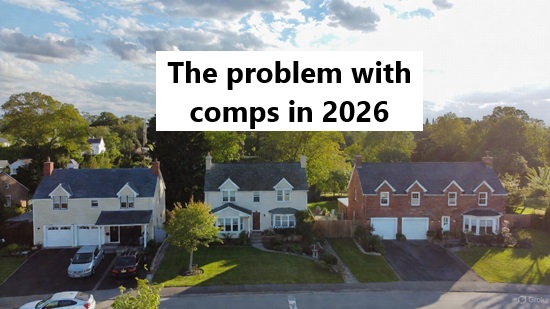
The problem with comps in 2026 (and the good news)

By Ryan Lundquist

Excerpts: We have a problem with comps in real estate. There just aren’t that many, and it’s made it much more challenging to figure out value. Yet, this could get a little better in 2026.

WE’VE HAD A COMP PROBLEM FOR THREE YEARS:

We’ve been missing about 30% of the normal number of sales. This is true both locally and nationally. This chart from Calculated Risk shows the gravity of the situation as we’ve been flirting with historically low volume for three years now. And what this means is we’ve had 30% less comps to choose from. Yikes!! This is exactly why it’s been challenging to value properties.

THE BAD NEWS

We’re still poised to have historically low volume until there is a sharper change with affordability. The housing market simply feels stuck, and there isn’t a mechanism to quickly increase the number of buyers. In other words, it’s not going to be a market with robust volume for a long time since it’s going to take years to get buyers and sellers back. Yet, if the projection is correct about next year, it’s going to be something positive to get even a little more volume back. This isn’t standing ovation news, but maybe a golf clap is in order. And for my real estate friends, this is a solid reminder to stay focused.

SOMEONE WAS MAD AT ME FOR USING OLD COMPS

I had someone angry with me recently that I used much older sales as comps in a private appraisal. I tried to explain my rationale, but the person wasn’t willing to listen. Here’s the deal though. If there aren’t any recent comps, then we have two choices. Use older sales and adjust for how the market has changed, or go out further into other markets for more recent sales (doable, but not always ideal). In real estate textbooks, this issue doesn’t come up since there are always three model match sales over the past 90 days, but the real world is different. The truth is valuations today look a bit messy since we don’t have the luxury of ample recent sales. We simply have to do the best with what we have. Remember, when the market changes, how we do things sometimes has to change also.

To read more, Click Here

My comments: Some interesting appraiser comments. This is a hot topic for appraisers now. Definitely a problem in most areas. What is your market like?

Read more!!

Appraising with Inventory Shortages and Surpluses

Newz: UAD Quality Ratings,

Appraising with Inventory Shortages and Surpluses

December 5, 2025

What’s in This Newsletter (In Order, Scroll Down)

  • LIA AD: When a Property Owner Wants to Do the Appraiser’s Job
  • Understanding UAD Quality Ratings (Updated for UAD 3.6 and the New URAR)
  • Gothic-Inspired ‘Fairytale Castle’ in Miami’s Exclusive Coconut Grove Michigan Hits the Market for $24 Million
  • Navigating the Challenges of Inventory Shortages and Surpluses in Real Estate: Insights from a Chief Appraiser at a National AMC By Jim Jenkins, Chief Appraiser
  • What Is a Scatter Chart Analysis in Appraisal?
  • 53% of U.S. homes lost value in the past year, the most since 2012 – Zillow
  • MBA:  Mortgage applications decreased 1.4 percent from one week earlier

————————————-

Click here to subscribe to our FREE weekly appraiser email newsletter and get the latest appraisal news

————————————————

—————————————-

Understanding UAD Quality Ratings (Updated for UAD 3.6 and the New URAR)

Excerpts: Quality ratings are one of the most familiar parts of UAD, but the way appraisers report them has changed under UAD 3.6 and the new dynamic Uniform Residential Appraisal Report (URAR). While the Q1–Q6 scale remains in place, the way you apply, support, and reconcile quality is more structured and data-driven than in the legacy forms.

What “Quality” Means in UAD 3.6

In UAD 3.6, quality represents the materials, craftsmanship, and construction standards of a dwelling. The familiar Q1 through Q6 framework still applies, but the workflow is different:

Quality is no longer a single, form-level checkbox.

You now provide quality ratings in multiple places:

  • Exterior Quality Rating (Dwelling Exterior section)
  • Interior Quality Rating (Unit Interior section)
  • Kitchen and Bathroom Detail tables
  • Overall Quality (reconciled in Section 15)
  • The “overall” rating is informed by the component-level data you report in these earlier sections.

Other topics include:

  • What Does UAD Stand For?
  • What Are the Quality of Construction Ratings?
  • Breaking Down the UAD Quality Ratings (Q1–Q6)
  • How Quality Is Applied in the New URAR
  • Tips for Applying Quality Ratings Credibly

Final Thoughts

Quality ratings remain an important part of UAD, but the approach is more precise now. UAD 3.6 pushes appraisers to rely on observable details rather than broad descriptions or market norms. When you follow the definitions, support your ratings with the structured data, and reconcile logically, the quality rating becomes a clear and defensible part of your analysis.

To read more, Click Here

My comments: Comprehensive and well written. Worth reading.

Read more!!

Appraisers – Disclose When You Did Not Do the Inspection 

Newz: 24 Hour Appraisal, Disclose When Some One Else Did the Inspection

November 7, 2025

What’s in This Newsletter (In Order, Scroll Down)

  • LIA AD: When a Property Owner Wants to Do the Appraiser’s Job
  • The Hazards of Signing a URAR When Another Person Conducts the Inspection
  • Honolulu Diamond Head Estate for $34,000,000
  • The 24-Hour Appraisal Funded by Appraisers
  • How Policy, Data, and Technology Are Reshaping Lending and Valuation: MBA 2025 Recap
  • MBA: Mortgage applications decreased 1.9 percent from one week earlier

———————————————————————–

Click here to subscribe to our FREE weekly appraiser email newsletter and get the latest appraisal news

———————————————–


———————————————-

The Hazards of Signing a URAR When Another Person Conducts the Inspection

By Dan Bradley

Excerpts: When using the Uniform Residential Appraisal Report (URAR) to report the results of an appraisal, the appraiser’s signature on the report is not merely a formality, it is a certification. By affixing his or her signature, the appraiser is certifying to (among other things) having personally made an interior and exterior inspection of the subject property.

Clients, AMCs, and state regulatory agencies are reporting that appraisers are increasingly delegating their inspection responsibilities to others yet are signing the URAR certifying they made a personal inspection.

What are the risks if an appraiser signs a URAR report certifying an interior and exterior inspection that was actually conducted by someone else?

Conclusion

Signing a URAR appraisal report that states the appraiser personally inspected the property, when in fact another party performed the inspection, is a serious liability risk. USPAP permits an appraiser to value a property that they did not make an interior and exterior inspection.

However, USPAP does not allow an appraiser to communicate a misleading report. A report that falsely indicates that an individual made an inspection of a property when in fact they did not is misleading, and could result in disciplinary action, civil liability, or other negative consequences.

To read more, Click Here

My comments: Good reminder, especially with the use by the GSEs of alternative valuation methods. Of course, you know nothing about the qualifications of the person doing the inspection. The article did not specifically address UAD 3.6, but I assume it would have the same certification section and requirements.

Read more!!

Bias in Appraisals. What Does It Mean?

Newz: Tariffs Effects on Home Building,
The Cupola and Its Cooling Comeback

October 17, 2025

What’s in This Newsletter (In Order, Scroll Down)

  • LIA AD: Unreasonable Subpoena Request
  • California home built around giant boulder lists for $2 million
  • What’s That Box on the Roof? The Cupola and Its Cooling Comeback
  • Trump’s Tariffs on Lumber and Cabinetry Kick In, Hitting Homebuilding and Renovation
  • The Appraiser’s Guide to Evaluating Home Value Before You Buy
  • Mortgage applications decreased 1.8 percent from one week earlier

—————————————————–

Click here to subscribe to our FREE weekly appraiser email newsletter and get the latest appraisal news

—————————————————————-

——————————————————————–

What does “bias” in appraisal really mean?

Hal Humphreys

and Peter Christensen Video

Excerpts: What constitutes “bias” in appraisal isn’t always what you expect, according to an attorney who handles cases involving appraisers.

Now let’s zoom in on bias. This topic does NOT inspire feelings of neutrality in the appraisal community. That non-neutrality comes out (a bit explosively) in comments threads and appraiser forums, and sometimes even in the classroom. I’ve sat in on several of Peter Christensen’s in-person classes on bias and fair housing law, and invariably somebody in class pushes back. Sometimes the air gets pretty hot and hostile. But Peter always handles the pushback with calm and aplomb. He hears folks out, responds respectfully, and steers the conversation back to his thesis — that bias exists, and it can take forms that we don’t necessarily expect.

In a brief interview I did with him (see the video below), he tells a story about a case he handled, in which an appraiser’s report was found to exhibit bias to a homeowner whose political views he loathed. Peter tells this story in his class, and it always surprises people, because they’ve seen this divide in their own lives and can imagine something like this actually happening.

I thought I knew what bias looked like, but I’ve begun to realize that it can creep in when we’re least expecting it. —Hal Humphreys

To read more and watch the video, Click Here

My comment: Interesting analysis. Very good video. Worth watching the video and reading the text.

Read more!!

Why AI Can’t Replace Appraisers

Newz: Why AI Can’t Replace Appraisers,
Value: Absolute or Relative?

October 3, 2025

What’s in This Newsletter (In Order, Scroll Down)

  • LIA AD: Weather Impact
  • Five Reasons AI Cannot Replace Real Estate Appraisers, By Timothy Andersen
  • Malibu (CA) Waterfront Home for $110,000,000
  • How Bureaucratic Overreach Turned Real Estate Appraisers into Scapegoats
  • September 2025 Housing Market Updates for Appraisers
  • Value: Relatively Absolute or Absolutely Relative?, By Brent Bowen
  • Mortgage applications decreased 12.7 percent from one week earlier

——————————————-

Click here to subscribe to our FREE weekly appraiser email newsletter and get the latest appraisal news

—————————————————————–

Five Reasons AI Cannot Replace Real Estate Appraisers

by Timothy Andersen

Excerpts:

QUESTION: When I got involved in real estate appraisal, nobody ever told me about AI, UAD 3.6, AVMs, and all the changes that would take place. I can’t keep up with these changes and the changes I will have to make to the way I appraise and report those appraisals. Please tell me there is some good news out there about the way I have chosen to make a living! Is there any such news?

RESPONSE: Traditionally, when there were questions of real property value, the party with the questions called a real property appraiser to answer them. Real estate appraisers are professionals who estimate the value of properties like homes or land. They are trained, licensed experts who visit properties, study local markets, and follow ethical rules to make fair valuations. Lately, artificial intelligence (AI) and computer models called Automated Valuation Models (AVMs) are helping estimate property values, thus possibly decreasing the demand for real estate appraisers.

From your question, you are asking if these innovations in AI are going to take your job. In all candor, AI is going to take some appraisal jobs. But the good news is that, with some upgrading on your part, that should not be a worry.

Reason 1

One reason you’ll get all the credit (or blame) is that humans exercise judgment, follow ethics, and accept responsibility. Algorithms cannot execute these since, to some extent, judgment, responsibility, etc. have an emotional component to them, rather than purely logic or reason. Remember, AI is a tool to help you. In so many ways it cannot replace you (nor was that its design).

Reason 2

One reason you’ll get all the credit (or blame) is that humans exercise judgment, follow ethics, and accept responsibility. Algorithms cannot execute these…

Reason 3

One reason it cannot replace you is simply because AI (i.e., AVMs) struggles with unique or complex houses, especially if those are rural properties…

Conclusion

At this point in the response, you rightly ask, “What does any of this have to do with me!?” That answer is essentially up to you….

To read more, Click Here

My comments: What AI means for your appraisals (and many jobs) can be scary. This article is understandable and comprehensive. Worth reading the details.

Read more!!

Paired Sales Analysis

Newz: Paired Sales Analysis, The Last Appraiser,
24 Hour Turn Times?

September 12, 2025

What’s in This Newsletter (In Order, Scroll Down)

  • LIA AD: Why do Claims get Settled?
  • Paired Sales Analysis: Tips and Tools for Appraisers
  • Home on rare stretch of California’s Lost Coast hits market for $11M in Ferndale, CA Some Assembly Required
  • Combining Tools for Appraisals By Brent Bowen
  • The 24-Hour Appraisal Diet: Slim on Time, Light on Credibility
  • A Review of MEIN COMP: The Last Appraiser by Desiree Mehbod
  • Mortgage applications decreased 1.2 percent from one week earlier

—————————————————————–

Tools To Support Appraisal Adjustments

Click here to subscribe to our FREE weekly appraiser email newsletter and get the latest appraisal news

———————————————————————

Paired Sales Analysis: Tips and Tools for Appraisers

By Kevin Hecht

Excerpts: As a professional real estate appraiser, you know that paired sales analysis is a reliable and popular method for determining the value of specific property features and providing market-based evidence to support appraisal adjustments.

Though not without challenges, paired sales analysis is a valuable technique to have in your appraisal toolkit. Mastering this method will help you develop more accurate, credible, and defensible appraisals.

Uses

Primarily used in the sales comparison approach, paired sales analysis is particularly useful for estimating the value of unique property attributes such as:

  • Location advantages (corner lots, cul-de-sac positions, or waterfront access)
  • Scenic views or privacy features
  • Property upgrades (pools, finished basements, luxury kitchens)

Importance

For property appraisers, paired sales analysis is an essential tool because it helps ensure that appraisal adjustments are supported by quantitative data. Rather than relying on cost estimates or subjective opinions, you can use actual sales data to support your value conclusions. This evidence strengthens your appraisal’s defensibility and helps you comply with USPAP.

Additional Topics

  • Step-by-Step Methodology of a Paired Sales Analysis
  • Paired Sales Analysis Tips and Best Practices

My comments: Paired sales has been used for decades by appraisers. Now, statistical analysis including graphs is available plus software that can determine adjustments. In the 8/25 issue of this newsletter, an appraiser survey of appraisal adjustments said that paired sales was the number one adjustment method used by appraisers.

I use paired sales for unusual adjustments, such as discussed above. For example, for many years I lived in waterfront homes, which is not unusual in my city. One of my homes was in a small development of similar homes built in the 1940s. Matched paired sales was very easy. Another non tract home built in the 1940s did not have similar homes nearby and paired sales did not work very well there.

To read more, Click Here

Read more!!

Appraisal Regulator Chaos

Newz: Appraisal Regulator Chaos , Cat and Raccoon Damages, Wildfire Risks

September 5, 2025

What’s in This Newsletter (In Order, Scroll Down)
NOTE: Scroll down to see Appraisal Regulator Chaos

  • LIA AD: Legal Request for Old Appraisal
  • The Kitty Litter Duplex: An Appraisal I Wish to Not Remember
  • $300K Maryland Home Is Overrun by Feral Cats and Raccoons
  • The Full Measure August 2025: Navigating Rates, Inventory, and Affordability
  • Appraisal Regulatory Chaos
  • The Town With No Bank: How Rural America Lost Its Mortgage Lifeline By Dallas T. Kiedrowski, MNAA
  • New Cotality Wildfire Risk Report finds more than 2.6 million homes are exposed to moderate or greater wildfire risk
  • Mortgage applications decreased 1.2 percent from one week earlier
    —————————————————————

Click here to subscribe to our FREE weekly appraiser email newsletter and get the latest appraisal news

————————————————-

———————————————————–

The Kitty Litter Duplex: An Appraisal I Wish to Not Remember

Excerpts: How one property’s furballs left an unforgettable impression on an apartment and an appraiser

Introduction

In the world of real estate, surprises abound. Industry professionals, especially appraisers, all expect the unexpected, but even the most seasoned professionals can stumble across situations that test the limits of their experience, composure, and their judgement. There are stories of haunted houses, collapsing ceilings, and outlandish tenant actions and decorative choices (Live, Laugh, Love), but the tale of the cat-soiled duplex stands out for its sheer yuck-factor. This is the story of what should be a routine property appraisal, which became cemented in my experience stories, due to its unfathomability and coated in an unmistakable, noxious layer of feline mischief.

The Setting: An Unimposing Duplex with a Dirty Little Secret…

The Appraisal Appointment: An Unforgettable First Impression

…I could only see the flooring in the opening and a few other spots around the living room from about a foot outside the threshold, the rest of the floor was completely caked with cat poop. The walls, ceiling, and windows were all enveloped by heavy spider webs in a variety of states, while some were fresh looking, others clearly blackened from a long life filled with dust, dirt, fur, and of course fecal matter. Also, you could see multiple patches of orange mold scattered throughout the walls and ceiling. I quickly replied I would not be going in there, because it was a danger to my health and safety, which somehow surprised her….

Financial and Health Implications: When Cleanliness Becomes a Value Killer

Hygiene, general maintenance, and property values parallel each other. This may be why we have condition codes for our appraisals. Just saying…. I made sure to thoroughly explain the situation and how the value was determined in the report. I did not want this rolling back downhill and getting me. Luckily, a very gracious Fresno Construction, was able to give me a quote very quickly, which came just over $100,000 for an estimate to redo the unit in its entirety.

Conclusion

The Kitty Litter Unit stands as a testament to both the resilience of a property and the unpredictability investors face. Especially in this case, since it was for an estate of a deceased former owner.

To read more, Click Here

My comments: I appraised a house for a relocation company – one story with 3 bedrooms. There were cats on every surface above the floor, such as dressers, – all staring at me of course. In the rear of the home was a very large cat enclosure. They were rescue cats, temporarily at the home. I did not ask the owner where the cats would go when she relocated – back to the shelter or with go with her.  I will never forget about all those cat eyes staring at me!

I had another relocation appraisal where the male cat had sprayed urine along several walls in the living room. I told the relocation company to replace the drywall.

Of course, I could fill up a book with dog stories. Such as two Dobermans that broke down the door of a trailer to get to me. I somehow made it to my car and I will never forget it. Or the small dogs who bit my ankles as I was trying to get through the front door (home was owned by an appraiser I knew). For both appraisals, I told my lender client to get another appraiser.

Read more!!